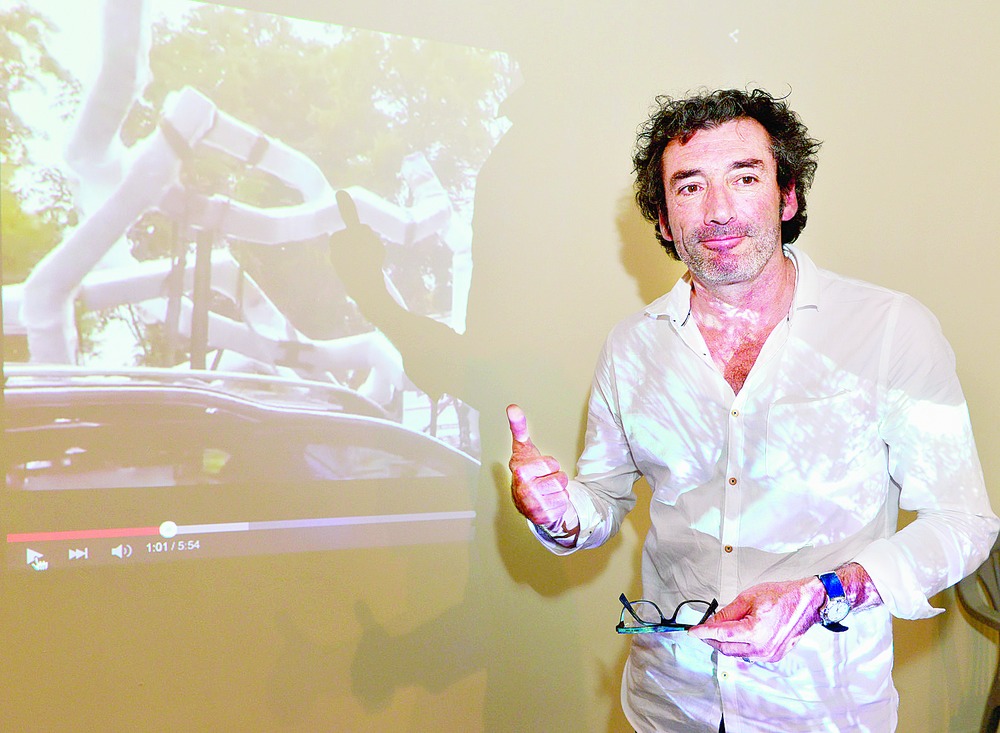

Studio 21 and the Alliance Française du Bengale presented a talk by the French sculptor, Nicolas Sanhes, who was on his maiden visit to India. During the course of the conversation - Sanhes spoke with the help of translators - the Rodez-born artist let his audience know that he is on a "quest for the absolute and pure form". This endeavour is executed through steel and wood, the artist's chosen media.
The presentation that accompanied the talk revealed several aspects of Sanhes's work. For instance, technique plays a central role in the sculptor's creations. The scale of some of his sculptures is daunting, necessitating mastery over technique.
Geometrical forms interest Sanhes. His fascination with radical positions espoused by such artists as Ellsworth Kelly has also left an indelible imprint on Sanhes's imagination. His art thus not only questions conventional notions of space, form and lines but is also an enquiry into the limits of collective acceptance of shapes that border on the abstract. He attempts to portray asymmetry as intriguing, even harmonious. Another notable feature of his art work is its engagement with public spaces. In France, several of Sanhes's installations can be found in open sites, encouraging the people to reflect on what they see.
His "soft sculptures" - latex is the material that Sanhes uses for these exhibits that resemble shrouds - also explore the idea of space in terms of its physicality.
As an artist, Sanhes is of an experimental disposition. Conformity bores him. This is evident from the methodology: he creates drawings of his sculptures (after) they have been completed.
These sketches are Sanhes's tools of analysis, aiding the artist in his mission to dissect and reimagine art forms that exist in a finished, but not the final, form.
It would be wrong to argue that Sanhes caters to the esoteric. His sculptures are a means of making art comprehensible to the people by encouraging them to engage with the diversity of physical forms.
India, expectedly, has kindled the artist's interests and further enriched his conceptions concerning shape and form. The Indian experience, Sanhes said, would certainly strengthen his resolve to ponder that perfect, yet elusive, form.
The talk was followed by an open session in which Sanhes answered questions from the audience. The session held out the hope that language, or the lack of it, is seldom an impediment when it comes to the relationship between the artist and his audience.