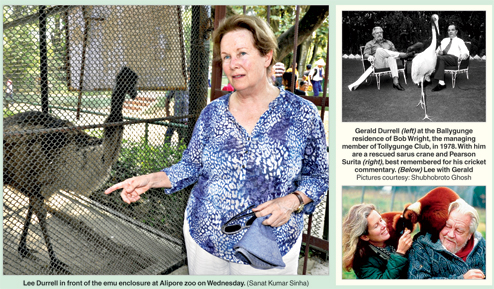
April 12: When the director of a wildlife conservation trust and wife of a man who famously carried a zoo in his luggage comes visiting, it is a given where she would head first on her first visit to a city — the zoo.
Lee Durrell, 67, the wife of conservation legend Gerald Durrell who now runs the zoo he had set up in the British island of Jersey, is in India, retracing her husband’s footsteps. Gerald, who penned humorous accounts of his wild encounters in books like My Family and Other Animals and A Zoo in My Luggage, was born and raised in Jamshedpur till the family relocated to Britain after his father died. Gerald was two-and-a-half- years old then. His return trip to India in 1978 included a Calcutta visit.
“That was a year before we got married,” smiled Lee, as she walked towards the elephants’ enclosure on Wednesday. Her Calcutta tour started with a morning visit to the Alipore address. “I do not remember much of what he had said of the trip — he must have — except that he had enjoyed it immensely and regretted that it had taken him so long to go back to India. I wanted to do this all my life because Gerry’s roots are here.”
There was also the pull of the pygmy hog. The Durrell Wildlife Conservation Trust runs about 50 projects in 14 countries.
One of them is the pygmy hog project in Assam. The world’s smallest pig was believed to be extinct by the 1960s. It was sighted again in an Assam tea estate in 1971. The trust has been breeding pygmy hogs since 1996. “We succeeded in releasing 100 pygmy hogs bred in captivity back in the wild last year in Orang National Park and elsewhere in Assam. They need to be monitored,” she said.
On reaching the elephants’ enclosure, the first question she put to her former student Shubhobroto Ghosh, a captive wildlife researcher who had done a course at Jersey Zoo in 1999, was if the zoological garden had a branch in the country.
“You would not find elephants at London Zoo anymore. They are all at Whipsnade. Most zoos in the city cannot expand. So they have a branch in the country. Even Bristol zoo has one. The extra space allows zoos to have themed areas which help the interpreters educate visitors better. For instance, a theme of African savannah will have all the wildlife from the region exhibited together and one can talk of the biodiversity there,” she said.
A visit to Burdwan House, built with an endowment from the Maharaja of Burdwan in 1879, resulted in a debate on hybridisation. It is here that the tigon, the product of a captive mating between a tiger and a lion, was housed. “The then zoo director Amarendranath Guha wanted to prove that hybrids could be fertile. The tigon Rudrani produced five litigons between 1979 and 1984,” Ghosh argued.

But Lee would have none of it. “Hybrids take away space in zoos that could be used for conservation of other natural species,” she countered.
That is why she gave a thumbs down even to the white tiger as it rested under a shade. “I do not like how some zoos mint money by exhibiting white tigers. They are not natural (being a mutant caused by a recessive gene. The dominant gene produces yellow tigers).”
But she was quick to appreciate the dilemma. “It is easy for me to pontificate but some zoos desperately need the money,” she added. The Jersey zoo itself is facing troubled times because of a dip in tourists to the Channel Islands.
She did not like the cages for leopards. “Obviously these are old. In those days, people had little idea about animal needs.” She was much happier with chimpanzee Babu’s enclosure with its climbing and hanging facilities. “It only needs some shade overhead so it can be used in summer too.”
Behavioural enrichment can be done at zoos without increase in space. “For some animals, quality of space matters more than quantity. The enclosure should offer the animal opportunities to express its natural behaviour. Does it like scratching on a bark or climbing trees? You can also feed in a certain way. We do scatter feeding five times a day. Animals are bored in the zoo. It gives them something to do.”
On learning how visitors toss stones at animals, requiring heights of fences to be raised, she advocated having a volunteer programme at the zoo. “They can educate and explain to visitors.”
As the zoo director was out of town, she plans to write to him on her return home with her suggestions.
Post-lunch, she spoke at the Indian Museum, where Gerald had also delivered a lecture during his visit.
Day after tomorrow, she will be off to Jamshedpur, her husband’s birthplace, but will be back for a slew of public events on April 18 and 19.
Last week, Lee and her partner Colin Stevenson were at Kaziranga National Park. “We saw a lot of rhinos but missed sighting dolphins despite three attempts.”
They might get another chance next winter. “Colin wants to come back to India for his birthday in January,” she smiled.