The Election Commission of India on Saturday night uploaded a list of around 30 lakh voters categorised as “unmapped voters”, whose records could not be linked with the last special intensive revision (SIR) conducted in 2002.
It also uploaded another list identifying nearly 1.2 crore voters with what the commission termed “logical discrepancies” in their names.
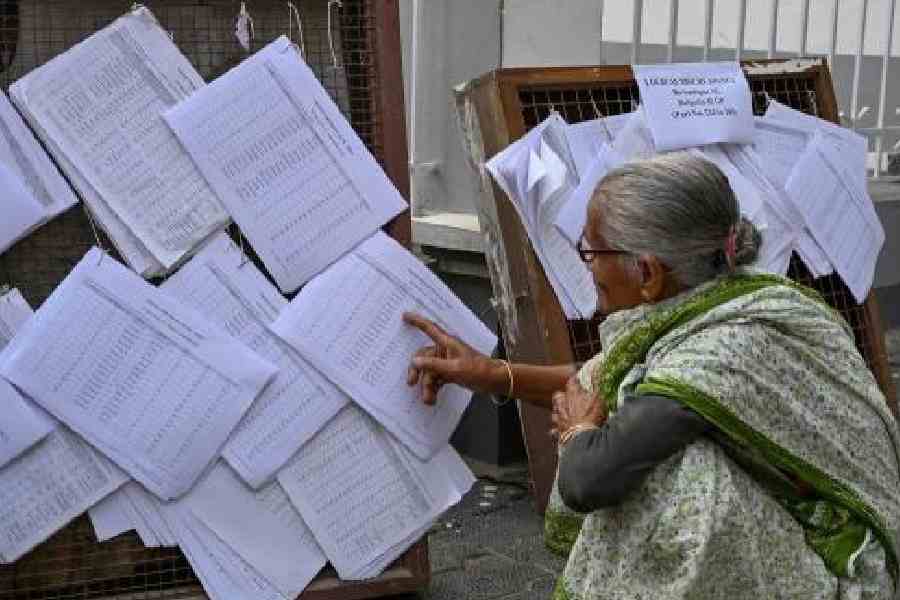
However, barring a handful of locations, the lists were largely not displayed at hearing centres or other designated places on Sunday, ironically the National Voters' Day, limiting public access to the information.
In several areas, voters waited for hours on Sunday to check the lists, but overall awareness remained low and public response appeared muted. Many voters either did not know about the publication of the lists or showed little inclination to verify whether their names figured among those flagged.
Some voters waiting outside verification hearing centres in Nadia said the lists had little practical relevance for them at this stage. “The notice for the discrepancy has already been served asking us to appear for hearing, so there is no logic in checking the list anymore,” a voter said while standing in a queue at a hearing centre in Santipur.
"Political parties might feel more interested in the lists than long-suffering individuals like us," he added.
Officials in the election cells of district administrations said that in most cases the so-called logical discrepancies stemmed from minor spelling variations, particularly in surnames, between details submitted in recent enumeration forms and those recorded in the 2002 benchmark electoral roll.
“The software used by the Election Commission failed to match surnames written in Bengali with their English versions, which has led not only to logical discrepancies but also to the unmapping of some voters,” an election cell official in South 24-Parganas said.
The emergence of a large pool of unmapped voters and those with discrepancies has fanned concerns about gaps in the SIR exercise itself.
Political observers and parties point to the risk that genuine voters could be left in a state of uncertainty due to data-matching limitations, outdated reference rolls and inadequate on-ground verification.
The absence or delayed display of the lists at many centres has further complicated the process, raising questions about how effectively affected voters can be informed and guided through rectification.
“People are preoccupied with anxiety after receiving notices for hearing and are busy arranging supporting documents to ensure their names remain on the voter list, so there has been little interest in checking the published lists,” a Trinamool Congress leader in Calcutta said.
“However, things should become clearer in the next few days,” the leader added.