 |
 |
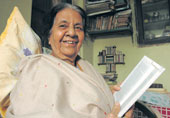
| Juthika Roy at her Shyampukur Street home. Picture by Sanjoy Chattopadhyaya. (Above) With Indira Gandhi at the Padmashri party in 1972 |
August 15, 1947. Prime Minister Jawaharlal Nehru?s motorcade rolls down from Teenmurti Bhavan to the Red Fort. Juthika Roy has just finished singing for a 15-minute slot at the All India Radio (AIR) station. ?A man came running, urging me to return to the studio. The Prime Minister had sent in a request that I was to keep singing till he reached Red Fort and hoisted the Tricolour.? So back she went and started off with Sone ka Hindusthan. ?I must have sung some seven-eight songs,? the 85-year-old reflects, sitting in a sun-bathed room of her Shyampukur Street house where she stays tucked away from the bustle of north Calcutta, with her two sisters.
Roy was then at the height of her fame. She had been hailed as ?adhunik Meera? and was criss-crossing the country and even beyond (to Sri Lanka and to East Africa) for performances. ?I would come back to Calcutta from one part of the country and find a telegram waiting at home inviting me to another show elsewhere.?
Nehru?s request was hardly her first call to national duty. The year before, during the Calcutta riots of August 1946, she stood by Mahatma Gandhi in his bid to keep the warring communities apart. ?Sarojini Naidu, who would always be present at my Hyderabad shows, had told me that Gandhiji listened to my songs before prarthana every morning. So I wanted to meet him,? she recalls.
The chance came when he announced a tour of Calcutta and Noakhali. ?Those were turbulent times. Trains would be halted mid-way, there was a curfew at Howrah station, villages were being torched in Noakhali. There was no knowing where I would get stuck. On reaching home after an eventful journey, I heard that Gandhiji had put up at Beleghata.?
Yet when the Roys reached, a huge lock stared them in the face at the gate of the ashram. Only when Manu Gandhi, one of Gandhiji?s companions, recognised her was the party escorted in. It was a Monday, Gandhiji?s day of maunavrat (vow of silence). ?He was sitting on a tattered mat, resting his back against the wall. He gestured that I start singing as he went to the next room for his bath. I sang my heart out ? Chaakar rakho ji, Main Ram naam ki churia??
When Gandhiji returned, he was ?beaming like a child and placed his hand on my head?. Soon, she was told that he wanted her to come with him to the Maidan.
That afternoon stands out in her memory ?thousands lining the streets showering rose petals on him. ?First there was Ram dhun, then I sang Orey nil jamunar jol. After that, Bapuji delivered a soul-stirring plea for peace.?
She was just 26 then. But then she had started phenomenally early. Her first record was released at 13. ?My father had a gramophone record by one ?Master Madan (7 years)?. It was his dream to make me emulate the feat. His job kept us on the move ? from Amta, where I was born, to Bagerhat, Khulna and Tangail. Yet when I turned seven, he wrote to the Gramophone Company of India and took me all the way to Calcutta.?
The Gramophone Company office in 1927 was housed in two rooms on the first floor of a Chitpur building. It was infamous for drinking, paan-chewing and adda. ?Women from respectable families did not venture there,? she explains. Little Juthika was asked to come back after she came of age. Her father did not give up. So their next destination was the All India Radio station at 1, Garstin Place. ?I auditioned with a Rabindrasangeet without instruments.?
The few artistes AIR had were of the stature of Krishna Chandra Dey and Supriti Majumdar. But seven-year-old Juthika was chosen. In those days, all performances were live. As there was no loudspeaker on the radio sets, one had to put on headphones to listen. When Juthika returned home, eager for a feedback, there were glum faces all around. ?Everyone complained that just when he or she got a chance to listen, someone else snatched away the headphone. So neither me nor my relatives managed to hear me sing.?
The call from Gramophone Company of India came six years later. Through a friend of her father?s, she made the acquaintance of Kazi Nazrul Islam, who was on the rolls as lyricist and music director. ?Kazida would always be in silk saffron robes and cap, chewing paan with a smile on his lips. He gave me two songs but they were too easy. Even as a child I fancied only serious songs.?
Nazrul invited Juthika?s mother home in nearby Hari Ghosh Street and offered her a pick of all his compositions. ?For two hours, Ma scanned his khata, but did not like a single song. Kazida was so humble that he wrote a couple of songs to suit my taste.?
By then, Juthika had recorded her first album. ?Recording in those days was an arduous affair. With just one microphone for singer and musicians, the seating arrangement would take an hour. First, the antara would be recorded on a wax disc for balancing voice and the music. The next sample on wax, the entire song, would be sent to the composer and trainer for approval. Then the record was printed.?
Nazrul had a big role in Juthika?s debut on the disc. ?The dealers refused to take my album as only Angurbala, Indubala and KC Dey would sell then. Kazida put his foot down saying that if they did not take my album, they would get nothing else from the company.? Ami bhorer Juthika, with music by her future mentor Kamal Dasgupta, registered record sales. There was no looking back.
The legend of Juthika Roy, the bhajan singer, was born with an experiment in the Bengali department of AIR ? to record in Hindi. ?It was the idea of an employee, Anil Das, who would roam the villages to collect folk songs. I did not know Hindi then, so Kamalda wrote out the lyrics in Bengali.? The success of the 78 RPM disc prompted a few more bhajan albums. This spawned the Hindi department of AIR.
In her heydays, Juthika recorded about 11 albums a year in time stolen from an unending stream of performances. ?Though offers came from films, I turned them down quoting exorbitant fees and refusing to sing anything except bhajans.? But when Debaki Bose accepted both conditions, she had to sing for his film Ratnadeep.
Bengali films came next. The result was the evergreen Dhooli in 1954-55. At a contest, Mala Sinha sings Ningariya nil sari in Pratima Banerjee?s voice. Then Suchitra Sen takes the stage with Roy?s Ei Jamunar-i teere to win the crown.
Recognition followed with the Padmashri in 1972. ?Indira (Gandhi) hugged me at the party. She had inherited a liking for my songs from her father. For 10 years, I had been singing at Bapuji?s birth anniversary in Delhi. On his birth centenary, Indira sent me to his birthplace.? The gentle face lights up in remembrance of how Jago musafir was broadcast live from the verandah of the kutcha hut in Porbandar.
With her albums disappearing from the stores, she?s long been pushed into pages from the past. But now a BSNL venture has prompted Saregama to bring out a compact disc of her bhajans. Back in the limelight with Governor Gopal Krishna Gandhi visiting her sleepy address a fortnight ago, Roy has one request to posterity: preserve the music of doyens Bhismadeb Chattopadhyay and Abdul Karim Khan, as well.