 |
 |
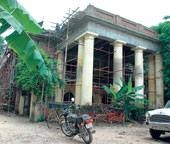
| The Natmandir of Sovabazar Rajbati being repaired by the CMC and (below) inside the Natmandir. Picture by Bishwarup Dutta |
Way back in September 1988, Calcutta High Court had in a landmark order prevented the sale of the famous Natmandir of Sovabazar, which had been reduced almost to a heap of rubble then, and also that of the plot on which it stands. The vacant space has been used for years as a parking lot. Sovabazar Rajbati, the palace adjacent to the Natmandir where Durga puja is still celebrated, is debuttar property. It has 40 co-owners all belonging to the Deb family. And although the groundfloor is intact and rented out for marriage and other ceremonies, the first floor with its gracious Islamic arches have all been reduced to dust.
Historian Nisith Ranjan Ray, who then headed the committee for celebrating Calcutta’s tercentenary, was of the opinion that the Sovabazar palace was the only surviving relic of secular Indian architecture of the colonial age in Calcutta.
The high court had ordered that “since the building is of historical importance going back to the period of Clive in 1757 and displays the secular Indian architecture of the colonial period, it should be preserved.” The court order also said: “it is in contemplation of the Calcutta Municipal Corporation (CMC) to acquire the Natmandir.”
The order added that if the CMC failed to take over the building, “the trustees after consultation with the shebaits will be at liberty to make necessary application for appropriate direction regarding preservation or otherwise of the said Natmandir.”
Later, the CMC actually acquired the Natmandir, and a few years ago there was an attempt to restore it. A private agency was commissioned to prepare a report but for some inexplicable reason nothing came of it. When the Natmandir was derelict, the household deity had been removed. Later it was whitewashed and used for cultural events. The Natmandir has not been in the news for some time.
Actually, for the past few years the CMC has been killing it with care. A CMC department has been turning this delicate chunam and surki structure into a thumping piece of concrete. When this correspondent visited Sovabazar on Friday afternoon, the masons were happily plastering the walls with cement, while others were busy removing the original skin. The windows with wooden lattice work overlooking the great central hall have been removed. Carpenters were busy creating replacements. The doors had been yanked out long ago to be replaced with cheap substitutes (albeit ornamented), the kind that one sees in government housing estate apartments.
The Natmandir is a wonderful example of the classical Greek style with imposing Doric columns and acanthus around its frieze. Now everything is solid concrete. According to an eyewitness, when the masons were unable to get all the columns in uniform shape, they simply chipped off the concrete. All the intricate stucco work as detailed as old lace has been erased now. The shining layer of lime that is supposed to plaster the walls is now dull, grey cement. The terrace is concretised. When the public works department had tried to do the same with Prinsep’s Ghat, a hue and cry was raised and the project was shelved. It does not need an expert to tell that this is in contravention of all the rules of restoration and conservation which make the use of original materials of construction for refurbishing a heritage structure absolutely mandatory. The CMC, which is supposed to be the custodian of Calcutta’s built heritage, has turned out to be its biggest enemy. And not just the CMC, all government agencies are guilty of this crime.
It is even more surprising that the CMC’s heritage conservation committee, which is supposed to be a watchdog body, had allowed this to happen. Actually one should not be surprised at its inaction. In the past, too, it did precious little to save some priceless treasures like Dunlop House on Free School Street, which was demolished about two years ago, and Great Eastern Hotel and the Mackinnon Mackenzie building on Strand Road, which are being rebuilt instead of being restored and reused. The heritage conservation committee did the same at Sovabazar. It twiddled its thumbs while the Natmandir was being rebuilt.
Sovabazar Rajbati had played a pivotal role in the cultural and social life of Bengal. Raja Nabakrishna Deb was one of the first residents of Calcutta to celebrate Durga puja on a grand scale after the British defeated Siraj-ud-Dowlah at the battle of Palasi. Of Nabakrishna’s ancestors, the first to settle down in Gobindapur from Karna Subarna or Kanasona in Murshidabad district was Ramcharan. The Hooghly washed away the house he had built, and subsequently, his descendant, Ramsundar, shifted to another part of Gobindapur. When Fort William came up, the British took over that area.
After Siraj-ud-Dowlah besieged Calcutta the city and its native sections were in ruins. The natives, whose land was ceded to build the new fort, were compensated with plots in neighbourhoods like Taltala, Kumartuli and Sovabazar. Ramsundar along with other Bengalis moved to Sovabazar, where his younger brother, Nabakrishna Deb, built his palace on a large tract that was granted them. The Sovabazar palace is a hybrid of the architecture of Hindu, Moorish and colonial traditions. The land was bought from Sovaram Ghosh by auction under Sunset law. Nabakrishna was Clive’s munshee, and taught him Urdu, Persian, Sanskrit as well. He was also quite close to Warren Hastings. Under Nabakrishna’s patronage the Sovabazar palace became a centre of learning, as they patronised scholars.
Nabakrishna’s grandson, Radhakanta, compiled Sabdakalpadrum, the first Sanskrit-Bengali dictionary, got the Indian epics translated into Persian and had a huge library, which was later donated to the Asiatic Society. Sovabazar became a seat of learning. Now that the Natmandir has been concretised, perhaps the Calcutta Municipal Corporation’s next move will be to strike it off the incomplete heritage list and sell it off, precious land and all, to the highest bidder.