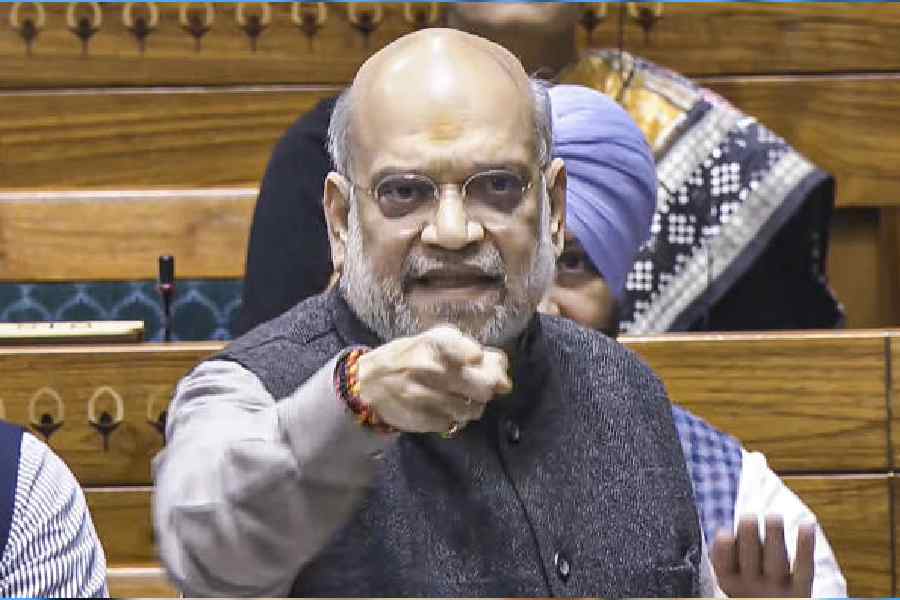
Mentored by Union home minister Amit Shah, the BJP will fight the perform-or-perish Bengal Assembly polls this summer with new strategies, aiming to rectify the mistakes the party made in 2021.
"There is no last election in politics. But in the case of Bengal, Amit ji and the top Delhi leaders have said that the 2026 election is a perform-or-perish battle. If the party fails to oust Mamata Banerjee even in 2026, the party's future will face a serious crisis in Bengal,” said a senior BJP leader in Calcutta.
Shah is likely to visit Bengal frequently to monitor and supervise poll strategies.
A BJP source said that during the series of meetings Shah conducted on his three-day trip to Bengal starting from December 29, 2025, he laid out several strategies for the party’s leaders.
Shah asked all leaders to hit the streets to highlight corruption, infiltration and unemployment in Bengal under Mamata Banerjee's rule. He advised state BJP leaders to take the anti-incumbency campaign to such a level that the ruling Trinamool Congress “cannot even breathe properly”, a senior BJP leader said.
"He asked all party leaders, including MLAs and MPs, to ensure there is no time for leisure in their daily schedules. Every day, they must step out of their homes and reach out to people in different ways. The protest schedule should be so tight that Trinamool cannot breathe properly,” the party leader said.
The most important decision Shah has taken for the forthcoming state election is that the party would not depend on any single face in 2026. Instead, it will adopt a "collegium model", where the BJP as an organisation will be projected as the Opposition, not any individual leader.
In this context, his decision to reactivate Dilip Ghosh — who was almost sidelined after meeting Mamata Banerjee at Digha’s Jagannath Temple on May 1 last year — is seen as the best example. “Instead of projecting a single face, on Shah’s instructions, a collegium model has been adopted by fielding all four cylinders — Samik Bhattacharya, Suvendu Adhikari, Sukanta Majumdar and Dilip Ghosh,” said a BJP insider.
In January, all four leaders are slated to address multiple political rallies and grassroots programmes. On Sunday, while state party unit chief Bhattacharya held two political rallies titled Parivartan Sankalpa Sabha in Howrah’s Ramrajatala and Khardah in North 24-Parganas, his predecessor, Majumdar was in Bandwan in Purulia for a similar rally.
The leader of the Opposition, Adhikari, has also been attending a series of Parivartan Sankalpa Sabhas.
Ghosh has been allotted a room at the state BJP’s Salt Lake office and assigned to hold meetings and programmes. He is currently focusing on West Midnapore district, his old stronghold.
Besides these four, several veterans, including former state president Rahul Sinha, have been assigned multiple organisational tasks.
“Against Mamata Banerjee, there is no single face in the Bengal BJP who can be accepted across the state. That is why Shah adopted the collegium model, prioritising the BJP over individual leaders,” said political scientist Biswanath Chakraborty.
Apart from this, Shah has made it clear that all major decisions, including candidate selection and key policy matters, will be taken by him or his core team. He asked MLAs to showcase their performance if they wanted tickets.
In 2021, the BJP held several Yogdan Melas (joining ceremonies), during which many senior Trinamool leaders joined the BJP. In 2026, the party has changed this approach, launching a drive to induct grassroots-level Trinamool workers.
However, a senior BJP leader cautioned that “firing all four cylinders simultaneously”, referring to Bhattacharya, Ghosh, Adhikari and Majumdar, could backfire if the party failed to control infighting.