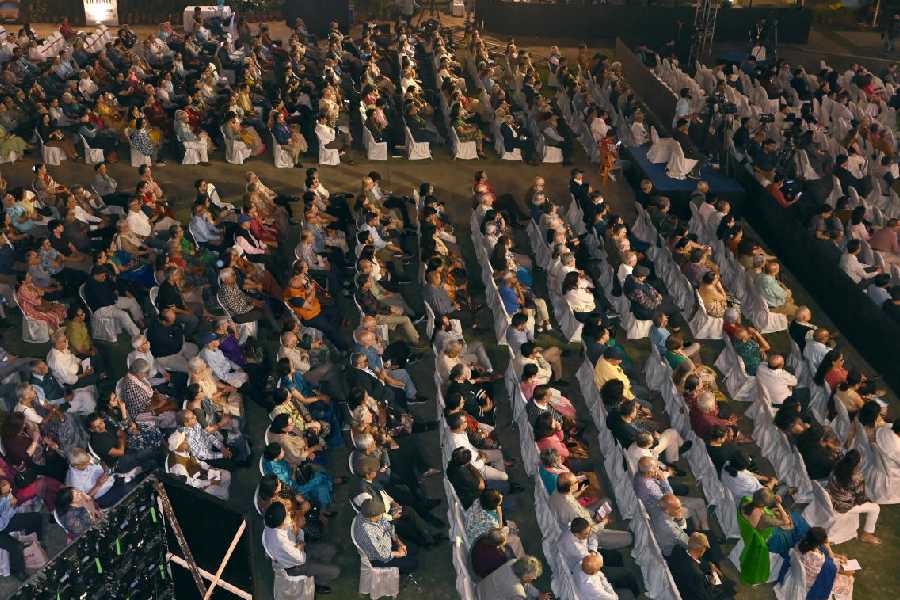
The formal debate on the Calcutta Club lawns on Saturday examined the motion — “In the Opinion of the House, Status Quo Has Been the Unmaking of West Bengal.” Yet, beyond the spotlight and structured arguments of the galaxy of speakers, another debate was quietly gathering force.
Across the terrace, in the lounge and along the hallowed club’s 119-year-old corridors, members and guests engaged in conversations that felt more urgent than the motion being debated. With Assembly elections nearing, the Sister Nivedita University presents Calcutta Club The Telegraph National Debate 2026 sought to reflect on Bengal’s trajectory. But away from the stage, discussions were anchored firmly in the anxieties of the present and the uncertainties of the future.
Artificial Intelligence surfaced as one of the dominant themes. Kinshuk Bardhan, general manager of IBM, dismissed the idea of AI as a looming threat. To him, it is already woven into daily life.
“AI is the next best thing the world has seen after computerisation or digitalisation. It is here to stay,” he said. Rather than resisting it, Bardhan argued, young people must learn to harness it. Only then can they position themselves as active contributors to India’s growth story, shaping policy, innovation and opportunity instead of fearing displacement.
From technology, conversations drifted to healthcare — and the mood turned sombre. Dr Ramaditya Ray, the club’s social and cultural chairman, criticised what he described as the growing corporatisation of medical services in Bengal. High-end private hospitals, he said, often subject patients to a battery of expensive tests without necessarily arriving at clear diagnoses. The financial and emotional burden, he warned, weighs heavily on the lower middle class. “This has been a persistent problem for nearly two decades,” Ray observed, calling for accountability and stronger
monitoring.
Healthcare concerns blended into a broader unease — the steady migration of Bengal’s youth.
Sujoy Biswas, principal of Ram Mohan Mission High School, spoke of neighbourhoods such as Jodhpur Park, Lake Gardens and Salt Lake increasingly populated by elderly residents, as younger generations relocate to cities like Mumbai, Delhi, Noida, Gurgaon and Bengaluru. What troubled him more, he said, was the mindset of those who leave and then encourage others to do the same, reinforcing the narrative of Bengal as a land of limited opportunity.
“No government can reverse this if the instinct is always to escape,” Biswas said. He argued that young people must first see themselves as stakeholders in the state’s future before demanding transformation.
Politics and federalism added yet another dimension.
Amitava Chaudhuri, a former United Nations adviser, questioned what he termed the excessive centralisation of power.
He advocated greater autonomy for states in managing education, administration and development, suggesting that a stronger federal structure would ultimately strengthen India. Drawing comparisons with Europe, he asked: “If such decentralisation works there, why not here?”
As teacups clinked and voices rose and fell in measured disagreement, these parallel conversations captured a mood perhaps more revealing than the formal debate itself. On the lawns, the question was whether stability had turned into stagnation — the audience seemed to agree as the motion was carried. In the corridors, the focus shifted to survival, aspiration and reinvention.
Between the structured arguments and the spontaneous exchanges, a more nuanced portrait of Bengal emerged — complex, concerned and searching for direction.