 |
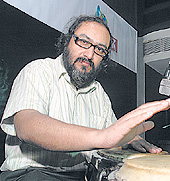
Name: Monojit Datta, also known as Kochu-da (picture by Sanjoy Chattopadhyaya) in the music fraternity
Claim to fame: He is the only Latin jazz percussionist in Calcutta and in all probability, in India as well. He mostly plays the bongo for bands Orient Express and Los Amigos. “Any musical style is like a door to a palace. And the palace is the music. It’s essential that you respect all musical styles and instruments. You can’t create a rich heritage in music otherwise,” he says.
This is probably why he has played for bands with different styles, including New Blues Connection, New Horizon, Airwave, Shiva and D for Brothers, with his brother Amyt Datta. Between them, these bands covered rhythm and blues, disco, rock, jazz and funk. Datta plays the clarinet, flute, keyboards and the guitar too.
Latin jazz percussion? What distinguishes Latin jazz percussion is the use of the bongo. “I have grown up listening to Latin American music. When I was seven or eight years old, I was intrigued by tunes like Tea for two and Manha de carnival. I would get records as a birthday gift,” he smiles. The music of Buddy Rich, Louis Armstrong, Pepe Jeramello and Xavier Cougat inspired him. “There was no friends’ circle or a set of people I associated with who liked the same music as I did.”
As a child he used to ask the household help to tie two tin cans together and play it like the bongo. “I was about nine when I got my first pair of bongos. They were red in colour,” he remembers fondly.
Taught himself: “I used to consult music sheets, notations, read up on the history of music. And keep practising. You have to love music in its entirety and be prepared for a lot of sacrifice. Love involves sacrifice,” says Datta.
He believes in discipline. He stops short of saying the word sadhana, but maintains that one cannot become a musician without discipline and perseverance.
About others: He has no contempt for the Bangla rock bands or wannabe rocksters, something that is so characteristic of musicians of his stature. Quite the opposite in fact. “It’s good that music is being written in an Indian language. But it does leave a lot to be desired in the form of vision. One has to take the music forward through dedication and research. You have to do it for the love of the music and not just as a career,” he asserts.