 |
The Archaeological Survey of India (ASI) will take over the restoration of Jorasanko Thakurbari from Rabindra Bharati University, whose attempts over the past two years at restoring one of the cradles of Bengal renaissance have earned more flak than praise.
The ASI move is part of the Centre’s initiative to introduce a tour circuit touching places associated with Rabindranath Tagore, on the occasion of his 150th birth anniversary.
“The governments of India and Bangladesh feel that the four important sites connected with Tagore — Jorasanko, Santiniketan, and the Kuthibaris at Shilaidah and Shahjadpur (both in Bangladesh) — could be part of a tour package that may be called Rabi Tirtha. The sites in Bangladesh are in good shape and we are trying our best to restore and improve the ones in Santiniketan and Jorasanko,” said Union culture secretary Jawhar Sircar.
The ASI functions under the culture ministry.
The Jorasanko Thakurbari, where Tagore was born and where he died, saw many changes since Nilmoni Tagore, the poet’s ancestor, built a clay-walled house in 1784.
Gautam Sengupta, the director-general of ASI, Delhi, said his agency had met and convinced the vice-chancellor of the university, housed in Thakurbari, and senior government officials about the need for a professional touch in the repair and conservation of the heritage structure.
“Considering the scale of work and the complexities involved, ASI is the only option. Funds for the restoration will come from the National Committee for Commemoration of Tagore’s 150 th Birth Anniversary. ASI, Calcutta, is sending an estimate of expenditure to the culture ministry for approval,” said Sengupta.
To start with, the north and south wings of Ram Bhavan and the Maharshi Bhavan will be restored at an estimated cost of Rs 2.5 crore.
Vice-chancellor Karuna Sindhu Das said the university had done the first stage of restoration — covering parts of Vichitra Bhavan, Ram Bhavan, Maharshi Bhavan and their adjoining enclosures — and now “it’s for the ASI to do the rest”.
He, however, did not allow the “restored parts” to be photographed — “No we cannot allow it. They are dilapidated and can’t be photographed”.
Tapanjyoti Baidya, the ASI superintending archaeologist who will head the Jorasanko project, expressed concern over the university architect’s technique of using the mordern mortar comprising sand, lime and cement to restore the lime-sand-shurki (powdered bricks) structure.
“Such technique is banned in archaeological conservation because the modern mortar and the traditional mix are incompatible. Besides, cement does not let the damp escape and in four-five years, the acidic reaction of the mortar harms the old structure,” said Baidya. “The ASI has the expertise to restore lime-sand-shurki structures. “We have in our team craftsmen who can work in traditional methods.”
ASI feels any attempt at restoration would be foiled unless the problem of waterlogging on the Jorasanko campus was addressed.
The Thakurbari complex is at a lower level than the adjoining areas and gets flooded during the monsoon. Water seeps in through the cracked walls and roofs and the resultant damp eats away at the foundation.
“The problem cannot be solved if we treat the campus as an isolated unit. We’ll have to consult the CPWD and the civic body for a solution. Alternatives like rainwater harvesting or recycling can be considered,” Baidya said.
Restoring Thakurbari can be tricky because there is no building plan to follow. “References in various writings of the Tagores are the only guide…. If a partition had been erected by a later Tagore then that, too, is part of Thakurbari’s history and should not be demolished,” said Baidya.
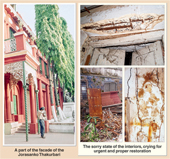
A visit to the campus revealed walls bearing dark blotches of damp, floors subsided or bulged out and glass panes missing from many grimy windows.
At Ram Bhavan, the walls were lined with termite tracks and corroded iron rods in the ceilings exposed.
One only hopes that the Tagore abode gets a better deal on the poet’s 150th birth anniversary.