 |
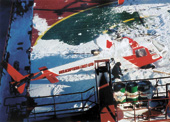
| A helicopter covered in snow. (Below) The expetition team in Antarctica. Pictures by Pradip Malhotra |
 |
A blizzard is blowing at 80 knots-plus speed and the waves of the Antarctic Ocean are tossing the gigantic Emerald Sea like a toy. The communication masts of the ship have been uprooted and the snowstorm has even damaged the helicopters in the helo hangars. The chill factor has dipped to minus 25 degrees Celsius and the nightmare has no end. This goes on for over four days before the blizzard relents and the ship sets off for Cape Town, from the shores of Antarctica.
Back home in Calcutta after spending around 15 months in Antarctica, braving blizzard, chill and loneliness, Dr Pradip Malhotra sums up his feelings about the southern end of the world: “If there is any part of this earth which is close to heaven, it’s Antarctica. Given a chance, I will grab the opportunity of going there once again.”
This despite the ordeal frozen in memory about when he had boarded Emerald Sea from Indian Bay (the Antarctic shore mostly used by Indian vessels) only for the ship to be stuck for over four days as the weather played havoc.
“All members of the Indian expedition team on board, including 23 of us, who were in Antarctica since January 2003, were consoling each other and praying for the waves to calm down. Icebergs were all around and the waves were so strong that it was tossing the ship against the shores,” recounts Malhotra, now lounging on a reassuringly stationary sofa in his new flat in Kendriya Vihar, off VIP Road.
Operation appendix
The expedition team, in which Malhotra was one of the two doctors, had 23 members with 13 from the Indian Army to look after the logistics. Seven scientists from institutes like the Indian Institute of Geomagnetism, Indian Meteorology Department and National Physical Laboratory formed the scientific wing of the team.
The soft-spoken 52-year-old doctor from Calcutta was also in the four-member task force that was set up to identify a suitable site for a new Indian station in Antarctica. For this, the team travelled over 3,000 miles east to locate a spot near Larseman Hills.
Over two weeks have passed since Malhotra returned to the world, but he still can’t get out of the “dream” that lasted 15 months.
As he browses through the photographs — both printed and digital — with wife Pushpa and children Puja and Rajiv by his side, the magic comes tumbling out — spotting aurora in the sky, spending time in a penguin rookery, capturing the total solar eclipse on camera…
Malhotra’s eyes light up as he brings out a photograph of the operating theatre that he, along with Dr Ashok Agarwal from Meerut, had set up in two days to carry out an appendectomy on young Indian Army officer K.S.R. Reddy. This has gone down as the first such operation conducted in the Indian station Maitri.
Commissioned in 1989 after Gangotri (the station is now buried in ice), the single-storeyed set-up with around 30 rooms is the address of the Indian expedition team in winter.
The summer teams — that spend around three months between January and March — put up in summer huts around Maitri, which has a kitchen, communication room, lounge and library.
“But there was no operating theatre. We hardly had the facilities and even the gloves (having lost their elasticity) were tending to tear off. A qualified anaesthetist from the Russian expedition team helped us in the operation, which we completed in a little over two hours. The signs of recovery were visible after three days and we were so relieved,” adds the gynaecologist with the Central Health Services, who volunteered to be part of the expedition team and got selected in December 2002 after a rigorous screening process.
Everyone assembled in Goa on January 1, 2003 and after briefing sessions with officials of the National Centre for Antarctic and Oceanographic Research, the team set off for Johannesburg on January 7 from Mumbai. Finally, on January 14, the squad boarded Magdelena Oldendroff, a German vessel managed by Russian crew, from Cape Town, at 33-degree latitude.
Rabindrasangeet radiance
“The ship touched the shores of Antarctica, at a latitude of over 70 degree, after crossing the Roaring 40s, the Furious 50s and the Screaming 60s on the 13th day. The temperature started dipping once we crossed 50-degree latitude and we could spot icebergs, albatross, whales, seals and penguins while sailing,” says Malhotra, who did his schooling from Santiniketan before enrolling for MBBS in Calcutta Medical College.
On reaching Antarctica, team leader Arun Hanchinal went for a courtesy sortie to Maitri — 100 miles from the shore — with food items, mail and gifts for the expedition team camping there.
It took more than a week to transport everyone and all the food and other stocks – in helicopters and a convoy of special German vehicles – to the Indian station.
“The temperature was maintained at around 18 to 20 degree Celsius inside Maitri, but the condition outside was extreme. It took me around a month to settle down,” adds the motor-rally enthusiast, pointing out a photograph where he is seen in complete polar gear.
To keep the team members fit, Malhotra and Agarwal would conduct regular check-ups but fortunately nothing more than injuries common to poor visibility had to be dealt with.
The daily routine was as diverse as clearing the snow and cleaning utensils, penning a diary and fiddling around with the computer. As connection with the world was restricted to weekly phone calls to friends and family through satellite phones, e-mails and letters, the avenues of entertainment in Antarctica ranged from listening to Rabindrasangeet on the music system to engaging in rounds of chess (sadly, not with the Russians).
For Malhotra – fondly nicknamed Dr Aurora by his team for his fascination with the luminous radiance -- the once-in-a-lifetime experience was worth all the strain. The polar sky and the natural beauty of the landmass bathed in white will remain with him forever.
As will the sense of relief at returning unscathed from Antarctica. “The nature is beautiful, but it’s really unforgiving. One has to pay a price for every mistake and at times the price is very high,” signs off Malhotra, relief mingling with the resolve to relive the difficult dream.