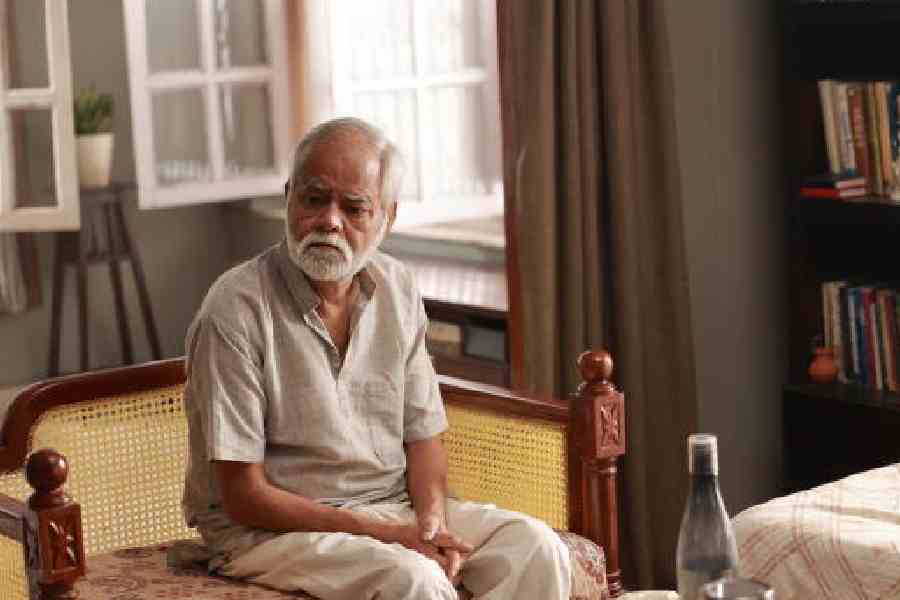
Pritha Chakraborty’s Phera marks Sanjay Mishra’s debut in Bengali cinema, where the actor stands out with his understated humour. His character Pannalal captures the nuances of a football enthusiast, an ageing father to a middle-aged son, with depth and detail in a manner that’s signature to Mishra. In a t2 chat, Mishra opens up about his premiere look, Calcutta culture, his relationship with his father, his experiences in Bengali cinema, and more:
You chose a Bengali look for the premiere. Did you specifically shop in Calcutta for it?
No, it was from my wardrobe. I don’t plan my looks for any occasion as such. This was not by any designer. My younger daughter suggested that I wear this.
When did you first visit the city?
I'd been to Calcutta several times with my father, who would often take me around the city, including places like Gariahat. Back then, I never thought I would eventually become part of a Bengali film. I've always enjoyed being in Calcutta; there's something unique about its culture and character. I give full credit to Bengalis for preserving their cuisine, traditions and cultural identity so beautifully.
How did Phera find its way into the Mishra cinematic universe?
I was working on a film involving SRFTI when a junior (Subrat Dutta) from the National School of Drama, who was also part of this film, mentioned a producer, Pradip Nandy. He wanted to meet me, and I agreed, though I was a little taken aback as I had not worked in any Bengali films before. He expressed interest in casting me for a Bengali film. Later, Pritha came to meet me to talk about the film. It was exciting to enter the Bengali film industry with this being my first project; I’m thrilled to have it as my pratham chobi (first film). It happened because Nandyda and Pritha wanted to collaborate with me.
You must have had several offers from Bengal before Phera. What made you decide to accept this project?
I had been approached before, but making films in Bengal was quite challenging at that time. So, Phera is my first released Bengali film, and I am glad for it.
Were you always interested in doing Bengali cinema?
My father’s roots are in Bihar, and my native language, Maithili, is closely related to Bengali. Many in my family speak Bengali fluently, too. My father translated a lot from Hindi to Bengali and would read it to me. He had many Bengali friends. I used to think it was an easy language, but I discovered during the dubbing that it’s quite challenging. Pritha was incredibly helpful during the dubbing process.
How important was knowing the language to play this role?
Knowing the language is essential, but I asked Pritha whether she wanted me to prioritise emotion or language. She mentioned wanting both language and emotion. I’ve been following Bengali cinema for quite some time. Back in sixth grade, I would often get low grades, but I still watched films by Satyajit Ray and Mrinal Sen. It was part of my family culture, and I’ve seen those films countless times. I always dreamed of being involved in the world of filmmaking. I feel fortunate to have become a part of Bengali cinema and to have worked on such a beautiful project.
What did you enjoy about portraying your character in Phera?
My character resonates with every household. In many ways, he reminded me of my own grandfather. The warmth, simplicity and affection he carried — the way he would ask me, 'Muri khabi, biscuit khabi?' — felt incredibly familiar. Those personal memories helped me connect deeply with Pannalal and bring authenticity to the performance. He would wake me up early and ask me to get dressed. That was a bit irritating, but it felt so familiar and personal to me. This helped me to imbibe these behavioural nuances in my character in Phera, too.
Does the father-son relationship in the film remind you of your bond with your own father?
Yes, absolutely! In middle-class families, we often didn’t say “I love you” to our fathers as my daughters do with me now. That kind of expression wasn’t common in our generation. There was always a certain distance. Even in the film, Pannalal says I never even wished my son a happy birthday. I had never hugged my father until the last days of his life. We hugged for almost nine minutes before he passed away.
How did you prepare for your role in Phera, which reflects the nuances of everyday Bengali life?
Many of my relatives are from places like Asansol, Kumartuli, and Maithal. I spent my holidays there, which fostered a deep connection with Bengali culture throughout my life.
Phera reflects contemporary society, touching on relationships and ambitions. You’ve moved to Mumbai but have roots in Bihar and Varanasi. Did the film inspire any personal reflections for you?
Absolutely, that rings true for many of us. We often leave our homes to seek work elsewhere. My grandfather moved to Patna, my father relocated to Varanasi, and I made the shift to Mumbai. This cycle of life continues and I knew it would resonate with many while watching the film. It is a part of life.
If there’s a place you’d love to revisit, which one would it be?
For me, it’s always Varanasi. I spent my formative years there, and it holds everything dear to me. I keep going back; it still feels like home.
What was your experience like with the cast and crew of Phera?
I feel incredibly fortunate to have had the chance to work with this talented cast and crew — Ritwick Chakraborty, Sohini Sarkar, Subrat and others. Initially, I was very sceptical as I would often feel that I didn’t know anything. But their support made all the difference for me.
What draws you to the comedy genre as an actor?
I have a humorous outlook on life, and I love expressing that through my acting. I’m grateful I didn’t fall into the trap of being a stereotypical actor, even though people love watching me perform humour. While I do comedy, I have also acted in films like Total Dhamaal with Ajay Devgn, Vadh, which was purely emotional, as was Phera.
You’ve had a longstanding connection to theatre, and Calcutta is renowned for its group theatre tradition. Did you manage to catch any shows while you were here?
Not at all! Pritha kept me busy with work, so I didn’t get the chance to explore much. I’ve received offers for Bengali theatre, but I’m hesitant right now because theatre is live, and films can be dubbed. Once I’ve done a couple of Bengali films, I’ll be more open to theatre.
What kind of films would you like to work on in Bengal? And do you have a list of directors you want to work with?
I’m looking forward to Bengali films with well-thought-out scripts, as I believe Phera will help establish my audience here. I won’t jump on any script that comes my way. I want to avoid stereotypical roles, even in comedy. I believe there’s a responsibility to convey the story through the character, so if I find smart, understanding directors, I’m all in. Pritha really gets me.
You enjoyed a shingara at the premiere. Did you take back any Calcutta specials with you to Mumbai?
I have a soft spot for sweets. I took back mishti, mishti doi, himshagar mango, gulab khash mango, and pui shank. But during my stay, I indulged in plenty of luchi and cholar daal. That was my absolute favourite!