The first time I met her was seven years ago. Her eyes were luminous like sunflowers. This must be the original global soul, I thought, as I heard her easy lilting voice speak of her adventurous life. Married to a high commissioner from Bangladesh, she had been a scholar at Loreto Convent, Darjeeling, and had lived in India for many years, and she clearly loves Calcutta. That first time, she enthralled me with her enormous knowledge about how cuisine was such an important sign of cultural identity. I was smitten by her repertoire.
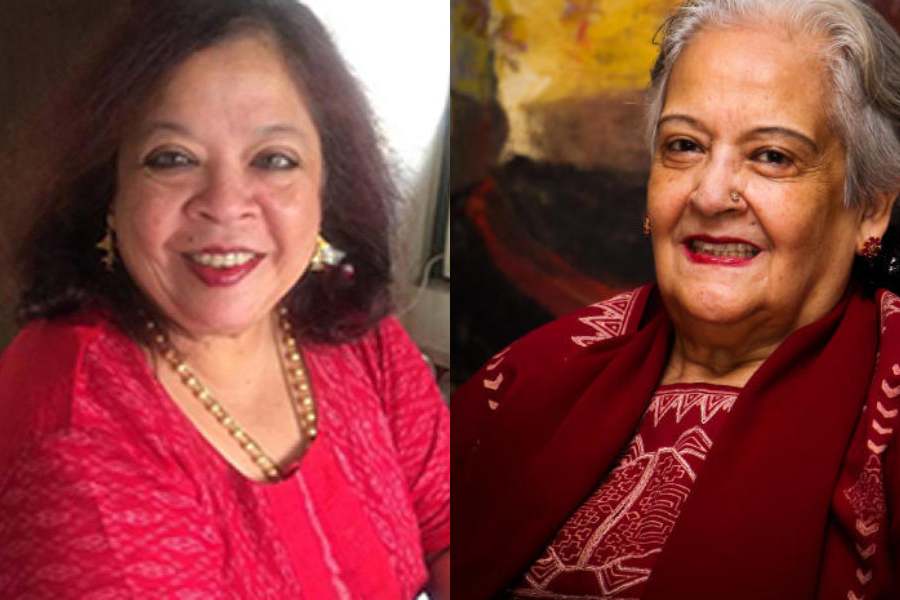
In a few days, writer Zeena Choudhury is all set to shine a new light on her old memories of the city. She is resurrecting the history of the city, creating her family history alongside that of the city and its communities belonging to different faiths.
The author, looking much younger than 87 years old, meets life with a smile, her secret to her youthfulness. In Oxford bookstore, just before Covid broke out, the graduate of Loreto Convent, Darjeeling, launched her first book, Church Bells and Darjeeling Tea, to standing room only, with filmmaker Anjan Dutt singing nostalgic ditties celebrating Zeena’s school days.
In her second book, written during the Covid years, which she is launching in Calcutta in the coming week, Zeena arrests the ethos of her felicitous years in Calcutta by signposting her deep sense of belonging through a simple attachment to a house. She writes: “7 Park Lane, Calcutta, was a corner house behind the Nawab of Murshidabad’s palace. The two-storey building had verandahs edging the house like frayed lace on a Victorian gown. 7 Park Lane is etched in memory like a beloved sepia photograph that one gazes at to recall the love, the unending happiness, and the excitement of surprise around every corner. This was the fountainhead of love and affection that I returned to every nine months.”
Zeena speaks with the same level of immediacy and veracity, employing memory of spaces, objects of art, and cuisines carrying with them universes of culture, spiritual beliefs, and family history. Speaking of her time in the 1950s and 1960s, she captures the hurly-burly of the city and its multiculturalism, underscored by the metaphor of kebabs and Christmas cake, through a compassionate and effervescent feeling for the richness of diverse cultures like Islam and Catholicism, and brings to the reader memories she has meticulously ferreted out after 60 years.
In those 60 years, she married the Bangladesh diplomat Faruq Choudhury in 1959, and after her country’s independence, she continued her education, graduating from London University with a BSc in Sociology in 1972, and earning her L.L.M. degree in International Law from Vrije Universiteit in Brussels in 1980. Her Calcutta homecomings are a world apart from the disciplined confines of Loreto Convent, Darjeeling. She recalls: “In Ranjit Singh’s taxi, bringing me from Sealdah Station at seven in the morning, the first thing I did was take off my shoes. Nanna, sitting on my right, smiled indulgently, while Maggie, sitting on my left, gave me a little hug. These were my grandmothers, two queens of my special world. Two queens of 7 Park Lane! Nanna was my maternal grandmother....”
The writer is a clear-eyed observer of life; her description of the “Three Chutney Marys” is perhaps one of the most distinct pieces of the recording of social history through the pen of a young lady with a proclivity for the comic. Zeena showcases the idiosyncrasies and hilarious elements of certain characters who came from a culture that, at once, smacked of colonial cantankerousness. Thus, the writer observes: “What excited tremendous interest in me was Maggie’s three daughters, to whom I curtseyed with a lot of cinematic flair. They were the three most exotic women I had ever seen. I decided to go all out to impress them. All of Park Lane knew them as the “Three Chutney Marys” — bright, svelte, stunning! Olive was very fair and very blonde — just about platinum blonde. Dulcie was pale with very dark hair — auburn, as she called it. Joycee, the youngest, was darker than her sisters. I giggled when she introduced herself, ‘I am Joycee, dark and dangerous!’ My, oh my! — those three women looked as if they had stepped straight out of the latest Hollywood magazine pages —a full page at that! 7 Park Lane’s gorgeous ‘Chutney Marys’”!
Many readers will recognise the places of importance in the narrative of Calcutta Kebabs and Christmas Cake. Especially, St Thomas’s Church and the South Park Street Cemetery will resonate with Calcuttans, old and young, in the following lines: “We will now take Georgu’s body to St Thomas’s Church in Middleton Row, near Park Street, for the final funeral service. Afterwards, my Georgu will be buried in the Catholic cemetery on South Park Street,’ she [Maggie] said firmly and quietly. We soon left the funeral parlour and headed for St Thomas’s Church. The religious service ended with the bishop reciting numerous prayers. At that moment, I whispered to Maggie, ‘But all this is too awful. Why are they only speaking about Christ, the Holy Ghost, and the Virgin Mary?’”
Zeena is an enormously gifted narrator who tells stories from her childhood with a rare ability to actually see herself as another person objectively, and this makes her style of remembering her own foibles as a child charming and endearing, a lack of viciousness and a large dose of empathy, making the writer write about children with deep understanding. Her ability to see herself as another person is reminiscent of the West Indian writer, Jamaica Kincaid, who in her novel Annie John makes the reader become the little girl protagonist Annie.
The writer’s ability to see herself as a warrior princess corralled in the middle of a pool of blood instead of a pool of urine is a remarkable example of how Zeena constructs the story to locate the child, whose condition is not to be belittled, but rather to be empathised with. This keeps the extraordinary tenor happy, positive and humorous in the midst of challenges in the story which is a memoir of exceptional enchantment. “Maggie was so exhausted that she had forgotten to take me to the bathroom. Now she was softly snoring … so what was I supposed to do? I was too embarrassed to nudge her awake, so I did the next best thing I could think of — I pretended I was a slain princess lying in a pool of blood — my henchmen were all dead, too. The enemy surrounded me, spears pointed. Some were digging into my ribs. I was about to die. I needed to make my last confession before I finally closed my eyes. Then, suddenly, I was awake. Everywhere I turned, it was wet — sopping wet — yet still Maggie slept. Finally, unable to bear my ‘bloody’ predicament any longer, I screamed aloud, ‘I want to go to Nanna; I want Mukmul khala to come and take me!’ ‘Shh, little princess,’ whispered a gentle voice. Maggie had quietly woken. She smiled, took me to her bathroom, bathed me, and dressed me in one of her gowns. She brought me some hot milk, and while I drank, she washed and changed her clothes. Then she took me upstairs and handed me gently to Nanna.’” All these characters, long gone, live on in her memory. And now in a book.
Julie Banerjee Mehta is the author of Dance of Life, and co-author of the bestselling biography Strongman: The Extraordinary Life of Hun Sen. She has a PhD in English and South Asian Studies from the University of Toronto, where she taught World Literature and Postcolonial Literature for many years. She currently lives in Calcutta and teaches Masters English at Loreto College. She curates and anchors the Rising Asia Literary Circle