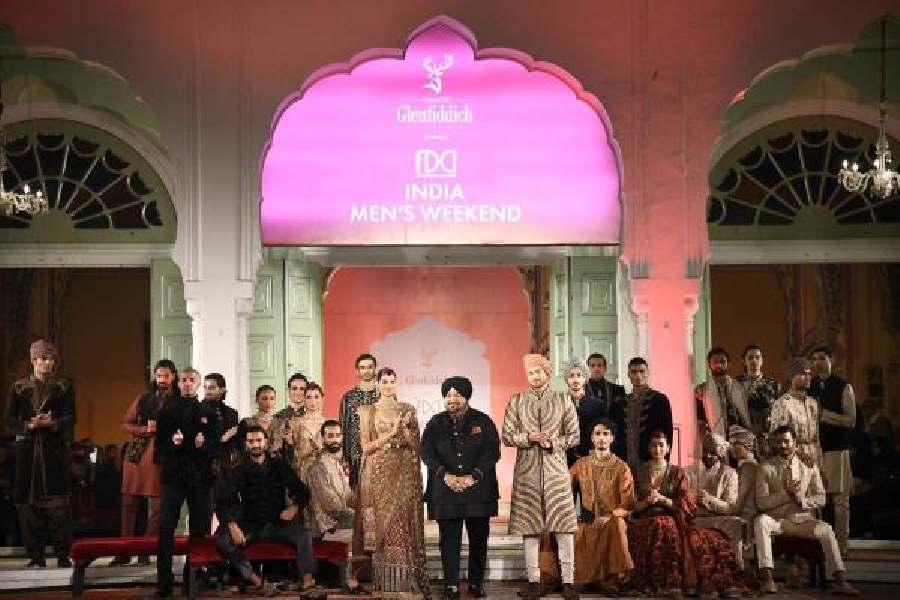
The House of Glenfiddich presents FDCI India Men’s Weekend 2026 made a striking statement on the theme of restraint. The weekend extravaganza at Diggi Palace in Jaipur culminated in JJ Valaya’s couture show, which served as a fitting finale. In the showcase, ‘The Valaya Man — East’, the veteran designer delved into the concept of regal restraint. What stood out was the experience he created to interpret restraint, which was no less immersive than the spectacle he creates with regal opulence.
His artistic vision, complemented with a captivating soundscape of live music, found expression through his signature play of craftsmanship and couture. The collection reinterpreted royal heritage through a language of minimalism that didn’t deviate from the Valaya aesthetic. A post-show t2 chat with the designer on luxury, couture, craft, legacy and more:
Your shows are always a spectacle. What inspires you to craft them with such detailing even after three decades?
For me, a fashion show has never been about clothes alone. It is about transporting the audience into the world that the collection belongs to. The architecture, music, light, movement are all narrative devices that I like to pay attention to in my showcases.
After more than three decades, what still excites me is the opportunity to build an immersive story every single time. The detailing comes from respect for the audience and respect for the garments. If the clothes carry history, craft and emotion, the environment in which they are presented must honour that same spirit and in a manner and scale which reflects my core ethos.
The label is already a legacy built. What excites you about creating a collection for a ramp show still?
Creation itself is the excitement. Legacy can never be a resting place; it must be a foundation from which you keep building.
Every collection allows me to reinterpret my vocabulary… heritage, travel, culture, the grandeur of royalty, the spirit of the nomad, the glamour of art deco… through a slightly different lens. The runway remains the purest space for that expression. It is where the narrative is presented in its most theatrical and uncompromised form.
Your design language is rooted in regal traditions. Why did you choose minimalism this time with ‘East’?
Minimalism in this context is not the absence of richness; it is the discipline of restraint. With East, I wanted to explore the idea that luxury does not always need to announce itself loudly. There is a quiet elegance that emerges when form, proportion and silhouette take precedence over overt ornamentation. The collection still carries the Valaya vocabulary of heritage and structure, but interpreted with a more distilled aesthetic.
Is luxury globally shifting from opulence to minimalism?
Not entirely, in fact maximalism is coming back with a vengeance. That said, luxury has always evolved with time. Earlier it was often expressed through visible abundance — embellishment, richness, weight. Today, it is increasingly expressed through subtlety, craftsmanship and refinement.
To me, true luxury has never been about excess alone. It is about mastery. Whether opulent or minimal, the real measure of luxury lies in the depth of craft and the integrity of design. There’s a reason why our collections are museum quality.
Your ceremonial creations celebrate craft and culture. What drew you to traditional crafts?
India’s craft traditions are among the richest in the world. When I began my journey, I felt strongly that these traditions deserved to be presented in a contemporary, global design language.
What connects me to craft is the human story behind it — the artisans, the techniques passed through generations, the patience embedded in every detail. My work has always been about giving heritage a modern platform.
Designers globally are looking at India for inspiration. Are we finally entering a phase of much-anticipated glory years in fashion?
India has always been a powerhouse of craft, textiles and cultural depth. The difference today is that the global fashion community is finally paying closer attention. In many ways this recognition should have happened earlier. But perhaps the world is now more open to cultural plurality. Even today, I believe India’s contribution to fashion is underestimated. The real potential has only begun to unfold.
Men’s fashion is shifting toward fluid silhouettes and androgynous influences. Is power dressing evolving?
Traditionally, men’s fashion, particularly ceremonial fashion, has been built around structure and authority. What we are seeing now is an expansion of that vocabulary. Fluidity, relaxed silhouettes and cross-cultural references allow men to express individuality without compromising elegance. It does not dilute masculinity; it simply broadens the spectrum of expression.
Is this experimental shift transient or a turning point?
I believe it represents a turning point. Younger generations are far more comfortable challenging rigid dress codes and exploring personal identity through fashion. Yet they value sartorial elegance. Designers are responding to that openness. As a result, menswear is becoming more expressive and culturally layered.
How do you envision Indian ethnic menswear in the near future?
I see it becoming far more versatile. The sherwani, bandhgala and kurta will remain central, but the way they are styled and constructed will continue to evolve. We will see evolved structuring, global influences and a greater emphasis on comfort and mobility while still preserving the dignity of traditional silhouettes.
With Indian crafts gaining global recognition, how do you see the future of couture in India?
India is uniquely positioned to lead the global couture conversation because couture is fundamentally about craftsmanship. Our challenge is not a lack of skill, it is about building systems that preserve these traditions while elevating them within the global luxury ecosystem. If done thoughtfully, Indian couture can become one of the most powerful voices in global fashion.
How important are platforms like FDCI for storytelling?
Platforms like FDCI are extremely important because they create a shared stage for dialogue between generations of designers. They allow legacy labels and emerging voices to coexist, which is essential for the growth of any creative industry. Fashion thrives when tradition and innovation are allowed to interact.
How would you define the Valaya man?
The Valaya man is confident in his identity. He respects heritage but is not constrained by it. He values elegance, craftsmanship and individuality. Above all, he understands that style is not about flamboyance, it is about a refined presence.
What does it take to build a globally recognised legacy label rooted in heritage?
It requires patience, conviction and consistency. Heritage can never be used as a decorative motif; it must be understood deeply and interpreted with integrity. Research and substance must be the foundation of each collection. At the same time, a global label must continuously evolve. The balance between respecting tradition and embracing change is what ultimately builds a lasting legacy.