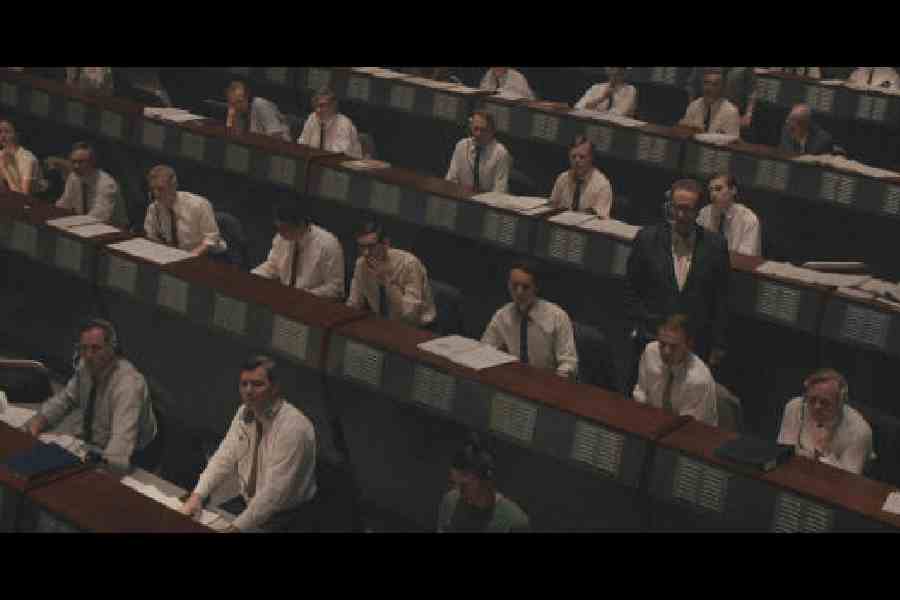
Counterfactual history offers countless possibilities — among them, the Russians becoming the first people to land on the moon. As the latest season of For All Mankind wraps up, a new Apple TV series is unspooling on screen. Called Star City, it focuses on the space race storyline from a Soviet Union point of view. For new viewers, there is nothing you need to know about For All Mankind to enjoy the spin-off, other than the fact that in this alternative timeline, the USSR’s space agency successfully landed humans on the moon well before NASA did.
America doesn’t retreat from its space ambitions — but what you see on screen is counterfactual history at its finest.From award-winning creators Ben Nedivi, Matt Wolpert and Ronald D. Moore, the eight-episode Star City explores a secretive Soviet space programme in the 1970s. In focusing on the Soviet perspective, the show offers a glimpse behind the Iron Curtain and what it was like to live and work in the extraordinarily secretive city where the Soviet space programme was based.
Nedivi has said: “So much of For All Mankind was about the American programme that we know so much about. But the more we learnt about the Soviet world, the more intrigued we became.”
Behind the Iron Curtain
At the heart of the show is a character simply known as the Chief Designer, played by Rhys Ifans. He oversees all engineers and cosmonauts in Star City — nothing happens without his knowledge.
“Moulding the character with all the secrets he has to shoulder was a challenge,” Ifans told this newspaper over a video call. “The one thing I will say about the look of the ’70s and the Soviet era is that, for the first time in my life, I didn’t have to choose what to wear each day. The Chief Designer has one suit, and he stays in it. That was really rather pleasing.”
Equally important is Lyudmila Raskova, played by Anna Maxwell Martin — the feared head of the KGB surveillance apparatus in Star City, who is determined to root out a mole passing confidential information to the Americans.
The characters who keep the plot moving are Sergei Nikulov (Josef Davies), a young Ground Control engineer who catches the Chief Designer’s eye, and Irina Morozova (Agnes O’Casey), an ambitious new recruit to the Star City surveillance department.
Solly McLeod portrays Sasha Polivanov, a wild card yet to fulfil his potential as a cosmonaut due to his erratic behaviour. His best friend is Valya Mironov, played by Adam Nagaitis, who burns with ambition to become the top astronaut. When Valya is selected as a cosmonaut candidate, his wife Tanya Mironova — played by Ruby Ashbourne Serkis — gives up her music and relocates to Star City with him.
Serkis explains how she prepared for the role: “Most of us were given a few books that we found interesting. One in particular I kept returning to because it was so brilliant — a collection of stories by Svetlana Alexievich, in which she gathers accounts of people living in the Soviet Union, before and after its collapse. They are incredibly harrowing, but they are the stories of ordinary people — their experiences and the pain that came with them. It is written in an astonishingly poetic way, and that was really helpful in terms of getting into this distant headspace.”
The daughter of actors Andy Serkis and Lorraine Ashbourne plays a character who struggles with the confined world of Star City and the Soviet space programme. Free-spirited yet perpetually trapped, Tanya longs to listen to “music on ribs” — gramophone recordings pressed onto X-ray film and smuggled into the Soviet Union, carrying the sounds of Elvis Presley and the Beatles — and simply enjoy herself. But surveillance is everywhere.
“Music was the other great thing for me,” Serkis adds. “I put together long playlists of what Tanya would have listened to — all that ’70s rock she would have sought out and played in secret. Dancing around to it helped free me up and feel liberated.”
Adam Nagaitis also immersed himself in the literature of the era. “We were given lots of books about the space race, about the sacrifices, the methods, the engineering approaches adopted by the Soviet Union,” he tells us. “It also helped to understand the jargon. And physically, what you do with that knowledge matters — otherwise you are trying to run before you can walk. Music was incredibly important too. I tried to imagine what Valya Mironov would have had access to.”
“I wasn’t reading One Day in the Life of Ivan Denisovich. Valya is not a dissident — he doesn’t inhabit that world. He would have been drawn to something older, something rooted in Russian literature. I ended up reading The Brothers Karamazov throughout the shoot. It isn’t directly relevant, but it is the kind of thing that might have shaped him. There are different reasons to read, not just for information. My character is not a doubter yet — he cannot afford to be.”
Authenticity over aesthetics
The series was filmed in Lithuania, which was under Soviet control during the period depicted, meaning the brutalist architecture is authentic and the residual atmosphere of occupation is unmistakable. A number of the props used in production were genuine KGB artefacts from the 1960s and ’70s. The design team — including production designer Paul Spriggs, costume designer Nicole Fischnaller, and director of episodes one and two Nick Murphy — were as obsessively detail-conscious as the show’s creators.
Matt Wolpert said: “It was something very important to us. With every show we work on, we want you to feel like you are genuinely in the time and place — and this era was particularly difficult to capture. But the research we did, the production design, the team we assembled — and crucially, shooting in Eastern Europe and Lithuania — gave us the textures, the colours, the buildings. The architecture and the feeling of the place were already there.”
Even so, Wolpert noted a striking irony in the process. “We actually had to go in and degrade everything — in post, we had to take all the material and break it down, add grain, make it resemble how film stock actually looked in the ’70s. Even in make-up, we told people: don’t over-do it. It was a very deliberate process to make everything feel genuinely of that period.”
Surveillance, unsurprisingly, runs through every episode — and it is a subject that resonates in 2026 as much as it did in the Cold War. Ben Nedivi reflects: “Obviously it is different when your government is actively listening to you and the consequences of saying or doing the wrong thing can be dire. It is a reminder of just how important privacy is — and how easily surveillance can become a more threatening presence in everyday life.”
Handled with care and confidence, Apple TV’s Star City celebrates the “what if” factor better than almost any television series or film of recent memory. It is a window into a world where people endure extraordinary pressure — and somehow, remarkably, survive it.