Asia’s biggest art fair and often billed as a bellwether for global art trends, Art Basel Hong Kong 2026 recently ended on an exuberant note. For Indian visitors, it was heartening to see the presence of Shrine Empire and TARQ — two of our most cutting-edge galleries who brought to the 13th edition of the world-renowned trade fair their own cabinet of curiosities.
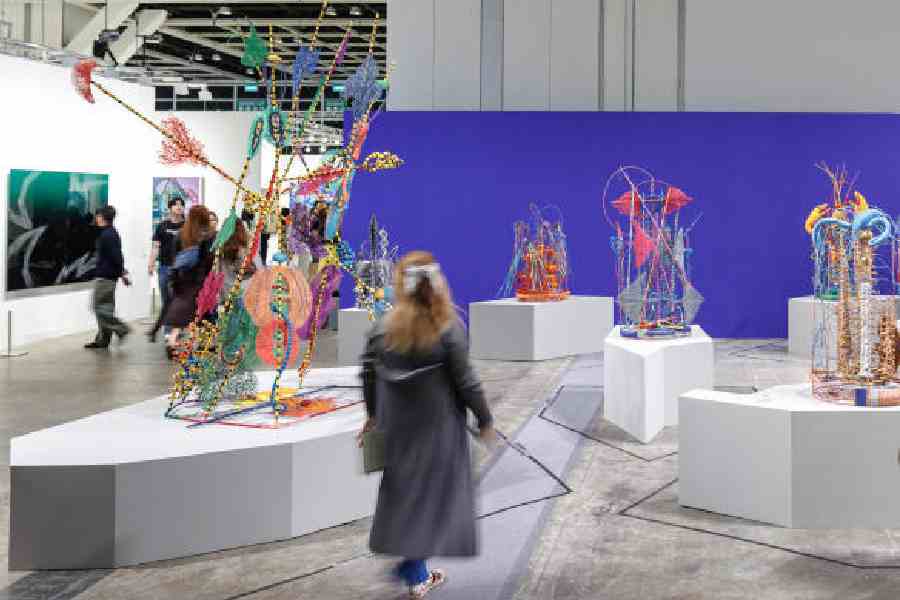
In the ‘Encounters’ section, thoughtfully curated by a team of four Asia-based curators, TARQ showcased Parag Tandel’s Anthems of Archipelago: We are King of Ocean, which explored the Mumbai-based artist’s long-standing interest in the social, cultural and archival practices of his ancestral Koli community. Reminiscent of fishing nets, the yarn-like textures of the sculpture sought to create talismanic shapes which bore witness to the very history of Mumbai and its original inhabitants who once shared a deep spiritual, professional and personal relationship with the ocean but today, as their cultural knowledge, identity and even livelihoods steadily fade away, native Kolis like Tandel are forced to stare at the vastness of the sea and wonder about the evolution of their once sleepy fishing village into a glass-fronted, cutthroat commercial megapolis.
The artwork seemed to suggest, rather humbly, that Maximum City may be maxing up but the Kolis will remain the last authentic link to its primitive roots. The ‘Encounters’ section was inspired by Five Elements, popular in traditional Asian cosmology. TARQ founder Hena Kapadia told t2oS that Tandel’s Anthems of Archipelago fitted perfectly into the Ether, Water, Fire, and Earth theme at ‘Encounters’, and hence he was a natural choice to headline a fair like this.
“Parag’s work focuses on the belief systems of the Koli community. It’s a look into how ancient knowledge can be transferred from one generation to the next,” she said, explaining that Art Basel Hong Kong’s success should be reassuring to anyone who thought the Iran-America war and the uncertainty in the Middle-East war would affect the contemporary art world. “The market here seemed cautiously optimistic, given the current geopolitical situation of the world,” observed Kapadia, whose gallery has been a regular at Art Basel Hong Kong.
Another Indian gallerist, Shrine Empire’s Anahita Taneja, echoed the sentiment: “There was a clear sense of optimism in the market at Art Basel Hong Kong this year, with a noticeably upbeat trajectory across the fair. We encountered collectors who were deeply engaged, taking time to understand both the practices and pricing of the artists we presented. Alongside this, there was a strong institutional and curatorial presence, not only from Southeast Asia, but also from Europe and the US, reflecting the fair’s global pull.”
The public days were bustling with artsy crowds, “with consistently high footfall and serious interest during the first three days of the fair. For us, conversations also extended towards potential museum exhibitions, generating interest from institutions in Spain and London”, added Taneja, who is the director of the New Delhi-based gallery.
Incidentally, Shrine Empire’s booth at the ‘Discoveries’ segment was enlivened by the poetic works of an artist with a Calcutta connection. Neerja Kothari’s pen-and-ink drawings On Walking (after Woolf) and On Walking (after Thoreau) experimented with text in playful yet profound ways. This series was both inspired by literature in some ways and conceived as an attempt to overcome the pain and trauma of a rare neurological condition called motor sensory neuropathy that the artist was diagnosed with in her early 20s. Despite the challenges, Kothari recovered and went ahead to pursue her art education in Boston.
Though executed during the years she spent in physical rehabilitation in Calcutta, the works have been incubating in her mind while she was studying at Tufts University in Boston. “During this time she got influenced by authors like Virginia Woolf and Henry David Thoreau who had written about walking. She was engaging with their writing more from a scientific or medical perspective. For instance, reading Thoreau’s essay on the joys of walking in the countryside, she thought to herself, ‘I cannot do this’. The simple act of walking was challenging enough for her, as she had to measure the amount of movement she could do in a day. Similarly, Woolf’s essay talks about the author stepping out into the city looking for lead pencils. This bit of writing became particularly relevant for her because, like Woolf, she was also going out to find art material. She had long dreamt of using this memory for her art and I guess this was it,” shared Shefali Somani, who co-founded Shrine Empire with Anahita Taneja in 2008.
Step closer and you could see that the words ‘heal’ and ‘toe’ recurred throughout Kothari’s paintings, perhaps reinforcing the artist’s own paradoxical life — torn, as she was, between the simple pleasures of life and hope for living and her debilitating illness, which prevented her from even a basic physical activity like walking that most of us take for granted.
Meanwhile, drop by any fair these days and it is impossible not to encounter Indian masters. This time at Art Basel, we spotted Anish Kapoor’s Mirrors and Nalini Malani’s Tales of Good and Evil (2008) at Galerie Lelong from New York, yet another affirmation (as if any was needed) that Indian art is not simply shaping the modern and contemporary art discourse but actively rewriting it.
Held during March 27-29 at the Hong Kong Convention and Exhibition Centre (HKCEC) in Wan Chai, Art Basel HK saw participation from 240 of the world’s top galleries, reaffirming its position as a leading stage where both global top-tier art and subversive gestures could co-exist and where both the traditional and transcendental could overlap, best epitomised this year by Kongkee’s Price/Value/Taotie tongue-in-cheek neon artwork (who can forget the Italian artist Maurizio Cattelan’s infamous duct-taped banana which grabbed all the attention at Art Basel Miami Beach back in 2019 and was later eaten by another artist, in a sensational act of Duchampian dare).
Two of the most interesting segments in this edition were undeniably ‘Encounters’ and ‘Zero 10’. Apart from Tandel’s Anthems of Archipelago: We are King of Ocean, the standout works here was the Chinese artist Hu Yinping’s installation Potatoes Grow on Trees, whose childlike premise endeared everyone, and the Kyoto-based Nobuya Hoki’s Sunflowers, which sparked a multidimensional dialogue between light and darkness.
After its remarkable debut at Art Basel Miami, ‘Zero 10’ returned to Hong Kong with its digital treasures that offered a glimpse into new media and how digital art is transforming our perception of art and creativity. Innovation and the shape of things to come formed the heart of ‘Zero 10’ and many of the projects revolved around the idea that the line between physical art and the digital world is fast disappearing.
Art Basel was born in Basel in 1970, Switzerland, and has since grown into one of the world’s most glamorous tent-poles, with editions in Miami, Paris, Hong Kong and, most recently, Doha. Its Hong Kong brand is known as a gateway to Asia and has been praised for its multilingual sensibility and for championing both bigger and much smaller galleries.
“I have spent my entire adult life thinking how we can recalibrate the art world to look at the Middle East, South East and the East as centres rather than as peripherals. Art Basel Hong Kong is at the nexus of that conversation, and the ultimate platform that illustrates so vividly that great art from around the world, including the West, can be in conversation with each other,” Alia Al-Senussi, Art Basel’s UK and MENA Representative and renowned art advisor, told t2oS.
This year’s edition of Art Basel Hong Kong was no different, she added, and continued: “Despite global turmoil, we saw collectors, patrons, curators and museum directors from around the world in the halls and truly engaged, perhaps even more curious and more open to unfamiliar artists than ever. The galleries also felt like they wanted to genuinely interact with a new public, bringing work that was intentional for both traditional and new audiences and about education rather than just quick transactions.”
Al-Senussi insisted that India’s success in global art is a result of its rich culture, coupled with the dedication of our practitioners and galleries who are eager to transcend borders. “Indian galleries have worked incredibly hard, with much success, to position their artists in the global art world, and in the context of the world’s greatest artists, museums and collections, understanding that the key to equal recognition is in fact the very first step, a noticeable recognition. Art Basel has embraced these galleries and their artists as being a key part of every conversation related to the global art world. We see Indian artists fully integrated into the canon, not just as novelties but as celebrated figures. For example, the M.F. Husain museum was a core part of the Art Basel Qatar program. Indian galleries have also been long-serving selection committee members to our shows, bringing that depth of knowledge to the community, and to the avant-garde that helps shape global trends,” she explained.
Though Art Basel is over, Indian visitors can still see works by our artists elsewhere. Take, for example, Himali Singh Soin, who is one among 14 Asian artists and collectives showing in an exciting group show titled Threading Inwards at Centre for Heritage Arts & Textile. Also known as CHAT, this textile heritage museum is housed in a former cotton spinning factory and had previously staged a major N.S. Harsha solo show.
“Thinking of textile culture, India is always in our focus as we respect its rich textile heritage, culture and ongoing innovation of textile and fashion there,” said Mizuki Takahashi, executive director and chief curator at CHAT, adding that this year, they are launching a project called Seed to Textile, as part of which they will invite a London and Hong Kong-based fashion designer to lead the public to co-design sustainable costumes for their Kathak-inspired contemporary dance performance.
“The Indian community is a huge and important part of Hong Kong’s culturally diverse community. Through Seed to Textile, we expect people in Hong Kong to become more familiar with India’s vibrant arts and cultural practices,” she concluded.