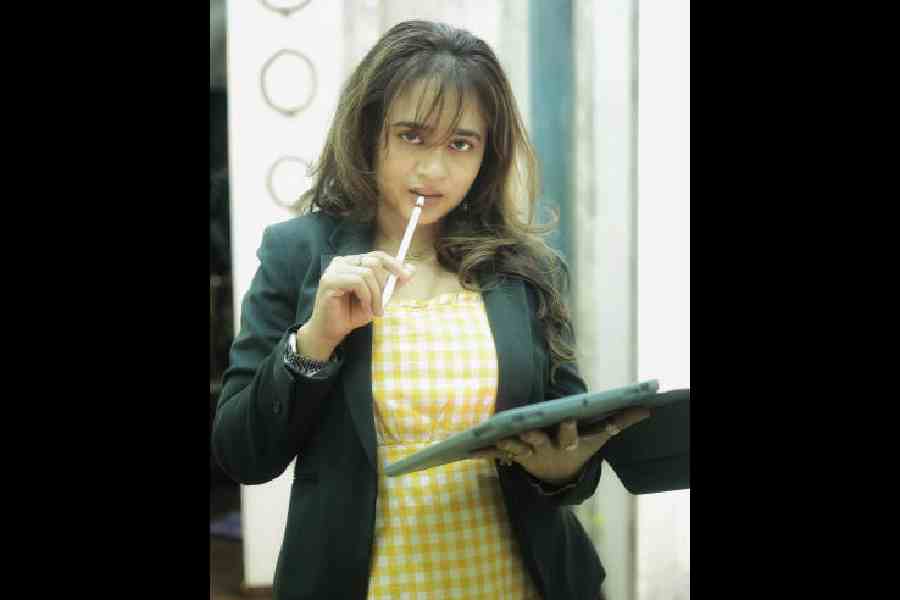
For Suchandra X Vaaniya, stepping behind the camera was less a sudden decision and more the fulfilment of a long-standing creative urge. Having worked successfully as both an actor and a producer, she had experienced the satisfaction of performance and the logistics of filmmaking — but something was missing. “In both scenarios, I have had very little creative control over the final product,” she admits. Direction, for her, became the space where she could finally “envision a story and tell it through my sensibility.”
There was also a deeper belief guiding her transition. Vaaniya sees cinema not merely as entertainment, but as influence. “In today’s time, the audio-visual medium has become the key to the hearts of millions,” she says. That conviction forms the ideological backbone of her directorial debut.
For her first film Poroborti Station Begunkodar, she chose to explore a horror-comedy rooted in the legend of Begunkodar Railway Station. “It’s often called Bengal’s ghost station,” she says. While the genre has seen extensive experimentation in Western cinema, Vaaniya feels it remains unexplored in Bengali films. Bengal, she points out, is rich in folklore and ghostly narratives, yet horror as a serious cinematic form is frequently overlooked. Too often, horror comedies turn into pure comedies, “with even the ghosts becoming funny and ludicrous.” She wanted to break away from that pattern.
Her approach is deliberate. “The horror shall scare the audiences and comedy shall come in as a breather,” she explains. Rather than blending the genres into parody, she aims to let them coexist — preserving genuine fear while allowing humour to provide relief.
The choice of Begunkodar was intentional. “A haunted railway station is a universally resonant concept, relatable across cultures and geographies. The film draws from the real events surrounding the station’s closure and its reopening in 2009. While the foundation is factual, cinematic liberties have been taken. It’s a mix and tiptoes on a thin line between fiction and reality,” she says, acknowledging the balance between authenticity and storytelling.
Vaaniya describes herself as spiritual. She also maintains a rational lens. This duality informs the film’s myth-buster character — “inspired by a real-life doctor who investigated the station in 2017.”
In the film, the character is reimagined as a London-based surgeon whose rational worldview is shaken during his investigation, drawing him back to Calcutta and into the mystery. Whether the narrative ultimately debunks the myth or uncovers something unexpected remains a carefully guarded secret. Authenticity, she insists, has been paramount in the filmmaking process. “Production design plays a pivotal role in films like these,” she notes, adding that much of the film is being shot on real locations to preserve atmosphere and credibility. For a story so deeply tied to place and legend, visual realism becomes essential.
Her path to direction can be traced back to childhood. Growing up, she watched producers and directors visit her father, a professional photographer. She would linger during those meetings, captivated by the narrations. As stories unfolded verbally, she would visualise them — the hero’s entry, the romance, the action, the villain’s arc, and the climax. Those formative experiences left a lasting impression. Though she eventually pursued acting, the urge to shape stories from behind the lens never left her. Later, while working independently as a producer, she realised direction was her true calling. She trained herself, prepared patiently, and when this story emerged, it propelled that calling forward.
Collaborating with Mumbai-based stand-up comedian and screenwriter Chaandroday Pal brought another dimension to the project. She admires his humour and rigorous research process, and their shared sensibility led to a creative partnership built on alignment of vision and tone. When asked what she hopes audiences take away from the film, her answer is simple yet ambitious: “I want them to be entertained, to provoke thoughts and questions — and hopefully want to watch more from me as a director.” While direction is currently her priority, acting remains, as she puts it, her “first love,” and she intends to continue balancing both.
If the film resonates, she already has a sequel in development. Indian folklore, she says, fascinates her deeply and evokes powerful emotions — making it likely that Begunkodar is only the beginning of a larger cinematic journey. In stepping behind the camera, Suchandra has not just transitioned roles; she has embraced authorship of her creative voice — one that seeks to explore fear, faith, scepticism, and storytelling with equal conviction.