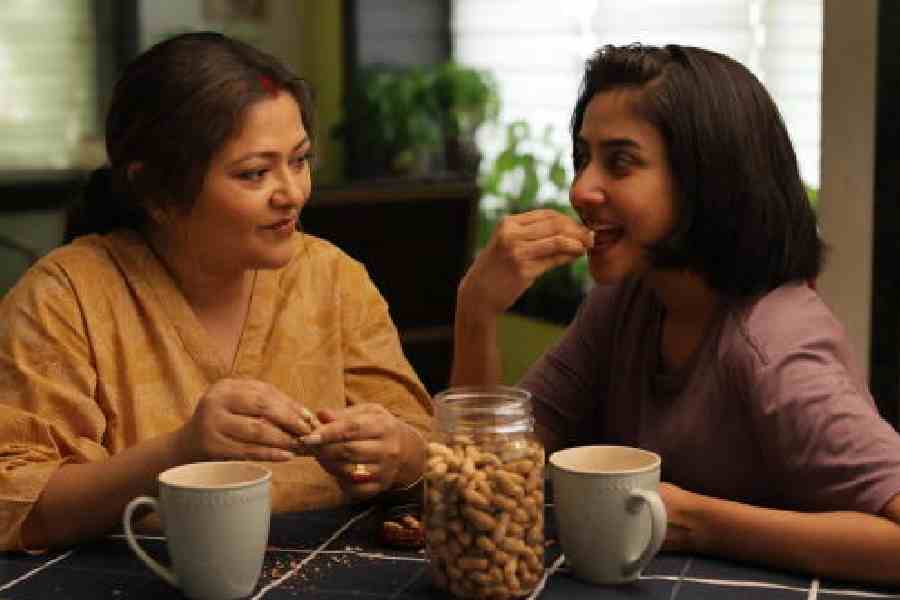
A quiet, sweltering Saturday afternoon sets the tone for the opening of Mrityu Bish Haran, where everyday life slowly gives way to a deeply unsettling narrative. The film stars Debleena Dutt as Soma and Koneenica Banerjee as Rupa, portraying two close friends whose long-standing weekend ritual becomes the lens through which a disturbing social issue is examined.
Set in a modest apartment, Soma is introduced attempting to distract herself from the oppressive heat with a crossword puzzle. The stillness is broken by the arrival of Rupa, an expected visit that has been part of their lives for over a decade. Their weekly meetings, once filled with light-hearted conversations about family, relationships, and current affairs, now take a darker turn.
The narrative pivots around a shocking incident in their neighbourhood: a young girl allegedly assaulted by her boyfriend. The case gains rapid public attention after the survivor shares her experience on social media, triggering widespread outrage and debate. Mrityu Bish Haran uses the intimate, conversational space between two women to unpack complex emotions and conflicting perspectives. The film’s strength lies in its storytelling, allowing dialogue and performance to carry the weight of its message. A t2 chat with director Abhishikta...
Why did you choose a domestic, intimate setting to explore such a heavy subject?
The domestic setting makes the movie relatable to the audience. A heavy subject relayed through an adda session between two best friends will not only be relatable to the audience but also enable them to carry the weight of the message without being overburdened by it. The intimate setting and the adda session leave no place for a preachy tone.
Do you see the film as more of a mirror to society or a call to action?
Both. The film will show the truth of our society and encourage change by acting as a wake-up call. One of the film’s main messages is that ordinary people can bring about that change through something as ordinary as adda.
How did you approach shaping Soma and Rupa as characters who represent contrasting mindsets?
I took inspiration from women around me and reflected those characteristics in Rupa and Soma. The focus was to display the mindsets realistically and accurately through actions and dialogues.
What was your process of working with Debleena Dutt and Koneenica Banerjee to bring out the nuances of these conversations?
We had workshops where I explained the characters and left the rest to them. Both Debleena Dutt and Koneenica Banerjee are exceptional at their craft with years of experience to back it up. I chose Koneenica for her unparalleled natural acting ability. She has the rare gift of making the mundane feel profound. In a film that relies on the “unspoken” as much as the spoken, her ability to inhabit a character with such organic ease is vital to making this living-room setting feel lived-in.
Debleena was chosen for her commanding screen presence. There is an inherent sharpness and intelligence to her performance style that the script demands. She provides the perfect counterweight, ensuring that the dialogue feels like a high-stakes chess match between two equals.
How did you use sound, silence, or pacing to build tension within a seemingly ordinary afternoon?
Putting a grim topic into a cosy afternoon in a middle-class living room creates a contrast that builds tension. This tension is accentuated by the fact that the topic is discussed via a leisure activity like adda. The audience gets the feeling that not everything is alright despite the relaxed atmosphere in the living room.
The crossword puzzle is an interesting motif. Does it symbolise something deeper in the narrative?
The crossword motif symbolises change, and that motif is wonderfully woven into the script.