A fist pump and a flying kiss towards the dugout on completing his 18-ball half-century was followed by a tight embrace as the two met on the field during the timeout on completion of the Powerplay overs.
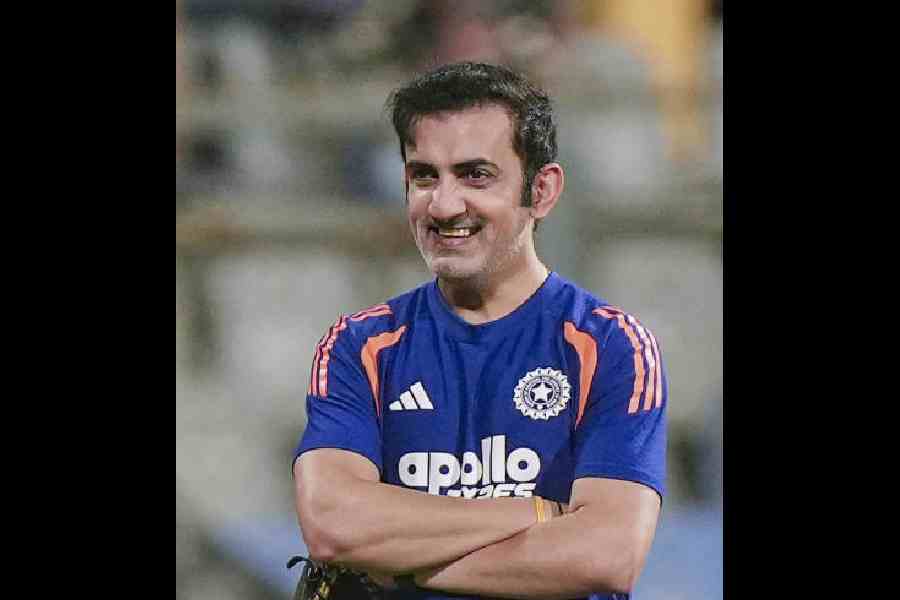
Abhishek Sharma and Gautam Gambhir's joy and relief were justified. Abhishek managed just 89, including a hat-trick of ducks, in his previous seven innings at a strike-rate of 130.88 in this World Cup. Gambhir, the head coach, ignored calls to drop Abhishek for his "headless" batting and the batter repaid his faith in the most demanding moment.
The momentum was set by Abhishek and Sanju Samson's 98-run explosive opening stand and New Zealand had lost the plot by the time the left-hander was dismissed for 52 off 21 balls. It was the quickest half-century of this World Cup and in all knockout matches in World Cups.
Gambhir and Suryakumar Yadav were ready to cop the blame by retaining Abhishek in the line-up for the final even though he repeated the mistakes and seemed low on confidence. The head coach spent close to 30 minutes with him after nets on Saturday evening in what was an intense and at times animated session.
Abhishek had practised solely against the spinners, with Gambhir stressing on playing inside-out shots to counter his failures against the spinners, especially off-spin. He repeatedly fell to the leg-side trap in this tournament and Gambhir showed him a few technical adjustments related to his stance, which would allow him to play the shots on the off-side more often.
His first strike on Sunday came after eight balls, and as luck would have it, he was up against Glenn Phillips's off-spin. Mitch Santner had put two men on the leg-side boundary to exploit the opener's weakness. But it hardly mattered since he was determined not to go for cross-batted shots.
Most of his lofted shots landed safely and the mishits raced for boundaries. His task became a little easier since there wasn't much turn on offer.
Abhishek's decision to go after Will Jacks in the semi-final drew much criticism since there was no need to attempt a third boundary in the over. But the team management had his back.
Abhishek's lean phase being broken by a useful knock in the final drew parallels with Virat Kohli's failure to be among the runs in the run-up to the final in the 2024 edition. While Kohli's 76 in Bridgetown laid the foundation for India's total, Abhishek, on Sunday, provided the initial impetus to India's total of 255/5.
More than skills and technical adjustments, it was a mental battle which Abhishek had to tide through. It was because of Abhishek timely show of aggression that India recovered quickly after managing 12 in the first two overs. It also put to the shade another brilliant Samson innings — 89 off 46 balls.
Samson's 105-run stand off 48 balls with Ishan Kishan proved to be the cornerstone of the Indian innings. However, for the third consecutive time, Samson missed out on a century.