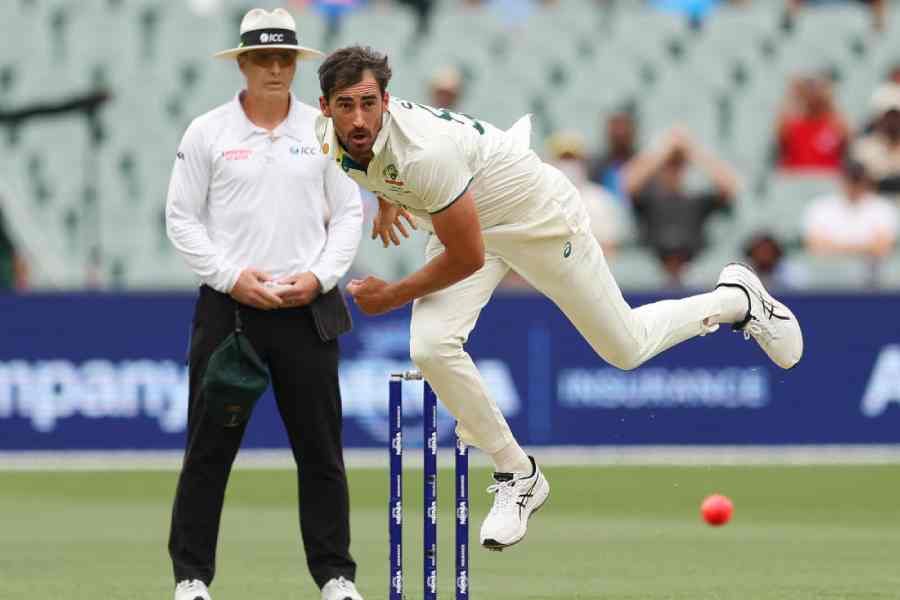
Once on the wrong side of their 30s, fast bowlers need to be wrapped in cotton wool, is an opinion held by many. However, there are some 30-plus pacers in the international circuit, who may be selective in their choice of matches, but don’t need that extra bit of cover just because of their age.
It won’t be an overstatement to say Mitchell Starc is in that league.
The senior Australia left-arm pacer is no longer an all-format player, having retired from T20Is in September. He doesn’t feature in every series that Australia play, even when it comes to the ODI format. But in Tests, Starc continues to spearhead the attack.
One doesn’t quite come across the left-armer hitting or crossing the 150kmph mark too often nowadays. His critics even argue that he isn’t too effective, or rather erratic at times when the ball is old. But with the new ball, if Starc strikes early, he is just as lethal as he used to be.
At 35, for a speedster to continue operating at full throttle obviously underlines his fitness. “Besides, the precision in terms of choosing the key series/tournaments has also played a role in keeping Mitch fresh and helping him to execute his best when the team needs him to,” agreed former Australia pacer Jason Gillespie.
“I think Mitch’s longevity is a testament to his work ethic,” former Australia Test opener Joe Burns, currently captain of Italy, emphasised. “Obviously, to have the skill he does but to play over 100 (101 so far) Tests for Australia as a fast bowler is a significant achievement.
“I think it’s always tough for bowlers to manage themselves through injuries and workload, so it also shows how meticulously he approaches his preparation.”
That meticulousness certainly keeps Starc in good stead not just for a successful home Ashes, where he has already had an excellent start with a 10-wicket match haul in Perth, but also when Australia tour India in early 2027 and when the ODI World Cup comes along in South Africa that year.
Wobble seam
With 81 wickets in 14 pink-ball Tests, Starc should be having his tail up in the day-night Test beginning on Thursday at the Gabba in Brisbane. At the Adelaide Oval last season, India had faced the heat before his 6/48 in the first innings. The West Indies were tormented in Kingston when his 6/9 bundled them out for a humiliating 27 in the second innings. Are England ready to tackle the speedster, who’s a different beast bowling with the pink ball?
Irrespective of the colour, if Starc gets the ball to swing, it’s not easy for even those considered to be defensively solid.
“Mitch has worked hard on his wrist position at the point of release. This helps him develop consistent swing as well as a quality ‘wobble-seam’ delivery,” Gillespie, with 259 wickets from 71 Tests, explained.
“His alignment at the crease helps too. When he is staying tall and not falling away at ball release, his wrist position is consistent, which allows for consistency with swing.”
“He normally swings the ball into the right-hander, and the seam comes out quite straight. But he just tilts the ball slightly, ever so slightly. So, he keeps his middle finger on the ball and then the ball comes out, and it’s sort of scrambled a little bit. That means he’s going to get movement away from the right-hander as well as a bit of extra bounce,” James Anderson, the highest wicket-taker among quicks in Tests with 704 scalps, said on TNT Sports.