 |
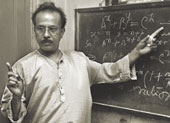
| T Byomkes Chandra Ghosh (Picture by Anindya Saha) (Below) Pierre De Fermat |
 |
It has been a great journey for Byomkes Chandra Ghosh from the crowded outskirts of Barrackpore, near Calcutta, to the pristine ambience of Honolulu in Hawaii. This 58-year-old private tutor claims to have solved one of the lingering mysteries and toughest problems in mathematics, the Beal’s Conjecture.
The story of the Beal’s Conjecture originated in 300 AD. The Greek mathematician Diophantine laid down the foundation of many algebraic equations in relation to the number system. Though Diophantine’s problems are treated as algebraic equations, they are not equations as we know them because the pre-assignment of numbers and the nature of solutions are not possible. There are also some people who argue that these equations may or may not have any solution.
Long history
In the 17th century, the German mathematician, Pierre De Fermat, found a translation of Diophantus Arithmetica and was attracted to the problem. His most famous work in 1637 was the modification of the Diophantine equation, x4 + y4 = z2 (where x, y and z cannot be positive integers). Fermat modified Diophantine’s equation by xn + yn = zn, which has no integral solution when is an integer and greater than 2. This statement has come to be known as Fermat’s Last Theorem. His original notes mentioned, “It’s impossible to write a cube as a sum of two cubes, a fourth power as a sum of two fourth powers, and in general, any power beyond the second as a sum of two similar powers. For this, I have discovered a truly wonderful proof, but the margin is too small to contain it.”
The equation awaited a solution till 1995, when Andrew Wiles established the proof of Fermat’s Last Theorem. But Wiles’s solution to Fermat’s Last Theorem using “elliptical curves” did not satisfy everybody. An amateur mathematician from Dallas, US, was thinking about solving Fermat’s Last Theorem in his own way. Andrew Beal, the proprietor of Beal Bank and Beal Aerospace, felt that Fermat’s “wonderful proof” must have had a simpler solution. Thus he formulated Beal’s Conjecture that says if Ax + By = Cz where A, B, C, x, y and z are all positive integers and x, y and z are all greater than 2, then A, B and C must have a common factor.
In 1997, the American Mathematical Society announced a $50,000 prize for either a proof or a counter example of this conjecture. Three mathematicians, Ron Graham, Charles Fefferman and Dan Mauldin from the University of North Texas were selected as members of a committee to evaluate the suggested solutions. The conditions set by them were that the solution had to be recognised by the mathematical community and the proof had to be accepted for publication in a refereed journal.
Puzzle obsession
Ghosh, a graduate in mathematics from Motijheel College, Calcutta University, first came to know about the problem and prize money through an article published in a Bengali newspaper in 1998. Ghosh, the eldest of four brothers and a sister, was always obsessed with solving mathematical puzzles and problems. Intrigued with the prize money, he immediately started working on the problem. It was an arduous and lengthy process indeed. For many years, Ghosh would wake up before dawn and his efforts continued till midnight, sometimes even beyond. “For the past seven years, my student Reba Dhar and my brother Moloy Ghosh have inspired and supported me enormously,” he says.
In January 2005, Ghosh submitted a paper on the solution at the 20th annual conference of the Mathematical Society of the Banaras Hindu University. “The paper, Proof of The Beal’s Conjecture, was well received and I got a lot of encouragement from the mathematical community,” he says.
Big breakthrough
In January this year, his paper was accepted for presentation at the 5th Annual International Conference on Statistics, Mathematics and Related Fields in Honolulu. “This was a big breakthrough since the acceptance of the paper meant international recognition for my efforts,” says Ghosh. It was not easy for a middle-class private tutor to travel to the US. However, the local MP, Tarit Topdar, assisted him to raise the requisite funds for travel. Ghosh felt his persistence had paid off after he presented his paper in front of an international community of mathematicians in Honululu.
Subenoy Chakrabarti, a professor of mathematics at Jadavpur University, feels that Ghosh’s work on one of the toughest mathematical problems is significant. “If he has presented two papers on the problem, it has to be acknowledged that his work is important,” Chakrabarti says. But others are still sceptical. Dr Sisir Kumar Sen, former dean of IIT Kharagpur and a fellow of the Indian National Academy of Sciences, feels that presentation of a paper is no guarantee of a “revolutionary” solution. “All I can say at this moment is that it’s only a first step.”
The same problem has also been approached differently by two mathematicians from Kalyani University in West Bengal, Amrita Ghatak and Tuhin Subhra Bhattacharya.
To gain universal acceptance, Ghosh must publish his paper in an internationally renowned journal. However, just the publication of the paper would not be enough. At least a year has to pass without anyone refuting his proof before it can be reasonably ascertained that his work is flawless.
Ghosh, however, is determined to stay on course. Having worked on the problem for close to a decade, he now feels he is inching towards his dream. “Renowned mathematicians like Patrick ’Ezepue of Sheffield Hallam University in Britain and Kenneth C. Wolff Of Montclair State University in US have expressed an interest in my work. They have encouraged me to present my work at a forthcoming British symposium. I am sending my paper to an international journal and am hopeful that it will be accepted,” he says.
It is now only a matter of time before it’s decided if Byomkes Chandra Ghosh has displayed the same ingenuity in solving a mathematical problem as his namesake and fictional sleuth, Byomkes Bakshi, did in solving a crime. If he ultimately wins the $50,000 prize, all conjectures would be put to rest, be it Diophantine, Fermat’s or Beal’s.