 |
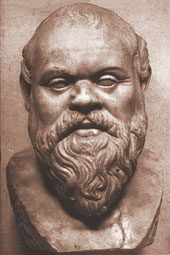
| First light: Socrates linked sound with words |
How did mankind learn the art of language? This fascinating question, once buried unceremoniously, has resurfaced, shattering a three-millennium-old hypothesis, thanks to sophisticated neurological mapping of the human brain. In 1866 the Societie de Linguistique de Paris warned their members not to discuss the origin of language, because “the topic spawned endless futile theorising.” Even a century later, the most influential linguist of modern times, Prof. Noam Chomsky, commented, “Language evolution appears to be beyond serious enquiry at this moment.”
So it was until 1990. Most researchers were content with the hypothesis that language evolved more as a social behaviour than as an evolutionary tool. It was also believed that the basic building blocks of language ? words ? were generated arbitrarily, that there was no connection between an object and the word used to call it. Recent neurological evidences, however, indicate that both the conjectures are largely untrue and that the origin of language has a strong component in a phenomenon called ‘synaesthesia’.
Synaesthesia, a hereditary abnormality, was first noticed by Francis Galton, a cousin of Charles Darwin. He found that some otherwise normal people had a peculiar sense of mixed perceptions. If they heard the sound of a particular tone, they saw a particular colour. And then there were some who saw colours by looking at numbers. Such a queer mixture of senses is known as synaesthesia. It’s an outcome of excessive neural connections between the neighbouring brain regions dealing with more than one senses.
In 2003, neuroscientist V.S. Ramachandran at the University of California, San Diego, argued that we all are mildly synaesthetic and this played a major role in developing the ability of abstraction and symbolisation in general and language in particular. Anatomically this makes sense, since the area in our brain responsible for symbolisation is located at the junction of the parts that deal with hearing, touch and vision. Perhaps the convergence of different perception modalities at this junction creates an abstract representation of ideas.
Neuroscientist Michel Arbib advocates a major role of mirror neurons (responsible for making us imitate others’ actions) in speech. Some people mimic the action of scissors by mouth while cutting a piece of paper or cloth, a peculiarity first observed by Darwin. Modern brain-mapping techniques have shown that the brain region controlling facial muscles for speech is almost touching that which control hand movement. So, vocalisation of hand gestures could be associated with mimicking by mouth.
To highlight synaesthesia’s role in word formation Ramachandran did an experiment; he drew two figures, one smooth and regular and the other with a zigzag outline. He told some viewers that one figure was ‘Booba’ and the other ‘Kiki’ in a language spoken by the inhabitants of a distant planet. Asked to guess which figure was what, 98 per cent of the viewers said the smooth one was Booba and the one with a zigzag outline Kiki. Ramachandran attributed this result to human tendency of associating a smooth sound with a smooth object ? a clear sign of synaesthesia.
It would be wrong to assume that Ramachandran was the first to talk about synaesthesia’s role in language evolution. Plato, in his Dialogue, depicted two imaginary characters Cratilus and Hermogenes, with Socrates acting as the mediator between them. Hermogenes thinks that the name of an object can be given arbitrarily, since the purpose of naming is only to distinguish one object from another. Cratilus, however, thinks the word to coin an object should be an acoustic icon of the object. Though Socrates admits that arbitrary words would serve the basic purpose of naming, he endorses Cratilus’ view. He thinks that one speech sound is more appropriate than another to signify a physical property of an object, and so it should be present in its name. For example, // is an audibly smooth semi-vowel, and hence more appropriate than, say, /p/ in naming a liquid or a smooth object. Socrates’ idea to link audible with visual sense was a precursor to synaesthesia.
Unfortunately, Socrates’ was a suppressed voice and the postulate of arbitrariness reigned supreme till the work of Ramachandran and some others came to the fore. Investigation into sound symbolism (connection between a particular sound and its meaning) ? which includes aspects called onomatopoeia and ideophone ? has been undertaken at the Indian Statistical Institute (ISI), Calcutta. My colleagues and I are analysing words from Bangla language, and, in the process, gathering new insights.
For example, we have identified more than 2,300 sound-symbolic words in Bangla, while another 1,000-odd nouns and adjectives are derived from these words. This makes Bangla the richest sound-symbolic Indian language. Onomatopoeia is shown by those words whose vocalisation automatically expresses their meaning. For instance, ‘kuu-kuu’ means the call of a cuckoo, and the utterance ‘kuu-kuu’ resembles that call. The name ‘cuckoo’ is derived from this call only. The call of a lizard is ‘tik-tik’, and the name tiktiki is derived from this call.
Ideophones are the words whose utterances do not directly signify their meaning, but give a synaesthetic feeling of what it means. For example, ‘gal-gal’ in Bangla signifies oozing out of liquid from a container or blood from someone’s wound. Similarly, ‘chham-chham’ signifies an eerie feeling or a peculiar fear associated with darkness.
Another interesting aspect of synaesthesia, discussed by Dr Edward Sapir, Dr John Ohala and Peter Ostwald, is connected with the evolution of species. For vocal animals, normally the male voice is more low-pitched than the female one. Males are generally bigger in size than females. Over generations, the animal brain has learned to associate bigness with bassness of sound. In signal processing terminology, it means that in the brain’s cognitive process low frequency signifies bigness, while high frequency implies smallness. This helps males to use their voice in signalling their bigger size and better reproductive fitness both to competitors and mating partners.
Ohala and others noticed that this size-frequency relationship has been there in the human language as well. For many languages, the nouns containing many vowels with high-frequency components (like /i/, /e/ or /ae/) tend to represent small, tender, light or feminine objects, while those containing vowels with many low-frequency components (like /a/, //or /u/) tend to represent big, heavy, dominating and masculine objects.
We have noticed that for Bangla agreement with that hypothesis is only partial. The presence of the vowel ‘i’ symbolises something smaller or more polite, as it should, but ‘u’ does not signify bigger or stronger objects. Rather, its effect is even politer than that of ‘i’. For example, ‘tak-tak’ is a tapping sound, ‘tik-tik’ represents a milder ticking of a pendulum, but ‘tuk-tuk’ is so polite that it has lost its sound connotation and is used as an adjective to represent ripeness (of fruits) or brightness (of colour). Other examples are ghat (big container), ghati (small container), ghunti (dice), or gola (big shell) and guli (small shell).
Why such a deviation in Bangla? We think the answer lies in the relative strengths of various components of language perception and generation. And the influence of one of them may predominate while conveying the meaning of the word. In case of ‘u’, the visual shape of the lip overrides other factors in sound frequency. This minimalism correlates with the sense of smallness, politeness or tenderness.
So, sound symbolism and synaesthesia are major players in human language evolution. Kudos to Socrates, who, more than two thousand years ago, could guess most of what we are observing now with complicated experiments.