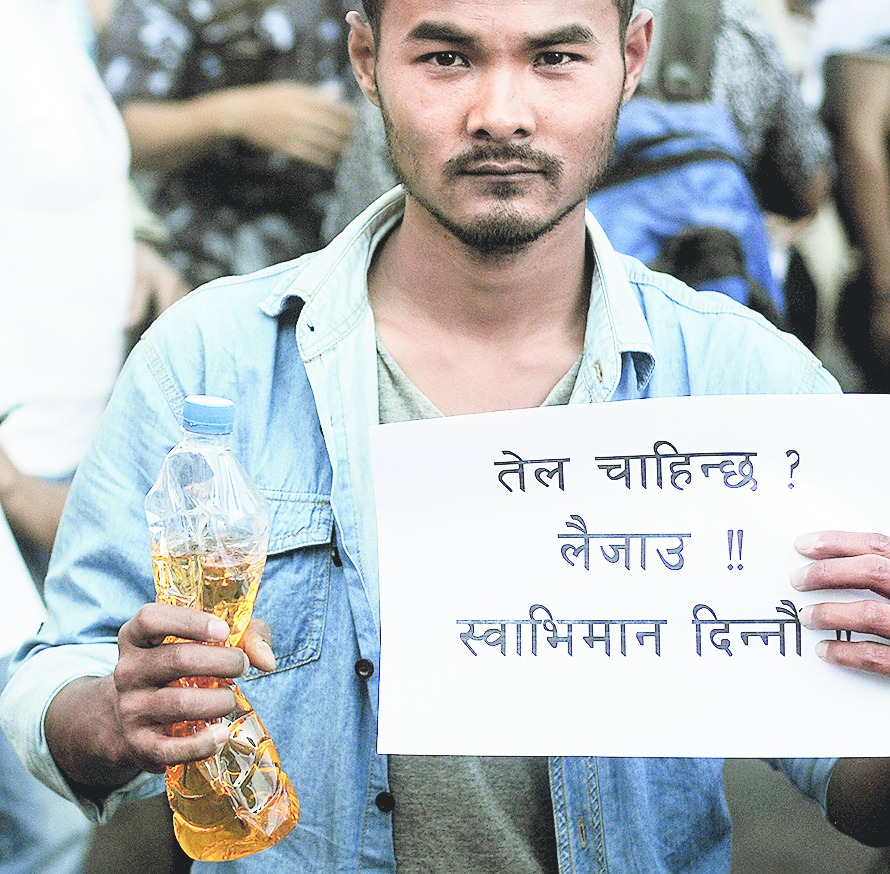

India has the largest embassy compound in Kathmandu. Almost at a shouting distance stands Narayanhiti Palace. Between them, the two establishments always controlled politics, diplomacy and most other aspects of life in Nepal. When, on November 6, 1950, King Tribhuvan Narayan Shah sought to free himself from the Rana regime that had made him a virtual prisoner in the palace, the Indian embassy came to his rescue. Pretending to go on a hunting trip, the king and his family drove to the embassy before being flown to New Delhi. By the time he flew back to Kathmandu, the death knell had been sounded for the 104-year-old Rana rule. The then Indian ambassador, C.P.N. Singh, who was known to be more powerful than the prime minister, would often sit at Nepal's cabinet meetings and call the shots.
Nepal's party politics too was born in India. The country's first two political parties - the Nepali Congress and the Nepal Communist Party - were both founded in India, the first in Varanasi in 1947 and the second in Calcutta in 1949. Obviously, India was both loved and hated by different sections of the Nepali society. King Tribhuvan's successors - Mahendra and Birendra - resented India's dominant role in their country's affairs as much as the Ranas once did. Even the political parties, especially the pro-palace and communist groups, periodically organized anti-India protests. For all that, there was no choice for Nepal but to live under New Delhi's shadow. India played a big role in all three 'revolutions' in modern Nepal's history - in 1951, when the Rana rule collapsed; in 1990, when a popular movement ended absolute monarchy and introduced multi-party democracy; and in 2006, when the New Delhi-brokered Comprehensive Peace Agreement between the Maoists and the mainstream parties formally brought the curtain down on the former's 10-year-long insurgency. The monarchy is gone, but India remains very much the big player in Nepal. Anti-India sentiments too have always been a part of Nepal's domestic politics.
However, New Delhi has to take much of the blame for the current anti-India protests in the Himalayan nation. The way India tried to force a postponement of the promulgation of Nepal's new constitution was a brazen act of interference in another country's affairs. It is incredible that India's foreign secretary, S. Jaishankar, failed to sense the mood in Kathmandu and tried to force the postponement. There was no way Nepal's political leaders could oblige him - he had gone to Kathmandu, as he was reportedly told by one of them, at least two weeks too late. Nepal had waited for the constitution for seven long years and its leaders - and the Constituent Assembly - could not have kept the country waiting any further. The first CA having failed to complete the constitution-making process, the present CA had to honour its pledge to the people. Indian attempts to stall the process were an affront to Nepal's sovereignty and to the people's right to their constitution.
This is not to suggest that India had no business or moral right to offer its views on Nepal's new constitution. Nearly one-third of Nepal's population, mostly those living in the southern plains, has ethnic, cultural and historical links with India. What happens to citizenship, territorial and other rights of these people should legitimately be of concern to India. Apart from the moral issue involved, there is a security angle to the question - unrest and violence in the Nepalese plains have a history of affecting peace and stability in large sections of the India-Nepal border. India's concern for the people in the southern Nepalese plains has been likened to what New Delhi feels about Tamils in Sri Lanka. But the failure of its attempts to push the Tamil cause in Sri Lanka should have prepared India to be more careful in its mission to secure what it considered a fair deal for the Indian-origin people in Nepal's new constitution.
But the failure of the Indian attempt in Nepal has exposed New Delhi to several charges. In Kathmandu, India is now accused once again of acting the Big Brother who would not allow a small neighbour to even draft its own constitution. And this despite the fact that nearly 90 per cent of the CA members had voted for the new constitution. India is also accused of looking at its interests not in the whole of Nepal, but only in parts of the country. Insinuations have been made that India's espousal of the Madhesi cause is aimed at controlling politics and policy in Nepal with the help of the plains people. And, New Delhi's hand is seen in the violence in the Terai region of Nepal, which has claimed over forty lives in the past few weeks. In other words, India is accused of threatening Nepal's peace and stability. Given the history of anti-India sentiments in Nepal, it is fair to assume that many of these charges are no better than conspiracy theories. But there is no denying the fact that New Delhi's insensitive handling of the issue has much to do with the mess in the Terai and in India-Nepal relations at the moment.
In fact, there is some substance in India's complaints about Nepal's new constitution. The most serious flaw in it affects all women - the constitution makes women, especially those married to foreigners, less than equal citizens. Some of its provisions on citizenship, property and political rights for the Madhesis and other people of Indian origin appear to be discriminatory and are not exactly inclusive. The anxiety among the Madhesi and Tharu communities over the delineation of the borders of the proposed provinces is not without basis. True, most of the Madhesi or Janjati representatives in the CA were among the huge majority of members in the CA who endorsed the new constitution. But Nepal's leaders cannot afford to leave such large sections of the population dissatisfied about the constitution, which aims to be the guiding spirit for Nepal's journey to political modernity.
Unfortunately for Nepal's constitution-makers, all these controversies have taken the focus away from the constitution itself. For all its shortcomings, it is a progressive and fairly inclusive document that can make its drafters justifiably proud. It is something of a riddle as to how Nepal's squabbling politicians managed to produce such a modernist constitution. Its provisions on fundamental rights are extensive. For a country that has always lived on orthodox religious and cultural values, the new constitution's safeguards for the rights of LGBTs offer the promise of a brave new world. It provides for 40 per cent of the seats in parliament for elections through proportional representation. This is aimed at giving adequate representation to the country's diverse ethnic communities. It also makes Nepal one of the few countries in the world where 33 per cent of the seats at all levels of the legislative - the parliament, provincial assemblies and local bodies - are reserved for women. In India, such reservations for women are there only at the level of civic bodies. The provisions for affirmative action reserve 45 per cent of government jobs, including those in the security forces, for minority groups. The constitution provides for the president and the vice-president to be chosen from different ethnicities and gender. And, there are seven constitutional commissions that are mandated to work for the uplift of marginalized communities. Few can deny that the new constitution is a great leap forward from all its predecessors, including the one promulgated in 1990. The big difference, of course, is that this is the first constitution that finally makes Nepal a secular, republican and federal State.
Yet, Nepal's politicians have to start work immediately on getting the agitating Madhesi and Tharu communities on board. For all its good provisions, the new constitution cannot take Nepal forward if these communities feel alienated. Heavens are not going to fall if the borders of one or two provinces in the plains are redrawn or if the number of provinces is increased. It is not a question of appeasing New Delhi; a deep divide between the hills and the plains may end up defeating the republican and federalist visions of the constitution.
And, the other thing that Nepal's politicians need to do is repair the damage caused to the country's ties with India. They need to face the fact that anti-India protests in Kathmandu will come and go, while India will always remain the big player in Nepal. Playing the so-called China card is not going to change things much either for India or for Nepal. Despite periodic irritants and tensions, the racial, religious, linguistic and cultural ties between India and Nepal are far too deep-rooted for either country to ignore them.
The bigger responsibility for repairing the relationship lies, of course, with India. And, imposing a blockade, even if an unofficial one, on goods traffic to Nepal is an act of petty revenge that can only harm India's image in Nepal and in the rest of South Asia even more. The Nepali people have bitter memories of the Indian trade embargo of 1989, but it was the year China struggled to cope with its Tiananmen Square challenge. What worked then for India may now prove to be a costly mistake. Besides, starving a small neighbour of supplies of food, fuel and medicine is not the best way to earn its trust.