
The people have spoken. Democracy has bared its fangs. The new world that stirs in the dying embers of 2016 is a product of the populist, anti-elite and anti-establishment outcome of public opinion tests in India, Britain and the United States of America. India spoke earlier than the others but harks back to the same roots for legitimacy as the Brexit vote and Donald Trump's elevation. Nothing could be more convenient for those who sanctify Vox Populi as Vox Dei to shatter the existing world to bits and remould it nearer to the heart's desire. The gutter was Napoleon's euphemism for the multitude when he famously claimed to have found the crown of France lying there.
Responding to the multitude is a democratic obligation. But recent experience indicates this means responding to the lowest common denominator in an idiom that appeals most to the illiterate and uninformed. Not for nothing does the Greek demokratía literally mean "rule of the commoners". Hence, the large part that mockery and mimicry plays in political speeches. Voters flock to meetings not to be enlightened through reasoned dialogue but to be entertained with body gestures, tonal variations and comic acts that have them in splits of laughter. The performer becomes doubly popular if he fulfils the yearning for some form of democratic dictatorship that will again ensure trains run on time. Unsuspected by most people, official patronage has built up a small but solid phalanx of courtiers to propagate the view that what John Adams, the second president of the US, called the "tyranny of the majority" is both logical and desirable. Abraham Lincoln's "government of the people, by the people, and for the people" has been reduced to Oscar Wilde's "bludgeoning of the people by the people for the people".
Every nation gets the government it deserves. Ironically, the French diplomat-philosopher author of that phrase coined another aphorism that seems peculiarly apposite to the present condition: "False opinions are like false money, struck first of all by guilty men and thereafter circulated by honest people who perpetuate the crime without knowing what they are doing." The prime minister declared in Dehradun that demonetization had in one stroke destroyed fake notes, terrorism, human trafficking and the drugs mafia. If true, that would mean 2017 will be clean as a whistle. However, much depends on exactly how much of the Rs 14 lakh crore, out of Rs 15.4 lakh crore said to have been circulating in Rs 500 and Rs 1,000 notes, deposited in banks was spurious. If the surrendered Rs 14 lakh crore was all in genuine notes, then demonetization has achieved nothing save headache and hardship for almost everyone, intense dislocation of the system, and vast expense. At the same time, reports of seized stacks of new Rs 2,000 notes suggest one of two conclusions. Either the counterfeiters are working overtime to replenish hoards with or without the connivance of official agencies, or the authorities have no idea of the channels into which real money is pumped and have again made fools of themselves - and inflicted agony on everyone else - by seizing legitimate savings in valid currency. There need not be any direct link between demonetization and the arrest of a chief secretary in South India or a businessman in Calcutta. Normal vigilance could have achieved both, providing they are guilty as charged.
The reported public enthusiasm for demonetization, which is seen as cutting the rich down to size although the rich don't hoard their wealth in Rs 1,000 and Rs 500 notes, links it to Brexit and Trump. Leaving aside doubtful reports of Queen Elizabeth secretly supporting Brexit, Britain's June 23 vote was to some extent a class thing. Most people who wanted to remain in the European Union valued the services of Polish plumbers and other East European mechanics and tradespeople whom they never met socially. But lower middle and working class people, especially in the northern provinces, feared competition for jobs, houses and educational and medical facilities. Normally they would have no hope of influencing policy. But the referendum gave them a voice. It also enabled Nigel Farage ("I want my country BACK!") of the United Kingdom Independence Party to exploit class and cultural fears. His party's triumph strengthens the view that democracy encourages the majority to decide things about which the majority is ignorant. Based on limited personal experience, voters imagined that by leaving the EU, Britain would be able to (quoting a former prime minister) "put the 'Great' back into Great Britain". A cruel awakening may await the many as, through no fault of her own, Theresa May grapples with an impossible task.
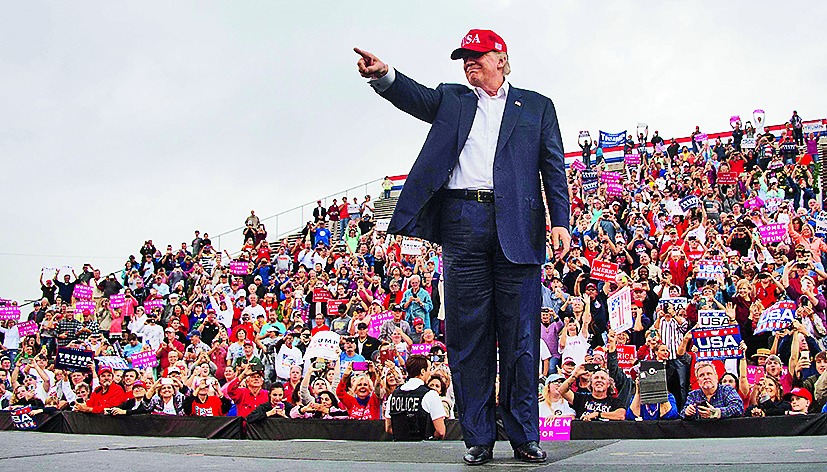
Across the Atlantic, Trump played similarly on frustration, aspiration and sentiment in America's one-time Manufacturing Belt, which became the Rust Belt when prosperity and population fled, towns stagnated and the powerful industrial sector started shrinking. Voters were taken with Trump's electoral promises to make Mexico pay for a "great, great wall" along the border, restrict Syrian refugees, deport 11 million immigrants, ban the entry of Muslims, "bomb the s**t out of" the so-called Islamic State of Iraq and Syria, bring back jobs, and introduce a series of rigorous measures. Most would not have known that his campaign reflected the white supremacist creed that Richard Spencer, president of a white nationalist think-tank, called the "alternative Right". It was to them a recipe for regeneration. Hope is the oxygen for democracy, and Trump's rhetoric ladled out hope in ample measure.
The common factor is nationalism, which General de Gaulle distinguished from patriotism. The latter, he said, "is when love of your own people comes first" while nationalism is "when hate for people other than your own comes first". This is true not just of India, Britain and the US but also continental European countries where also ultra-nationalistic parties feed on the majority's sense of deprivation. Crimes against Muslims and Jews increased by more than 50 per cent in Austria in the last year under the influence of the Freedom Party, founded by a Nazi SS general, which Vienna's mayor calls the "xenophobic face of Austria". The US Southern Poverty Law Centre counted 867 cases of hateful harassment or intimidation in the 10 days after Trump's election, following a year when, according to the US attorney-general, crimes against Muslims alone (not against Jews, African Americans and gays) shot up by 67 per cent. Hate crimes in Britain rose by 41 per cent post-Brexit.
The National Crime Records Bureau's finding of a 44 per cent rise in attacks against Dalits may not take fully into account either anti-Muslim acts or criminals masquerading as gau rakshaks, ghar wapsi bullying or sangh parivar rampaging. A series of governmental acts of omission and commission (not appointing a lokayukta or making the national anthem mandatory on trivial occasions) suggests the emergence of a State-approved code of behaviour. Suspicions of a sectarian identity are further reinforced by a list of appointments (the latest being that of Delhi's lieutenant-governor) of people connected with institutions like the Vivekananda International Foundation whose promise to fight "the threats posed by the demographic invasion from Bangladesh" recalls the harangues of Balraj Madhok who almost single-handedly kept the Jana Sangh flag flying for many years until the present, more accomplished and resourceful, leadership emerged.
The multitude might lap up this shift from the secular tolerance the Constitution envisaged, but it leaves little scope for the "freedom to doubt, disagree and dispute" that Pranab Mukherjee upheld on Thursday as an "essential pillar of democracy." It is ochlocracy or disguised mob rule that the ancient Greeks bracketed with tyranny and oligarchy as one of the bad forms of government. The Supreme Court's 1973 Kesavananda Bharati ruling can protect the basic structure doctrine of the Constitution, but probably not how it is interpreted and operated.