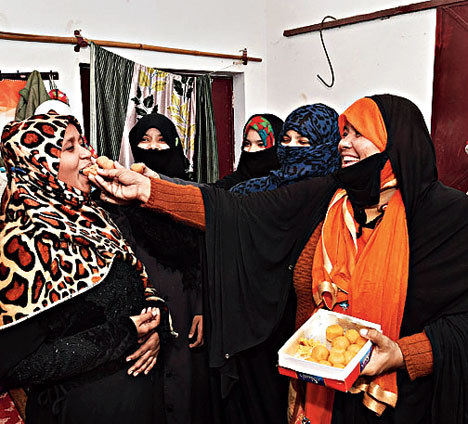

Last Monday, Ishrat Jahan, the lady whose petition triggered last year's Supreme Court ruling on the practice of instant triple talaq, made her debut as a political worker of the Bharatiya Janata Party. She began her speech at a public meeting in Howrah district with 'Bharat Mata ki jai' and 'Vande Mataram', slogans that are today inextricably linked with the BJP. She was a huge hit with the audience, some of whom responded with lusty chants of ' Jai Shri Ram'. However, a group of Muslim men observing the meeting from a discreet distance weren't so enthused. If anything, the presence of Ishrat at a BJP rally, read with the excitement around the Muslim women (protection of rights on marriage) bill, 2017, may even have convinced some of them that the Narendra Modi government was intent on assaulting the religious rights of the Muslim community, as claimed by the All India Muslim Personal Law Board.
The fears may be wilfully exaggerated by those who see themselves as the custodians of the shariat in India but there is some basis to the suggestion. It is one thing for the BJP to have always included the demand for a uniform civil code in all its election manifestos. It is a separate matter that a bill for the criminalization of instant triple talaq was moved in Parliament and passed by the Lok Sabha before it was stalled by a united Opposition in the Rajya Sabha last Thursday. It is worth remembering that the only occasion Muslim personal laws have been subjected to legislation in independent India was in 1986 when the Rajiv Gandhi government enacted the Muslim Women (Protection of Rights on Divorce) Act. That act overturned the Supreme Court judgment granting alimony to a divorced Muslim woman in the Shah Bano case. The act was widely seen as a piece of retrograde legislation.
The personal laws of Hindus were subjected to radical changes after spirited debates in Parliament between 1954 and 1956. The laws affecting marriage and divorce of Christians too have undergone legislative changes in independent India. Both sets of changes followed the logic of what the then prime minister, Jawaharlal Nehru, told the Lok Sabha on May 5, 1955: "We talk about the Five-Year Plan, of economic progress, industrialisation, political freedom and all that. They are all highly important. But I have no doubt in my mind that the real progress of the country means progress not only on the political plane but also on the social plane. They have to be integrated, all these, when the great nation goes forward."
Nehru's desire to harmonize modernity with social legislation was never followed in the case of the Muslim community. The personal laws of India's Muslim community continue to be governed by two pieces of pre-Independence legislation - the Muslim Personal Law (Shariat) Application Act, 1937 and the Dissolution of Muslim Marriages Act, 1939. The practice of instant triple talaq may have originated in a distant past but it derived its legitimacy from these laws, as did the right of Muslim men to have four wives simultaneously. Islamic nations, notably neighbouring Pakistan, have changed their personal laws over time but India has stuck to laws formulated by unrepresentative legislatures.
There are provisions of the Muslim personal laws that are not only hideously iniquitous but will not stand the test of human rights. Yet, they remain on the statutes thanks to a constitutional protection accorded to minorities to both practise their faith and maintain separate codes of social conduct. The framers of the Indian Constitution were fully aware of the anomaly between what passed off as custom and faith and composite modern citizenship based on equality and fraternity. This was the rationale behind Article 44 of the Constitution that stipulated that the "state shall endeavour to secure for the citizens a uniform civil code throughout the territory of India". Note the use of 'shall' which suggests a prescriptive direction of future polity.
During the passage of the Hindu social code bills in the mid-1950s, an article of faith for Nehru, it was asked why the Hindu community was being singled out for reform. When speaking on the special marriage bill in the Lok Sabha on May 21, 1954, Nehru emphasized its universalism: "The Bill affects not Hindus only, but is permissive for anybody, but I referred to the Hindu aspect because that aspect comes up before us repeatedly in this and other matters." Indeed, when introducing this legislation, the then law minister, Charu Chandra Biswas, was clear that the bill was an important step in the direction of a uniform civil code.
The political argument that was proffered - and continues to be made - against any immediate consideration of a non-denominational uniform civil code is that the urge for reforms must emanate from within the Muslim community. In theory this is ideal. However, the issue that must preoccupy the minds of all Indians is why in the 70 years of Independence Muslim politicians and community leaders haven't deemed it fit to urge the modification of personal laws that were framed in the late-1930s. On the contrary, every tentative move in this direction has been shouted down, sometimes on the specious plea that Islam itself was being threatened by majoritarian impulses.
It is striking, for example, that the innocuous two-page bill prescribing punishment for those Muslim men who persist with instant triple talaq, rather than take the matter of divorce to a court where the law as it stands is in any case totally weighed against women, has encountered so much disingenuous opposition. The otherwise very vocal feminists who played such a major role in pressurizing the enactment of very draconian anti-dowry and anti-rape laws have remained curiously mealy-mouthed, one activist lawyer even arguing that the ban on saying talaq, talaq, talaq even violated the right of free speech.
In a similar vein, the argument that a divorce procedure deemed illegal by the highest court in the land doesn't require separate legislation to make it criminal is dodgy. The Supreme Court judgment in the Ishrat case doesn't remove instant triple talaq from the statutes; it merely makes it inapplicable. However, it is no guarantee against either deliberately flouting the ban - as often happens in the case of dowry - or a bench in a regressive future overturning the Ishrat judgment. Indeed, if there is no stipulated punishment prescribed for those who violate the Supreme Court order, we may even see defiant clerics sanctioning instant triple talaq on the ground that their version of sharia is sacrosanct and not prone to human intervention. Of course, a future Parliament has an undeniable right to overturn the Supreme Court judgment and restore instant triple talaq. However, the likelihood of this happening is remote.
Over the past two decades, there has been a growing awareness in India of the increasing dangers of what is called 'vote bank' politics. There is also a political backlash against a form of ghetto politics that has significantly increased sectarian faultlines in society. Today, political parties, especially those claiming the 'secular' mantle, are more wary of being too explicitly identified with the identity politics of aggressive minority communities. This is one reason why no party with cross-community support is keen to be seen to formally oppose the instant triple talaq bill and support the AIMPLB's opposition. At the same time, they don't want to be seen to be supporting the Modi government's initiatives. Consequently, the country is witnessing a form of parliamentary doublespeak: grudging endorsement of the government in the Lok Sabha and filibustering in the Rajya Sabha so as to prevent changes in the Muslim personal law.