|
|
| Tragic flaw |

The Leopard and the Fox: A Pakistani Tragedy By Tariq Ali,
Seagull,
Rs 425
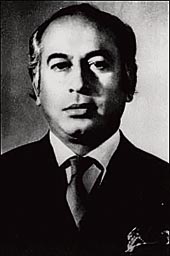
One evening in June, 1977 — a month before General Zia-ul-Haq upstaged Zulfiqar Ali Bhutto, Pakistan’s first elected prime minister, in a military coup — members of Bhutto’s cabinet and senior army officials were invited to the PM’s bungalow for dinner. When Bhutto’s arrival was announced, General Zia — a chain smoker at the time — had a lit cigarette in his hand. Having no time to stub it out before Bhutto entered, the General is known to have quickly put the burning stick in the pocket of his uniform jacket. Bhutto told Zia matter-of-factly: “General, take that cigarette out, it will burn your jacket.”
Stories like this, canonical as well as apocryphal, abound on the mentor-protégé relationship between Bhutto and Zia before the latter turned into a Judas/ Brutus figure. That Bhutto fell victim to a hypocritical, power-hungry military man remains the predominant view on his hanging to this day. Tariq Ali not only subscribes to it, but does so rather strongly. He has his own twist to add to the gory tale of Bhutto’s execution. In The Leopard and the Fox, Bhutto dies in a fisticuff with a colonel inside the death cell, and it is a dead man who is hanged on April 4, 1979, in a show of justice being carried out. It is another matter that the trial was a sham, and never before in Pakistan’s history had a death sentence been carried out where there was a split verdict.
The controversies surrounding the play, it must be admitted, are more interesting than the play itself. It was 1985, while Zia was still at the helm in Pakistan, that the BBC commissioned Tariq Ali to “write a three-part series on the circumstances leading to the overthrow, trial and execution” of Bhutto. The commission itself is a commentary on the admirable degree of autonomy enjoyed by the BBC not so long back. But the fact that the project had to be cancelled under pressure from the Foreign Office hints at the imminent end of the happy days. There is no doubt that the play contains several libellous passages, and each possibility of libel is meticulously pointed out by A.T. Hoolahan, QC, in his appended letter on the play. The playwright invents names for most characters other than the Bhutto family and the General, but as Hoolahan points out, it is all too easy for people to identify which real characters inspired, say, General Azad (most certainly General Faiz Ali Chishti) or Whiskey (Kausar Niazi, in all probability). Such identifications would not have been happy for either Ali or the BBC.
Yet another insinuation in Ali’s dramatized account is that America was somehow instrumental — or at least lent implicit support to Zia — in planning Bhutto’s overthrow. The single American well-wisher that Bhutto seems to have had, in the form of Bob Cherry (not the real name again), warns the Oxford-educated, cigar-smoking, mildly flirtatious prime minister time and again about the traps being laid for him. Does it imply that the Americans knew of the coup, and all that followed, well in advance?
The Leopard and the Fox paints a picture of subcontinental politics that is hardly salutary. The elected, popular leaders are, at best, flawed characters. Bhutto is the prototype — vengeful and blinded by the trappings of power and sycophancy all around. The history of Pakistan (and of Bangladesh) is the story of the gagging of democracy. India has reason to feel proud of the myriad ways in which democracy expresses itself here to this day.