|
|
| A history long forgotten |

The Aligarh Movement and the Making of the Indian Muslim Mind,
1857-2002
By Tariq Hasan,
Rupa, Rs 500
Since the formation of the Muslim Anglo-Oriental College by Syed Ahmad Khan, now known as the Aligarh Muslim University, this educational institution had always been the nerve centre of the Muslims, and of the whole country. But few know that the institution had been in the forefront during the national movement. Some relate the place to only the Muslims, linking all the activities in and around the institution to the Muslim mind. This book will not only bust some of the myths about Muslims but also provide a glimpse of how the Muslim psyche evolved over the last hundred and fifty odd years. Tariq Hasan seems to be the best person to write about the subject for he is a descendant of one of the co-founders of the university.
Although the book focuses on the Aligarh movement and the Muslim mindset, it is also an analysis of the life and times of Syed Ahmad Khan. Hasan begins with Khan’s biography and soon merges the life of the great man with the most troubled times in Indian history, not only for the Muslims, but also for the whole nation.
Hasan is not the first to write about the life of Khan, who was considered one of the greatest visionaries and educationists of Muslims in India, and he is certainly not going to be the last. He mentions how Khan singlemindedly devoted himself to the establishment of an educational institution for the Muslims in the face of severe opposition from all quarters, including his own community. Khan’s religious views, and his opinions about the British vis-à-vis his own community, are also discussed here.
This book traces the history of the university since its inception, talks about its Western teachers, their commitment to the institution as well as their fidelity to their British masters. It also enumerates the period of strife when the British had succeeded in dividing the Hindu and Muslim communities. Hasan shows how Khan remained a votary of Hindu-Muslim unity till his last days.
Everything comes under close scrutiny, from the rise of the Muslim League to the freedom struggle. The question of partition triggers serious thoughts. “The point often glossed over,” Hasan writes, “is that Lala Lajpat Rai was the first national leader who publicly mooted a proposal that ultimately led to the creation of Pakistan.” If the staunch Hindu forces were raising their heads that made even Motilal Nehru sad, the separatist Muslims were becoming more and more powerful within their own community.
The author also follows the predicament of the many nationalist Muslims who were sidelined by the Congress and were looked down upon by those Muslims who wanted a truncated country. Hasan does not mince words when he talks about how some forces in the AMU and other parts of the country came under Jinnah’s influence and later regretted it when Pakistan came into existence. Hasan makes the discussion topical by referring constantly to the present. The final section is devoted to the present-day AMU, where Hasan shows how, in its steady decline, the university has become just a shadow of its former self.
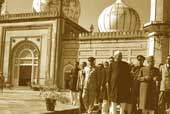
The book contains some rare photographs that will be of interest to students of history. The history of the Aligarh movement and AMU is a peek into Hindu-Muslim relations over the years. It illustrates how fundamentalist forces in both the communities succeeded in driving a wedge between the two. But the question is: have we learnt a lesson from history?
The book is invaluable for those interested in the affairs of the AMU as well as for historians who want to learn the truth about what happened during the nation’s most trying times.