|
|
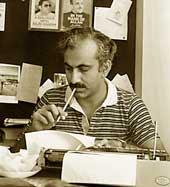
| As a young man |

Blood Brothers By M.J. Akbar, Roli, Rs 395
Heart-rending, heart-warming fiction, or hard history? Telinipara, around which this moving family chronicle unfolds, is of course no imaginary spot. It is in West Bengal, a couple of miles off Chandernagore, abutting the river Hooghly. The story begins with the famine in Bihar in the 1870s. It wipes off an entire village. A teenager, Prayaag, somehow survives the blight and takes an east-bound train. He lands in Telinipara, mostly consisting of ragged dwellings of workers employed by the Victoria Jute Mills. The workers, mostly from Bihar and the United Provinces, belong to both communities. The boy is taken in by Wali Mohammad, who runs a small eatery-cum-tea stall. Wali?s wife is childless, and mothers the orphan; she becomes Mai to him. Wali?s business looks up, Prayaag learns the tricks of the trade, he is diligent and loyal. When Wali dies, Prayaag assumes charge of the business, expands it and gradually discovers prosperity. Mai has chosen a Muslim girl for him. Prayaag agrees to conversion and marriage. He is now Rahmatullah.
Rahmat quietly takes to Muslim religiosity. It could be because of his growing affluence, or his piety, that he draws around him friends and admirers from both communities. As the narrative proceeds, characters jostle for attention. Rahmat is intensely devoted to a wisdom-laden ascetic, who emerges as a sort of guardian angel for Telinipara. Others in Rahmat?s circle include a gatekeeper, a coolie sardar, a greengrocer, a school teacher, a part-time intellectual who is a great lover of poetry too, the owner of a sweet shop, a milkman, similar types who are attracted to goodness because they themselves are of innate good nature.
Blood Brothers leads us through the late decades of the 19th century and the early decades of the 20th: the plague of 1890, the First World War, the Khilafat movement and Gandhiji?s arrival on the scene, the hopes and frustrations over the Gandhi-Jinnah parleys. The ripples of big events reach Telinipara in slow motion but fail to disturb its equilibrium. Evil elements from both communities are on the prowl; Rahmatullah and his group, ever on the alert, fight back, more or less successfully. Things look hunky-dory till the late Forties. Mai?s adopted son has meanwhile become a substantial man of property, and builds the first pucca structure in Telinipara. His son, Akbar Ali ? the answer, Rahmat firmly believes, to his prayer at Nizamuddin Aulia?s shrine ? learns English, is fond of English clothes and is friendly with the young Scot sahibs working for the jute mill. The narrative is a little vague regarding Akbar Ali?s professional interests; his father, one has to assume, grooms him in the family business. A police superintendent of Kashmiri stock finds a beautiful Kashmiri bride from Punjab for Akbar Ali. Level-headed Rahmatullah and his god-fearing friends try hard to ensure that Telinipara remains an abode of peace. But rough times arrive, Rahmatullah and his family go through a series of nightmarish experiences. The mill is sold to a Marwari. Akbar Ali?s Scot friends return home and their concubines go their separate ways; one of them is given shelter by Rahmatullah?s wife. Communal passion rises to a crescendo, close friends, belonging to both communities, get murdered; Muslim blood is spilled to save Hindu lives, and Hindu blood spilled to save Muslim lives. At a point of time, the family is forced to flee to East Pakistan. But Rahmat and his son do not give up their faith in India. As madness recedes, they return to Telinipara. Akbar Ali?s son, Mubasher, enjoys kindergarten life in convent school and is admitted to Calcutta Boys? School, where he learns to play pranks and develops a love for English literature. His occasional visits to Pakistan, where he meets relatives on the mother?s side, cause a further broadening of experience. He proceeds to Calcutta?s Presidency College, and from there to celebrity status as journalist and author. M.J. Akbar is Sheikh Rahmatullah?s grandson.
Akbar?s prose is crisp and sparkling. He has, besides, the knack of injecting dynamics into the narrative at appropriate moments so that the tension does not sag. A moral flows from the story, belonging to the we-shall-overcome genre: living and toiling under the humble sky of Telinipara, a pious converted Muslim preserves and prospers in life, he grows influential in the neighbourhood. Malevolent characters attempt to tear asunder the texture of daily routine of the simple, god-fearing residents of the area. Akbar describes some of these cruel, scheming people bent on mischief. But they cannot kill the soul of Telinipara; the dream of an integrated India bathed in communal harmony survives the arson and killings.
Considered as a fictional paradigm of economic development, social mobility and Hindu-Muslim relations, Blood Brothers cannot but induce empathy. Akbar crafts his tale with impressive skill and throws in references to passages from both the Quran and Hindu puranas to explain the psyche of particular characters ? or perhaps to slyly make fun of them.
There is a problem, however. Akbar would perhaps like to claim Blood Brothers to be an authentic biography of three generations of his family ending with himself. To sustain that claim, the narrative should not have strayed from facts. It has. For example, the person Akbar regards as the principal malefactor of his family was not ever elected to the state assembly on a Congress ticket; his affiliation was always with another party. The sub-story of how Atulya Ghosh wangled a ticket for him is, it follows, pure fiction. If liberty is taken with facts in one instance, might it not have been taken, the query is inevitable, in some other instances too? Blood Brothers therefore does not quite qualify as contemporary history; it is at most a romanticized version of it.
The caveat notwithstanding, this family saga is outstandingly marvellous stuff. It also helps to explain much about the genealogy of the man M.J. Akbar is: brilliant and naughty, a hint of steel inside, yet generous to a fault.