|
|
| Mighty fall |

THE LAST DAYS OF THE THIRD REICH By Joachim Fest, Macmillan, £ 9.75
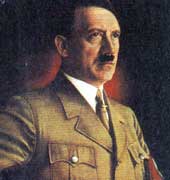
Hitler, writes Fest, was a nihilist. Earlier, he had destroyed foreign nations. In 1945 when power slipped from his hands, the tyrant took pleasure in smashing his Fatherland. Hitler issued his “Nero Command” which laid down that the retreating German armies should destroy all the public infrastructure of Germany. Hitler told his subordinates that the defeated Germans have forfeited their right to live.
Previous chroniclers of Hitler’s court like Trevor-Roper, John Toland (The Last 100 Days) and others, have focused on the dictator’s physical deterioration as the end approached. Hitler appeared slovenly, his dress shaggy, his left hand and left leg moved “like a clock pendulum.” Moreover, he developed a craving for chocolates and cakes. In fact, writes Fest, Hitler’s stooping appearance and the visible effort with which he dragged himself along the bunker increased his hypnotic power.
Fest writes that Hitler remained in total command till the end. None of the senior generals dared to challenge the Führer as he moved non-existent divisions along the map table. Rather, the sycophants shouted that he was displaying military genius. From his bunker, Hitler sent SS execution squads to hunt down deserters in Berlin.
As the Russian artillery turned Faust’s city into something like Dante’s Inferno, men and women continued to play their selfish games. German women were seen looting burnt down departmental stores even though their own homes were bombed to dust. The civilians and the soldiers, realizing that the situation was hopeless, displayed drunkenness and committed erotic excesses. Few paid attention to the hyperbolic messages imbued with a heavy dose of mythology still churned out by Josef Goebbel’s propaganda department. The propaganda material pasted on the walls of Berlin equated the Red Army with Lucifer and the Führerbunker with the citadel of God.
Meanwhile, the luminaries of Hitler’s court continued to play power games. After Hitler’s birthday on 20 April, most of the ministers removed themselves from the bunker. From his headquarter at Hohenlychen, Heinrich Himmler tried to contact the Western powers. When news of Himmler’s diplomatic maneuverings leaked out, Hitler shot dead his brother-in-law and SS general, Hermann Fegelin. Fegelin was Himmler’s representative at Hitler’s bunker and knew about his boss’s peace plan with the West. An additional charge against Fegelin was that he had made advances towards Eva Braun. In his book, The Last Days of Hitler, Anton Joachimsthaler has argued that there was no relation between Eva and Fegelin. However, Fest disagrees with him.
On 23 April, a telegram arrived from Reichsmarschal, Hermann Goering, saying that the time has now come for him to succeed Hitler. Contrary to the assertions of the earlier scholars like Trevor-Roper, William L. Shirer (The Rise and Fall of the Third Reich), Toland and Joachimsthaler, Hitler, asserts Fest, remained unmoved. But, Hitler’s private secretary, Martin Bormann, and Goebbels continued to provoke Hitler by saying that Goering should be punished for his treachery. The propaganda chief and Hitler’s bull-faced secretary had personal scores to settle with Goering. Finally, Hitler gave in to the pressure of Bormann and Goebbels. Unlike the British historians like Trevor-Roper and R.J. Overy (Berlin), who have overemphasized on the role played by the shadowy Bormann during the last days of the Nazi regime, Fest claims that it was Goebbels who was the moving force in the bunker. In fact, Goebbels urged Hitler to stay in Berlin and die like a hero.
With treachery all around, Hitler’s conduct became contradictory. At times, he sat in a chair and wept looking at the portrait of Frederick the Great which was hung in his bedroom. Frequently, he would play with his pet Alsatian and its five puppies. Occasionally, he would run to the phone and shout to the generals, “Implement my order otherwise heads would roll. Your head is on the line too.” On April 30, with the Russians nearing the Chancellery, Hitler shot himself. As his body doused with gasoline burnt on the Chancellery garden, and Russian shells landed nearby, Hitler’s henchmen raised their right hands and shouted for the last time “Heil Hitler!”
Fest provides a reason for writing this book. He claims that despite the claims of narrative history being unscientific by the current generation of historians, the narrative technique remains the most powerful mode of historical discourse. In spite of the recent criticism of the “Great Man Theory” of history, at times, writes Fest, it is necessary to study individuals who control the destinies of the nations. It is necessary to study Hitler, because he was an aberration and represents no continuity in German history. Fest concludes by saying that instead of relying on structural factors and the concept of “special path of German history”, it is necessary to have indepth studies on accidental figures like Hitler.
The author deserves praise for throwing new light on the day to day activities within the bunker and for linking the image of Hitler in bunker with the bigger picture. This micro-macro linkage was absent even in Trevor-Roper’s monograph. To sum up, this well researched, and lucidly written slim volume almost reads like a thriller and deepens our understanding about Nazi Germany’s Götterdämmerung.