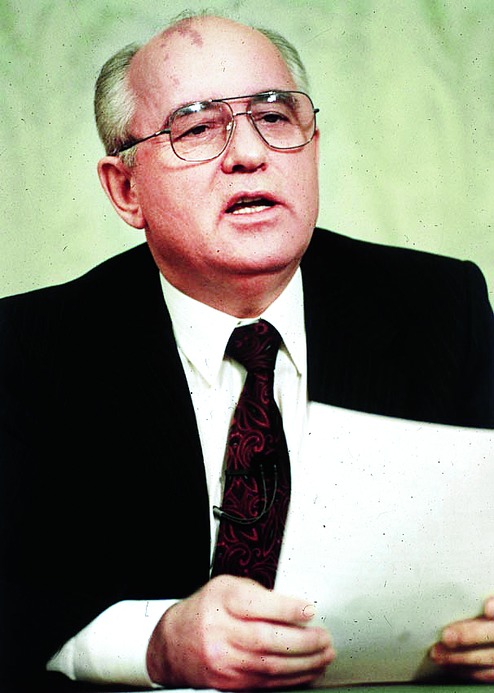

GORBACHEV: HIS LIFE AND TIMES By William Taubman, Simon & Schuster, Rs 799
Barring a few critics, Euro-American discourse places the northern Atlantic rim at the core of modern global democratic practice. Russia and China provide rival dispensations, the Soviet experiment had been the first in that direction. M.S. Gorbachev is said to be the tragic hero, who tried to win Russia for democracy. His failure is put down to his fatal flaws and the exceptional nature of the problem he confronted.
Marshal Taubman has an interest in fatally flawed Soviet reformers and made a reputation for a Khrushchev biography. Like his Khrushchev, Taubman's Gorbachev is studded with archival sources and interviews; his negotiation of memoirs is scholarly, though his biography sets out to tell a personal story, skimming scholarly debates. And unlike much in that debate, Taubman argues a fundamental "decency" to Russians, attributing their problems to systems that come their way through chance or compulsion, including Soviet communism. Contrary to "developing world" accounts of the USSR, he is emphatic about Russian barbarity, Soviet Communist Party tyranny and the marginal standing of intellectual traditions under Soviet rule until Gorbachev. Equality was the equality of the mob, lorded over by Soviet apparatchiki; economic achievement was a crude imitation of the Western equivalent and the result of individual hard work to sustain an unworkable system. The will to telescoped modernization gets no shrift.
Locating Gorbachev within this frame, Taubman shows how his protagonist came to seek to change Russia. Beginning with Gorbachev's birth (1931) in the Stavropol area of Kuban country east of the Black Sea he traces family life and village ambience in the steppe (Gorbachev did not see a train until the age of 14). This is situated within the tumult of Collectivization, Stalinism and the War. Gorbachev is linked to the regional elite (nomenklatura) where a local grandfather took the lead against fellow peasants in standing for Stalin's devastating policies. Thereafter, the adolescence of a hard-working country boy and award-winning student is punched with details of elevation in Communist Youth (Komsomol) and entry into the Communist Party. This paved the way to Moscow University (MGU) in 1950 to study law, during "high Stalinism" and before Khrushchev's thaw.
In Moscow, Gorbachev encountered the USSR's metropolitan elite, for whom he was a country bumpkin. He married Raisa Titarenko, also from a Ukrainian peasant background. She had a fine sense of the capital and was on the rebound from an affair with a Baltic Russian, whose careerist mother thought her inadequate for her son. Gorbachev also befriended Zdenek Mlynar, a committed Czech communist, later prominent in the Czech '68. Gorbachev, it appears, read a lot. He and Mlynar respected the Soviet egalitarian agenda but had a firm sense of the realities of Soviet life, despite Stalinist propaganda. That reality was crudity and disorder, illustrated through snapshots of MGU's Stromynka hostel and the mess at Stalin's "lying in state".
It was Gorbachev's hard headed, de-ideologized compulsion to seek public improvement that was his lodestone thereafter. He returned to the Kuban and made his way up through the hierarchy of the Communist Party (nomenklatura) before he went back to Moscow. Barring asides on family life, told with sympathy, Taubman's narration comes down to provincial political manoeuvres. Gorbachev "rose" during the ups and downs of the Khrushchev era and the experimentation to refine Stalin's planned economy. He maintained a code of propriety, commenting on a rival that "he didn't mind up whose a*****e he climbed, without soap". Gorbachev came to the Central Committee in Moscow under the protection of the former KGB chief, Andropov. And it was during Andropov's general secretaryship of the Communist Party (1982-84) that he rose to eminence.
Gorbachev's years in power (1985-91) dominate the volume. The inertia of the Soviet system, contingencies of politics and his over-confidence would defeat a visionary agenda. The claim that there was no alternative to Gorbachev in 1985 may be disputed. But the engagement with the West during 1986-91 is thorough, with unilateral disarmament and the fall of the Berlin Wall in focus. The role of George Shultz as a minor mentor is questionable. The documentation of the democratization of the Soviet political system is excellent — through the 27th and 28th Party Congresses (1986/1990), the rise of the anti-Communist opposition and Boris Yeltsin's emergence as its leader. There is fine drama in the narration of the overlap (1990-91) between this, the crisis over economic reform, the disintegration of the Soviet Communist Party, local crises in the Baltic and Caucasus and Gorbachev's increasing disorientation. The climax of disintegration in August-December 1991 is painstakingly told, and is unrivalled in standard literature in English.
Taubman's "hero" is in the wilderness post 1991 in chapters which attempt poignancy and "verdict", but which fall short of the achievement of the narration of Soviet collapse. Good history has its share of fatal flaws.