
MR AND MRS JINNAH: THE MARRIAGE THAT SHOOK INDIA
By Sheela Reddy, Viking, Rs 699
This is an interesting book, one that has managed to capture not only the subtle elements of an enduring and intimate relationship, but also the flavour of the larger socio-political matrix within which it developed. Through evocative vignettes spanning 22 chapters Sheela Reddy etches out this history. For a piece of work that is not strictly meant to address only a niche academic readership, it is noticeably well-researched, as is attested by the corpus of primary and secondary sources referred to.
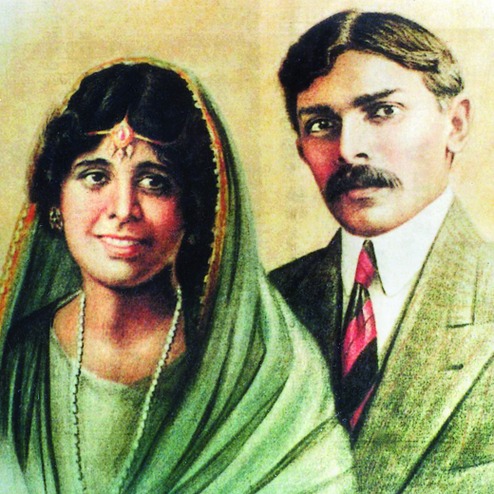
Not only does the book chronicle the nuances of the relationship between two individuals, the rising lawyer-politician of the early 20th century, Muhammad Ali Jinnah, and his wife, Rattanbai Petit, but it also provides sufficient insights into their personalities. As Reddy notes, "no two people could be more unlike each other, even in their outward appearance". The book, above all, is about much more than mere "outward appearance". It is about two individuals, who were "a dazzlingly handsome couple despite the twenty-four-year age difference". They also came from two different worlds: Jinnah from that of an ambitious and "distinctly old school" barrister-politician, and Rattanbai - "Ruttie" - from that of a Europeanized Parsi elite at ease at once with Annie Besant's theosophy and with old Zoroastrian rituals, which had become less of religious occasions than grand celebrations in the Petit house where she grew up. What brought this "dainty, warm, spontaneous" Ruttie and the out-and-out pragmatic Jinnah together was a romantic passion.
At one level, this book is a homage to both this romance as well as to the two lives who lived that passion. At another level, this is also a work that recurrently reminds its readers of the two very different worlds these two individuals lived in. If, then, there was an increasingly yawning gap between them, it was to a great extent because of the inherently different worlds from which they came. The young elegant socialite, Ruttie, would thus try her best to cast aside the yearnings of a newly-wed and accompany her husband to Delhi soon after her marriage to attend political events, only to discover that this "was not the stirring political life" that she had meant to share with her husband. Above all, her marriage, her conversion to Islam, the tumultuous political career of Jinnah all combined to engender more hostility than friendship amongst Parsi and non-Parsi circles alike. There is this immensely poignant account of how the couple welcomed their child: "It was a girl, with Ruttie's exquisite mouth and her large, dark eyes. There were no visitors, neither family nor friends, to admire the baby or fuss over the mother." Much of the growing distance between Ruttie, alias Maryam, Jinnah and Muhammad Ali Jinnah and the sad fate that eventually befell both, have been part of sensational speculations that easily lent themselves to lurid feuilleton. What this book does though, is to examine the history of their relationship in some detail without being narrowly pedantic. It is at once anecdotal, drawing upon a range of primary and secondary works, and refreshing in its presentation. At the same time, it is sensitized to the historical context.
There are further aspects that make the book an important contribution towards understanding the couple, their personalities, their dynamics and aspirations. Reddy's Ruttie is not just another socialite. Contrary to contemporary as well as later views (in Mahommedali Currim Chagla's Roses in December for example) on her daring dress sense, Reddy recovers a Ruttie who would let her sartorial choices reflect her personality no less than her manner of directness in conversations. Thus, not long after her marriage, Ruttie is reported to have once greeted the viceroy, Lord Chelmsford, with folded hands, whereupon Lord Chelmsford reminded Ruttie of her husband's "great political future" while also casually mentioning the old adage of behaving as Romans do while in Rome. Ruttie retorted by pointing out how she had done exactly that: she had greeted His Excellency in India in the Indian way. Equally instructive is the way Reddy narrates Jinnah's coming to terms with the news of the death of his ailing wife on her 29th birthday. Jinnah could restrain his emotions only by "talking politics" but would break down soon after. This facet of Jinnah is not entirely unknown though. Interestingly, however, the funeral "was unusual for the large turnout of ladies and gentlemen from all communities, friends of both Jinnah and Ruttie".
Reddy's, thus, is an evocative account of a romance, and the world in which it evolved. It is a book about one diehard romantic, the elegant and effervescent Ruttie, and her outwardly pragmatic and sombre but otherwise disguised romantic husband "J". Reddy's narrative, in the end, does well to chart the profile of the future Quaid-e-Azam.