|
|
| First blood |

HONORARY TIGER: THE LIFE OF BILLY ARJAN SINGH
By Duff Hart-Davis,
Roli, Rs 350
Duff Hart-Davis could not have chosen a better name for his super little biography of Billy Arjan Singh. Even the tigers around Tiger Haven, near where the forests of northern Uttar Pradesh become part of the Nepal Terai, have accepted Billy Arjan Singh as one of their own. There could be no better tribute to the man who has become a legend in wildlife preservation in India.
Billy, as he is fondly known by all who know him, is the classic case of the hunter turned conservationist. He was born into purple in 1917 with the proverbial silver spoon in his mouth. His father, Jasbir Singh, was the grandson of Raja Harnam Singh, and great grandson of Maharaja Randhir Singh (1830-1870), the ruler of the Sikh principality of Kapurthala. Harnam Singh lost his chance to succeed to the Kapurthala gaddi when he converted to Christianity under the influence of a Bengali Christian missionary, Golakhnath Chatterjee.
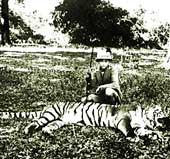
Billy grew up in Balarampur, where his father was special manager of the estate, and it was here that his lifelong love affair with the forest started. It was in Balarampur, also, that Billy, as a young and strapping lad, learnt how to shoot. He was only 12 when he shot his first leopard and at 14 he had bagged his first tiger.
In Naini Tal in the summer of 1924, Billy met Jim Corbett and befriended him. But Corbett had yielded to the charm of the big cat after having hunted man-eaters in Kumaon and elsewhere in the forests of UP. It would take Billy 20 years longer to follow in the footsteps of his mentor. His conversion came sometime in 1960 when he killed a leopard with a perfect shot and then came to realize the futility of it all. He laid down his rifle. Since then, Billy went to the forest with his loyal mongrel, Eelie, and a strong stick.
His first experiment with a big cat was with Prince, a leopard cub that Anne Wright had given him. Prince grew up in Tiger Haven, a kind of resort for wildlife lovers that Billy had built at the edge of what was to become in the early Seventies the Dudhwa National Park. Prince and Eelie became the best of friends, and then gradually Billy began to introduce Prince to the jungle. One day he was gone. His natural habitat had claimed him. Billy?s more famous experiment was with Tara, a female tiger cub he had imported from a zoo in England. Billy wanted to see if Tara would take naturally to the wild once she attained adulthood. She did. The experiment also brought to Billy his share of controversy. His detractors said that he had introduced a ?genetic cocktail? into the jungle since Tara had Siberian genes in her ancestry.
By the late Sixties and early Seventies, with the support of Indira Gandhi, Billy had become a major figure in the conservation of wild life, especially big cats. His approach was not always conventional and he hated the bureaucracy. He campaigned to separate the aims of forestry from the goals of conservation. When he first articulated the need for this differentiation, it was seen as another of Billy?s bizarre ideas. Today people have come to recognize the different priorities of environmentalists and conservationists.
Duff Hart-Davis is an unreconciled admirer of Billy. This is an admirer?s book and thus should not be judged by the strict canons of biography. It is a tribute to a living legend. Billy is loved in the jungle and also outside it, even though he would hate to admit the last part.