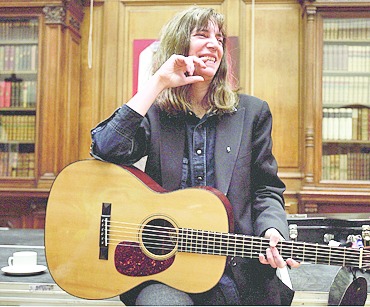

M TRAIN By Patti Smith, Bloomsbury, Rs 499
The first Patti Smith song I ever heard was "Because the Night". It had started off as a partial Bruce Springsteen lyric, recorded for the album, Darkness on the Edge of Town. Springsteen then declared that he did not think it was good enough; he decided to hand it over to Patti Smith, who, at the time, was recording in an adjoining studio. Patti retained the fabulous refrain, rewrote the rest of the lyrics, and created a scorching American rock and roll classic. "Because the Night" was released in 1978 as a single from the Patti Smith Group album, Easter. I heard it in the early 2000s, and loved it. It was then that I discovered her debut album, Horses (1975), which really drew me in. It was a pioneering record, one in which Patti discovered ideas and passions so unique as to connect Charles Baudelaire and Keith Richards. Horses created an explosion that still reverberates in music and literature, and set Patti on her way to becoming a punk rock poet-goddess before the genre even existed properly. Last year marked four decades since the release of Patti's debut album, and M Train , her latest book, is a Proustian daydream that spans those 40 years, bringing alive a lost world in a slim volume.
Just Kids (2010), Patti's award-winning memoir, focused on important relationships in her life, and can easily be counted as part of a golden body of work about young people going to New York to fulfil their dreams and find themselves. The 20-year-old Patti went to New York in the late 1960s, and like her guides in poetry and life, Allen Ginsberg and Walt Whitman, she closed her eyes and took a leap of faith into the arms of the city. Happily, New York rewarded her faith by keeping her afloat. Patti, however, is no longer the "kid" she was in that book. She is nearly 70, with a head and heart crammed with memories - most of which find their way into M Train - and has lost many she held dear, including Robert Mapplethorpe, the close friend and controversial photographer who shot the stark, beautiful cover portrait of Horses, and her husband, the MC5 guitarist, Fred 'Sonic' Smith. "They are all stories now," says Patti in M Train, thinking of the two men and other people she loved and lost. "The things I touched were living. My husband's fingers, a dandelion, a skinned knee. I didn't seek to frame these moments. They passed without souvenir."
Fred died in 1994, at the age of 45. Grieving for a loved one never really stops for the rest of the survivor's life, because emotions and memories suddenly appear at erratic times and the most unexpected of places. Patti lost her brother a month after Fred's death, increasing her pain manifold. Grief, like mist, sneaks in on tip-toe and then goes away - but, like mist, it also comes back, often resulting in the creativity one encounters in M Train. Unlike Just Kids, which was all about the excitement of "becoming", M Train is about suffering, and living through, erosion. Its narrative, aptly, is more allusive, like the lyrics of the author's songs. Combing through Patti's recollections is like chancing upon a years-old, forgotten to-do list in one's pocket - the completed tasks, the abandoned jobs, the supposedly mundane, all scribbled together in a waning mélange. These moments are fiery with passion because we see them through the eyes of a poet.
As a writer, Patti is charming, generous and brilliant. M Train finds her living by herself in an apartment in New York and following a familiar, if lonely, daily pattern of drinking endless cups of black coffee and fretting over her writing at a little table tucked away in the corner of Café 'Ino in the West Village (it is now permanently closed). Her kids have left home, Fred is gone, and her place among 20th-century artists is assured - so she struggles to find meaning in loss, bereavement and the painful awareness that she has outlived so many loved ones. She scoops up her Polaroid camera, a dog-eared copy of Haruki Murakami's The Wind-Up Bird Chronicle and her notebooks, and journeys across the world. She visits Casa Azul, the house where Frida Kahlo died, and the gravesites of authors. Her travels take her through countries, decades and the landscapes of her own mind. She meets fellow travellers. She sings with Bobby Fischer in secrecy in Iceland, where they were not permitted to talk about chess.
In her crippling isolation, Patti's treasured possessions acquire a talismanic quality and give her a chance to wax eloquent. Here is Patti musing about a misplaced, "ill-fitting, unlined" Comme des Garçons overcoat that a friend gave her on her 57th birthday: "Do our lost possessions mourn us?... Will my coat, riddled with holes, remember the rich hours of our companionship? Asleep on buses from Vienna to Prague, nights at the opera, walks by the sea, the grave of Swinburne in the Isle of Wight... Human experience bound in its threads. How many poems bleeding from its ragged sleeves?... Lost things. They claw through the membranes, attempting to summon our attention through an indecipherable mayday. Words tumble in helpless disorder. The dead speak. We have forgotten how to listen. Have you seen my coat? It is black and absent of detail, with frayed sleeves and a tattered hem. Have you seen my coat? It is the dead speak coat." Her cupboard has a little chest of drawers hidden at the back; it is full of tiny treasures, "some sacred and some whose origins were entirely forgotten." These charms are protection against loss and the ravages of time. Patti's obsession with material objects is a tribute to the things that time snatched away from her, such as Fred and the writer, Jean Genet. The reliable permanence of the things she can touch and hold only brings into sharper focus the people that she can never touch or hold again. She wonders what her legacy will be. What does one leave behind, if not the things that filled a life and the things that a life yielded? "Home is a desk," Patti writes. "Home is the cats, my books, and my work never done. All the lost things that may one day call to me..." Only a skilled writer can stitch jagged moments together to form a coherent whole, and Patti does just that with her recollections. The readers were not present when the events occurred, but they are there now, in the memories. Unlike Patti, they never went to a clandestine Continental Drift Club celebration of the deceased Alfred Wegener's life; if they had, they would have watched the strange proceedings spell-bound, just as Patti did.
With equal ease, Patti writes about the intellectual influences in her life, such as William S. Burroughs, Mohammed Mrabet and Henrik Ibsen - she tries hard to pay attention to what they are telling her - and television crime shows such as Law and Order and CSI: Miami. She is not ashamed or self-conscious about the art she loves, and the honest lessons it affords her. Patti is not merely an artist who admires other artists; that happens all the time, and there is nothing unique about it. Labelling Patti a 'fan' of Arthur Rimbaud or Genet does not do justice to the manner in which she has lifted her worship of art and turned it into an artistic form in its own right. She thinks that spending hours on a plane is a small price to pay for the mere chance to take Polaroid pictures of Hermann Hesse's typewriter or Kahlo's clothes. Patti and Fred go to French Guiana just to get a handful of earth from Saint-Laurent-du-Maroni for an old, ill Genet. She washes Yukio Mishima's grave in Japan; in Britain, she places offerings at the place where Sylvia Plath was buried. There is no doubt about the difference she perceives between their abilities and her own: "All writers are bums... May I be counted among you one day."
A cowboy appears in the recurring dream that M Train opens with. (It has been suggested that he may be the actor-writer, Sam Shepard, with whom Patti was involved in the early 1970s; she had written about him in Woolgathering [1992], in a sketch called "Cowboy Truths".) The dream-cowpoke tersely muses, "It's not so easy writing about nothing." His cryptic words plague Patti throughout the book. And yet, M Train's greatest reward for a reader - apart from its exceptional affinity with Patti's music, given that she has always been a poet first and a performer later - is her refusal to succumb to the cowboy's doubtful words. Nothing, too, has meaning, she decides - little things remembered, objects lost and found, cups of coffee that mark the passing of time better than watches. "I'm going to remember everything and then I'm going to write it all down," she says at the end of M Train. "An aria to a coat. A requiem for a café. That's what I was thinking, in my dream, looking down at my hands."