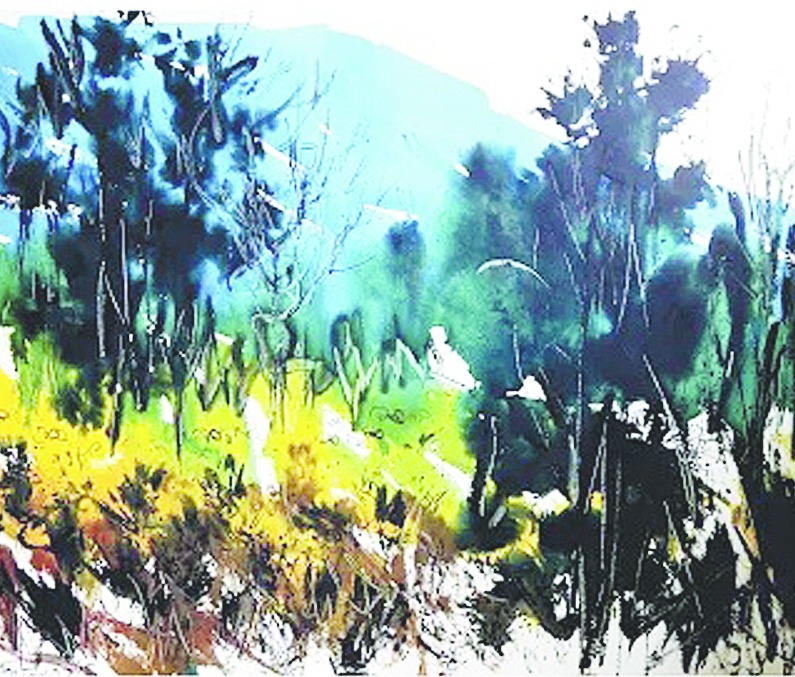

There are no tears, no wringing of hands. Yet, a heart-rending poignancy haunts Dhaka-born Mahjabin Imam Majumdar's art seen at her recent solo show at Ganges gallery. That's because Missing Tales is a deeply reflective footnote to a conflict zone by a sensitive, questing outsider who speaks in understated, yet gently probing, tones. A conflict zone that's being brutalized as a reluctant wife might be in India by an indignant, chastising, he-man husband. It is, in other words, about Kashmir. Where young rebels go missing regularly. Either to join the militants; or, equally worryingly, to be picked up by security forces unrestrained by constitutional guarantees to citizens.
So, of course, their tales go missing as well. But what and who do these young men leave behind? The artist sees the old and the infirm, women and the girl child. Surviving, it seems to the viewer of her art, on little everyday rituals like drinking salt tea from exquisitely crafted samovars that still speak of vintage Kashmiri refinement. Caught between diffident smiles, silent screams and patient piety, you could suppose. Condemned to a futile, yet palpable, wait, perhaps, in featureless fields or behind lattice partitions or under arched doorways. But waiting for what? For the return of paradise in this life or the promise of Jannah in the next? Not surprisingly, Majumdar's images suggest an ironic parallel: between the land known as paradise on earth, which has turned into hell, and afterlife in an eternal garden, which could mean both a numbing addiction to escapism or a final metaphorical redemption.

Two sets of acrylic paintings were presented, both with emphatic imagery. By contrast, the third suite, Book of Allusions, is spare and pale, woven into a gossamer elegy as it were, with little daubs of sepia or lines of text in watercolour and dry pastel counterpointing photographic images. The lines from the Book -that is, the Quran - describing paradise lend to Allusions 1, 2 and 3 a quiet, resigned anguish. The withered old man who sits on the bare, white ground of a page of the Book, having taken off his shoes, evokes a limbo of utterly drained volition. He has no past to glory in; no future to look forward to. But he's past caring. If what echoes in his ears is the allure of paradise for the faithful, he can at least comfort himself with the thought that they also serve who only stand and wait.
The rest of the portraits in this series are of women and adolescent girls, whose vulnerability comes across in their shy openness towards the artist- lenswoman. Majumdar plays with the filigree patterns of Islamic architecture to connote a physical gender divide. This is particularly layered in its suggestiveness in Allusions 9, where a girl gazes through the gaps with several eyes, and in 10, in which the shadow of the pattern falls on her face as she smiles a mysteriously knowing smile.
The allusion to the Quran -the word of God - is given an arch ambiguity in the two paintings titled Adorned with Words. In one, vision is being planted in a woman's blank eyes, implying both the gift of sight to view the world and, contrarily, a worldview shaped by inherited faith. The other set, Days of Demolition, comes out in a strident vermillion: probably her colour of protest to capture what she describes as her "despair" at the destruction of priceless historical art of ancient times in the name of religion. A despair that is, understandably, sharper, because she is Muslim and an artist. But then negotiating personal conflict zones is, you could say, the occupational hazard of contemporary artists.
Yet there are also those who thrive in easy harmony with their society and culture. The sculptor, Ramkumar Manna, for example, seeks to channelize his considerable skills into terracotta pieces of imposing sizes that certainly wouldn't offend viewers with contrarian gestures, nor stump them with incomprehensibility. His solo show at Shree Gallery had figures from Hindu mythology, whether gods and goddesses or lesser beings like Jokkho, the guardian of treasures. Hence, while an undeniable reverence permeates the figure of Krishna, with a lost, poetic look on his face, no such compunction holds him back from turning the Hindu equivalent of a Scrooge into quite a compelling presence: short, stout, with a bulbous belly and fired in three sections. Radha, too, has a fetchingly faraway look, while Shiva boasts a regal bearing. Because, after all, what he seeks to present is Mythology Recreated.