
The greater adjutant stork, or hadgila (bone-swallower) as we call it, is an endangered species. Named so on account of its quaint gait that is supposedly similar to that of military officers, only 1,200 of these gigantic, hideous birds survive today, two-thirds of them in Assam. Yet, till 1900, hundreds of these birds winged around central Calcutta and stood stock still along parapets of buildings like the statues crowning Writers' Buildings. They plodded around Fort William and the Government House (Raj Bhavan) grounds, and perched on the terrace of Spence's, the city's first luxury hotel.
In 19th-century Calcutta, omnivorous and gluttonous adjutants were prized as scavengers as they gourmandized on garbage heaps, saving the populace from pestilence. Special laws protected the birds. They were often the target of the cruel tricks of raw cadets who offered them marrow bones stuffed with gunpowder. The greedy birds swallowed these whole, and blew up pronto.
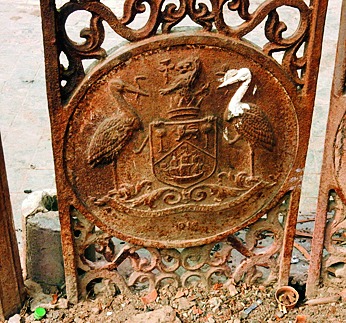
No wonder these birds once figured prominently on the escutcheon of the Calcutta Municipal Corporation. The bird is equipped with a giant bill, has a bare head and an inflatable neck pouch that may remind one of an ancient dowager's dewlap. These 'disgusting-looking animals' wear a white collar ruff at the base of their necks which, along with the pouch, turn bright orange in the breeding season.
Few know that their under-tail covert feathers marketed as Commercolly (after Kumarkhali in Bangladesh) were once exported to London to produce fashion accessories like tippets, boas and victorines that were the rage of France and England. These were displayed at the Great Exhibition of 1851. By the 1900s, the birds had disappeared perhaps owing to improved sanitation.
The only surviving CMC escutcheon made of cast iron is rusty with age. It is rooted to the pavement of Alimuddin Street close to APC Road. The last time I saw it nine years ago, rags were drying on it. This time, it stood isolated. The emblems in low relief are struck on both sides of twin conjoined cast iron discs. Somebody has tried to paint the discs white on one side.
The CMC has no records on this emblem. I sought the help of the historian, Rosie Llewellyn-Jones, in London, and here is what she collected from the College of Arms, also known as the College of Heralds. It was founded in 1484 by King Richard III of England. "The Herald on Duty today has described the coat of arms in the following terms: 'The two adjutant cranes are each holding a serpent proper in their beaks. The animal at the top, emerging from the crown, is a sea lion, with a piscine body. It is holding a lotus. So it's a fantasy animal, half lion, half fish. There are three eastern crowns, one on either side of the cranes, one at the top. It's also got two palm trees and a ship, or galleon. The Herald said it was a typical British Empire coat of arms and represents Calcutta as an entrepôt. He confirmed the date of award of the coat of arms as 1896 and the College records show that it was the Chairman of the CMC at the time who approached the College. They don't have a record of who designed the coat of arms. The Latin wording reads: Per Ardua Stabilis Esto, which means 'Be firm through difficulties'. This was the motto adopted by the Calcutta Scottish Auxiliary Force of India in 1914."
The emblem is cemented to the past.