
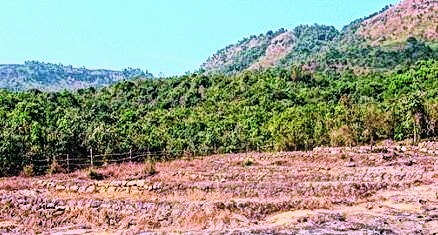

Shillong, Aug. 25: A detailed project report for the Rs 1,000-crore Meghalaya Community Led Landscapes Management Project (MCLLMP) is under consideration of the Centre and World Bank.
The project is funded by the World Bank with an approach to strengthen community-led natural resource management in different landscapes in Meghalaya.
The Meghalaya Basin Development Authority (MBDA), which is implementing the project, has applied for finance from the World Bank.
Principal secretary (soil and water conservation) and MBDA chief executive officer R.M. Mishra told The Telegraph that a tripartite agreement between the Centre, state government and World Bank would be signed for the purpose.
"We hope that the tripartite agreement would be signed within this year," Mishra said.
He said besides funds from the World Bank, the state government would also mobilise resources for the project by converging development schemes, including the MNREGA, with livelihood programmes.
The major components of the project include focus on strengthening of knowledge and capacity of communities for improved natural resource management, landscape planning and investment and project management-best management practices and social and environmental safeguards to facilitate community-led planning by providing support, technical inputs and funding.
The community will be engaged at a very early stage of project planning.
The stakeholders will work with the communities broadly in the area of landscape forest and water and will help in identifying activities for degraded forest, soil and water conservation, rejuvenation of springs and waterbodies, nature-based tourism, agro-forestry and homestead forestry.
The project will also enhance skills and technical capacity of communities.
According to a document related to the project, community land has considerably decreased with increase of private land.
"It can be seen that in Khasi hills more land has been used for agricultural purposes (45.51 per cent). In Garo hills, on the other hand, a considerable amount of land has been left barren (31.07 per cent). It is interesting to note that Garo hills has the highest percentage of community-owned forests (18 per cent)," the document said.
Geographic information system analysis showed that 1,427.31 square km area is highly vulnerable and 8,891.86 square km is highly vulnerable to soil erosion.
The state has 10,993 square km that is moderately vulnerable to soil erosion. Based on vulnerability of sub-watersheds (land that drains to a specific water body) to soil erosion, it was found that 30 sub-watersheds have very high priority while 29 have high priority for conservation measures.
The state has 77 medium-priority sub-watersheds, 43 low or very low priority for any conservation measure.
East Khasi Hills district has the maximum with 13 sub-watersheds of very high priority followed by West Khasi Hills (9) and Jaintia Hills with three sub-watersheds with very high priority.
Meghalaya has 6,026 villages, where 140 will come under the MCLLMP, besides 140 spring-shed development projects.
Soil and water conservation measures, including spring-shed development, rehabilitation of shifting cultivators, improvement of vegetation cover, community forestry cover 91.43 square km.
Agro-forestry and soil improvement treatment (fallows and current fallows and degraded portion of cultivated land) will constitute 60 square km and treatment of mine-spoiled areas will encompass 6.77 square km.