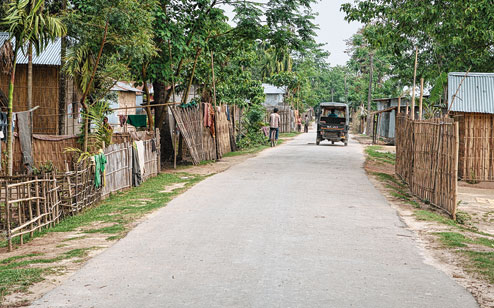


Darchuka (Gauripur): The 2-km concrete road is perhaps the only good thing the state government has done in this village in western Assam. The situation otherwise is similar to many other villages - no hospital, one government primary school for more than 300 students, no drinking water supply, no irrigation facilities and electricity always playing hide and seek.
But these amenities come later in the wishlist of the 1,157 Koch Rajbongshi and Muslim voters ahead of the Assembly elections here on April 11. The question of identity - Scheduled Tribe (ST) status for the Koch Rajbongshis and inclusion in National Register of Citizens (NRC) for the Muslims - figures prominently in the political discourse here.
"Development on our side (Dhubri) is neglected because of the Bangladeshi problem. They (the government) think what is the point in providing good facilities to Bangladeshis. They seem to have forgotten that we are not Bangladeshis. The Scheduled Tribe status only will perhaps protect our identity," 77-year-old Masuram Roy, one of the Koch Rajbongshi villagers, told The Telegraph as he sat in the courtyard of his neighbour, Madan Roy, a carpenter.
Masuram and his eight-member family live on one bigha of land but do not possess land for cultivation.
"How do we buy land by working as daily wagers? I have a job card but did not get even 10 days of work last year. This year I have not got a single day of work yet," Roy said, as he showed his job card given under the Mahatma Gandhi National Rural Employment Guarantee Act, that guarantees 100 days of work in a year.
The condition of Madan and his two brothers - Dhaneswar and Kanuram - is almost same. They, too are landless and work as daily wagers. "We have not even got a house under the Indira Awaas Yojana. We are in constant fear of losing our home to the migrants," said Dhaneswar.
Darchuka, about 4km from Gauripur town, is a village under Gauripur Assembly constituency under Dhubri district that shares a 134-km border with Bangladesh, of which 44km is still porous riverine border.
Large-scale migration from the neighbouring country has not just changed demography but has also deepened the threat of identity among communities such as the Koch Rajbongshis.
The Koch Rajbongshis and five other ethnic communities - Tai Ahom, Moran, Muttock, Sutia and tea tribes - have been demanding ST status for protection of their ethnic identity and culture.
The issue of ST has figured prominently ahead of almost every election in Assam. The organisations representing the communities, however, this time demanded that this elections should be last one of politicians exploiting the Scheduled Tribe issue for votes.
The Congress workers campaigning in this village are facing flak over the party's "failure" to give Scheduled Tribe status, despite being in power for 15 years in the state and 10 years at the Centre.
Sitting MLA Banendra Kumar Narzary, who is contesting as BJP-BPF-AGP combine candidate too is flooded with questions on why the NDA government at the Centre had not yet fulfilled its promise of ST status made before 2014 Lok Sabha polls.
"The Koch Rajbongshis are now considered as OBC but the reservation in jobs for OBCs is almost same of the general category. We need Scheduled Tribe status for reservation, land rights and special attention for protection of our culture and development," said Kamal Chandra Adhikary, a Koch Rajbongshi youth.
Kamal is part of an NGO, Northeast Janata Assurance, that runs a school in the village for children of the underprivileged villagers.
The concern for identity was equally strong among the Muslim voters about a kilometre away in Darchuka.
"When will we get NRC cards? We have already submitted the papers," asked 65-year-old Akbar Ali, a farmer.
Ali owns six bighas of land but lack of irrigation has affected cultivation.
"The free seeds are supplied only at the end of the farming season. What will we do with those then?" he said.
Anuwar Hussain, a youth, stopped Ali, saying that the NRC was more important than the government benefits.
"We want the NRC cards immediately so that we are no longer remain branded Bangladeshis. Let them do whatever they want to with the Bangladeshis but why would we suffer?" he said.
"The NRC will also stop politicians from exploiting it for votes and duping the Muslim voters every elections," he added.
Presence of illegal migrants in the village, however, would come into focus once the ongoing verification of the documents submitted for inclusion in the updated NRC is complete.
The NRC 1951 is being updated in Assam to solve the state's vexed foreigner problem, and those proving theirheir forefather's existence in the state till March 24, 1971 will be included in the updated NRC.
Gauripur goes for poll on April 11.