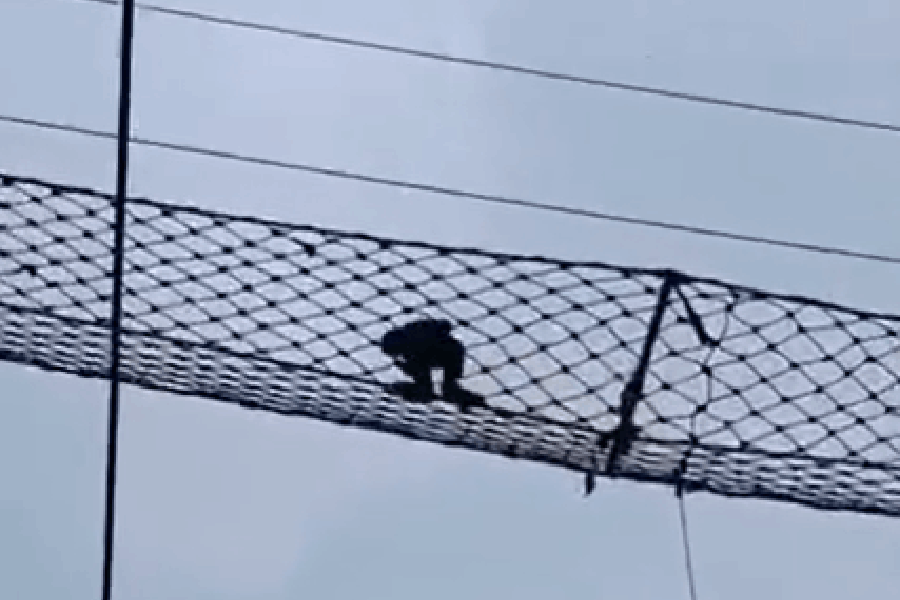
In a first, a male Western Hoolock Gibbon housed in the Hollongapar Gibbon Sanctuary in Assam's Jorhat district crossed the canopy bridges installed over a railway line passing through the sanctuary on Friday.
This is the first confirmed use of the canopy bridge by a gibbon at the sanctuary, and the first documented use of the structure over a railway line anywhere in the world, according to a statement by the Wildlife Institute of India (WII).
Canopy bridges are artificial or natural crossings that connect tree-tops. Aimed at wildlife conservation, these structures help arboreal animals cross roads or train tracks; enabling infrastructure development while minimising its impact on environment and wildlife.
In a post on X, Union Environment Minister Bhupendra Yadav commended the "tech-led conservation" effort, saying, "Good to see that mitigation measures such as this canopy bridge made over a railway passing through Assam has started being used by Hoolock Gibbon. This shows science-led small-scale efforts can also be of great help in biodiversity conservation." The WII said the bridges were designed as to mitigate the impact of electrification works on the existing single-track Lumding-Dibrugarh railway line passing through the sanctuary, during February-March 2025.
Western Hoolock Gibbons are India's only ape species, and listed as endangered in the International Union for Conservation of Nature (IUCN) Red List.
In India, they are found in all the northeast states, between south of the Brahmaputra and east of the Dibang river, according to a report by the World Wildlife Fund.
Outside India, Western Hoolock Gibbons are found in eastern Bangladesh and north-west Myanmar.
They face numerous threats, including habitat encroachment by humans, forest clearance for tea cultivation, and illegal trade.
"Long-term solutions -- careful infrastructure planning and eco-conscious siting and creating reforested corridors to connect isolated populations -- remain critical for the long-term survival of exclusively arboreal and threatened species like gibbons," the WII said on X on Friday.
Except for the headline, this story has not been edited by The Telegraph Online staff and has been published from a syndicated feed.