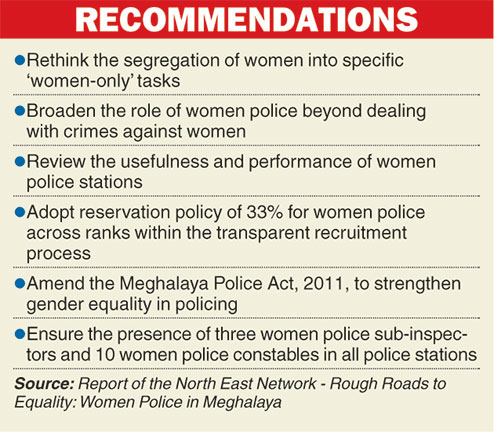

Shillong, Feb. 23: A report on women police in Meghalaya has recommended review of usefulness and performance of women police stations while senior police officers have called for scrapping the entire model.
Today, Meghalaya additional chief secretary K.S. Kropha released the findings and recommendations of the report prepared by the North East Network, an NGO, and the Commonwealth Human Rights Initiative.
The aim of the report - Rough Roads to Equality: Women Police in Meghalaya was to identify obstacles and challenges to women's entry into the police force, explore their functioning, their responsibilities and the degree of decision-making opportunities available to them.
Besides, it also aimed to identify trainings received by women police, future strategies, examine recruitment process, positions held, promotions and working conditions of women police in Meghalaya.
As part of the recommendations, the report suggested that the role of women police should be reconceptualised and broadened beyond dealing with crimes against women.
The report recommended a review of "usefulness and performance" of all women police stations following concerns raised by parliamentary committee reports.
"A majority of women police at present are deployed in all-women police stations in the state. Even when posted in regular police stations, women spoke about how they dealt with cases of crimes against women. This is not welcomed by many women who feel that this process actually deprives them of the exposure required should they be promoted in future," the report noted.
It said: "The rising rate of registered crimes against women in the state coupled with statutory obligations of the functions to be performed by women personnel in dealing with such crimes, mean that till the number of women personnel increases substantially, those in service will be engaged primarily with crimes-against-women cases," the report stated.
"The department should take note of the dissatisfaction brewing among women personnel and the strong desire for mainstreaming women's role in policing," it added.
The report noted that in Meghalaya where there are seven women police stations, such police stations are authorised to investigate cases, including serious offences such as murder for dowry.
The director of the North Eastern Police Academy, D.R. Doley Barman, while speaking at the launch of the report expressed her displeasure over women police stations.
"I do not agree with women police stations. We can do much more being part of the general police system. We are also no less than any policeman," Barman, a 1986 batch IPS officer of the Jammu and Kashmir cadre, said.
Meghalaya's senior superintendent of police (CID), Claudia Lyngwa, who was at the forefront in tackling militancy in the state, said women police officers can work alongside their male counterparts.
Meghalaya's special director-general of police, S.K. Jain, too said the establishment of women police stations has to be revisited. "Women police stations have neither increased efficiency and effectiveness nor public service delivery," Jain said.
As on January 1, 2015, the report noted, there were 489 women personnel in Meghalaya police, constituting nearly 4 per cent of the police force. Out of these, 11 were of gazetted rank and 478 were non-gazetted officers.
Out of the 489 women police personnel, 75 per cent are constables which is similar to the trend across the country where majority of the women police personnel are in the constabulary.
Moreover, 18 per cent have the ranks of investigating officers while only 2 per cent hold the rank of deputy superintendent of police and above.
"Like elsewhere in the country, the percentage of women police in Meghalaya too is nowhere close to the percentage of women in society," the report noted.
The report, while stating that Meghalaya does not have a separate cadre for women police, pointed out that improvement in infrastructure at police stations and barracks and providing accommodation to women police are required.
At the same time, the report suggested for the institution of the internal complaints committee as mandated by the Sexual Harassment of Women at Workplace (Prevention, Prohibition and Redressal) Act, 2013.