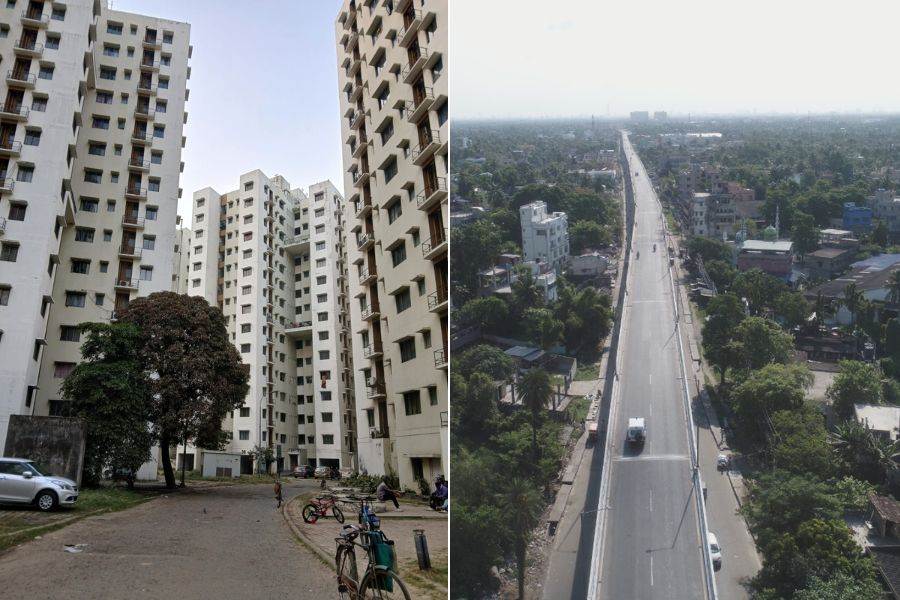
Calcutta Riverside was to be one of the most ambitious residential township development projects contemplated for Bengal. Covering 262 acres beside the Ganges in Batanagar, it was designed by six of the finest architects in the country.
And yet, the project collapsed.
Road connectivity was always the challenge when it came to development in Batanagar. All kinds of options were explored to connect Jinjira Mor to Batanagar. Finally, an elevated road, since horizontal widening had its limitations, was settled upon — that solution being agreed upon during the Left government's regime.
The project was sanctioned in 2012, after the change in the state government from the Left Front to Trinamool Congress. A tender was floated in 2013. L&T and Riverbank Developers came together, won it, and built the elevated road.
However, in March 2018, the government reversed its documented decision and said it would not permit tolling on the elevated road, leading to cascading problems for the project, and its eventual failure.
Mudar Patherya spoke to Sumit Dabriwala, the former managing director of Riverfront Developers, to understand what made the project remarkable, the reversal of a cabinet-level decision, and how it all fell apart. Excerpts from a conversation…
Q: Calcutta Riverside was one of the most ambitious residential township development projects contemplated for Bengal. What made it remarkable?
A: It was one of three projects of scale and vision contemplated in Calcutta (the others being Kolkata West International City and Hindustan Motors site in Uttarpara). Calcutta Riverside covered 262 acres beside the Ganges. We brought the reputed HOK for the master planning, and then assembled six of the finest architects in the country — Bimal Patel, Balkrishna Doshi, Aniket Bhagwat, Pramod Balakrishnan, Kiran Kapadia, and Dulal Mukherjee. The design process was probably the most documented master-planning exercise in the country. We also had an infrastructure consultant from Ahmedabad handle what was essentially a municipal-scale physical infrastructure exercise. The location, the design ambition, and the quality of thinking behind it — all of that made it genuinely singular.
Q: And yet it collapsed.
A: Road connectivity was always the challenge when it came to development in Batanagar. We began engaging with the West Bengal government early to address it. All kinds of options were explored to connect Jinjira Mor to Batanagar, one of the most congested roads of the city. This included a monorail, which was discussed at the highest government levels. But the cost per kilometre for a monorail was by far the highest within the spectrum of solutions. The workable alternative was an elevated road, since horizontal widening had its limitations. That solution was agreed upon during the Left government, which wasn’t otherwise enthusiastic about infrastructure spending. Through the Jawaharlal Nehru National Urban Renewal Mission, the central government was willing to fund a third of the cost. The state refused to contribute.They said that road building was unlikely to get them any votes, so why waste the funds? We proposed a tolling framework instead, arguing that existing and projected traffic on that corridor would be sufficient to repay the entire investment across the years. The project was sanctioned in 2012, after the change in the state government from Left Front to Trinamool Congress. A tender was floated in 2013. L&T and Riverbank Developers came together, won it, and built the elevated road.
Q: What happened thereafter?
A: In March 2018, the government reversed its documented decision and said it would not permit tolling on the elevated road. We continued construction (completed in November 2018) after being told that despite no tolling we would not be financially left in any difficulty. We invested Rs 185 crore of equity and quasi-equity and Rs 125 crore of debt (drew down much less than what was sanctioned as there was no time or cost overrun). More than 95 per cent of the project cost went to L&T (EPC contractor). Our books had no establishment or employee costs in the road company — we were not paid and we, in fact, subsidised the project.
Q: When did you first learn that the tolling of the elevated road might not be permitted?
A: The chief minister had organised a summit in Darjeeling. She was on a morning walk. I was four steps behind her when she called me to fall in step. She said ‘Kolkatar onno rastay toll tola hoi na. Amra ekhaneo toll nebo na.’ I started to explain that this had been a cabinet-approved decision, not something inherited arbitrarily from a previous government. She simply said ‘Tomar khoti hobe na.’ How do you argue this with the chief minister? Months of planning and a sovereign contract were written off in seconds.
We had already been in advanced conversations with several infrastructure and private equity funds to sell the elevated road — which is standard for these assets. Now no fund would transact until the toll has been formally notified. That notification never came. Later, at a meeting in Frankfurt — the CM had come from Rome following the canonisation of Mother Teresa — she convened a discussion with the chief secretary, the finance secretary, her principal secretary and the finance minister. Once again, I impressed on everyone that a solution needed to be found. I’d carried paperwork on a land parcel that could potentially have served as compensation for my company. But the officials present were not comfortable with land-for-infrastructure swaps. Nothing came of it. Now I was on the backfoot. My only recourse was that the CM had assured ‘Kono khoti hotay debo na!’ One lived in hope.
Q: What were the financial and legal fallouts?
A: The non-notification of tolling was effectively an event of default — the entire loan was predicated on it. When the loan was called back, it created a cascading effect. The road company was a subsidiary of the real estate company. We could not repay the debt or interest because we could not monetise what we had built. One default pulled everything down. I went to every political door I knew. I received eloquent expressions of sympathy, including from the chief minister. Nothing meaningful emerged.
The elevated road was inaugurated in January 2019. A committee was constituted in October 2020, which came to nothing. I had no option but to go to court. We are currently in the Commercial Court at Alipore, but the IBC process for the real estate company has complicated the pursuit of that litigation — because once an insolvency process commences, the resolution professional takes over, and I lose the ability to independently pursue the case. Canara Bank has not been forthcoming with the funds legally required to keep our company operational. Lawyers didn’t get paid and personal relationships only carry you so far.
Q: Did the government acknowledge that it was principally responsible for your company’s collapse?
A: The government is never an individual. Individuals within it may have said things privately. At the end of the day the government is an amorphous, multi-headed hydra — expressing remorse is almost an impossibility for it. I went to the chief minister personally, more than once. The response was always sympathetic language and platitudes. After a point, I stopped going. It was incongruous to maintain a personal relationship in the face of this extraordinary adversity.
Q: Many people blamed you personally rather than the government.
A: I have to assume responsibility for the decisions I made. I recommended this course of action. My confidence in the administration was completely misplaced. But there are two dimensions to this. One is the human dimension — my trust in the people involved was completely wrong. The other is institutional — my faith in the sanctity of a sovereign contract. When I describe this story outside Bengal, people are incredulous. They ask, how is it possible that one conversation can turn an extraordinarily successful business and a well-received development of this scale into dust? But people who live in Bengal understand. This is how things happen here.
Q: The irony is that the elevated road between Jinjira Mor and Batanagar is a showpiece that has reduced a half-an-hour drive to only around eight minutes.
A: Canara Bank told me that ours was probably the only infrastructure project in their portfolio that was delivered without delays, without cost overruns, and without public protest. My financial sanction was Rs 131 crore; we drew down only Rs 125 crore. To facilitate the road building, a temple deconstructed its forecourt. A mazaar voluntarily shifted. More than 500 shops moved themselves further inward.
Even as we were building the elevated road, the government decided to simultaneously replace the main water supply line — an extraordinary thing to do on such a constrained alignment. But we worked through it, with KMWSA, with CESC, navigating unmapped high-tension lines beneath the Budge Budge Trunk Road. No noise, no scandal, no delays. Other projects in West Bengal — much smaller ones — have seen extraordinary disruptions. Here, nobody said anything. It was built with consensus, with community support, and the road worth Rs 350 crore turned out to be a complete gift to the government.
Q: Was the tolling model financially sound?
A: Absolutely. This wasn’t just our assessment — Simplex Infrastructure had also bid for the project independently. Two of the largest infrastructure companies operating in Bengal at the time both found it commercially viable. We were also Rs 8 crore below the benchmark cost of Rs 50 crore per kilometre that L&T had indicated at the outset. The road was scientifically constructed. The funds we were in conversation with were sophisticated investors with long infrastructure track records. It would have worked.
Q: Are you hopeful about where this may end?
A: My priority now is to help ensure the IBC resolution for the real estate development reaches finality — ideally within two months. The resolution professional is Ashish Chawchharia from Grant Thornton, who handled the Jet Airways resolution — extremely seasoned. The resolution applicants are respected organisations. Three things will come from a successful resolution: buyers who paid for apartments in Hiland Greens will finally receive their homes; the banks will be paid; and the resolution applicant will take over the remaining land and develop it. What is currently a somewhat abandoned property will be transformed.
When it comes to being compensated for the road, I don’t have answers yet. What I want now is to be able to walk away from this situation with as much of the debt resolved as possible, and with my conscience clear about the people whose lives were caught in the middle of all this.
Q: With the benefit of hindsight, would you have done this at all if given a chance?
A: Honestly no. Not just because of the road. But because 262 acres anywhere else in the country would have produced dramatically different financial outcomes. Calcutta sells roughly 16,000 apartments a year across the entire metropolitan area. Greater Mumbai, in a smaller geography, sells 160,000. When you price-correct, Calcutta’s share of national real estate consumption is a rounding error. We’re not even in the top 10 Indian cities.
Layered on that demand deficit is a regulatory environment that remains non-transparent and rent-seeking. Why should building anything require friendships with politicians and bureaucrats? Why is there no clean, transparent framework? That combination — weak demand and opaque governance — is what makes this market so unforgiving. The road was the final blow. But Bengal itself was always the deeper constraint.
Q: I am going to pick on that last line.
A: Let me explain. I am personally aware of a central government sanction of Rs 2,200 crore for a project to decongest Santragachhi from the Vidyasagar Setu all the way to the NH2-NH6 junction through elevated roads; 90 per cent of that project cost was to be paid for by the government of India, and only 10 per cent by the government of West Bengal. This is where it gets shocking: the government of West Bengal refused to make that 10 per cent contribution to the project and effectively let that Rs 2,000 crore grant go down the tube. Who suffered? Citizens! If only the Bengal government could have been a bit more open in its mindset the city of Kolkata and the state of West Bengal would have been different!