“Being wrong is part of the nature of being any kind of scientist” — these were Nobel laureate Abhijit Vinayak Banerjee’s words at a Kolkata event where he reflected on his decision of choosing to revise a book more than a decade after its original publication.
The book Poor Economics, which Banerjee wrote along with his wife, economist Esther Duflo, came out in 2011. He has now revised it.
Emphasising that economics, like any other discipline, does not deal in final truths, Banerjee said that revisiting old assumptions was not a failure but an essential part of “intellectual honesty”. “You never really get to the truth… You're always making a hypothesis, testing it, sometimes learning that your hypothesis itself was not sophisticated enough and refining it,” he said.
The 64-year-old economist was speaking at the epilogue session of Exide Kolkata Literary Meet 2026 on Tuesday at Alipore Museum.
Banerjee discussed how development economics has changed since the book Poor Economics was first written 15 years ago. He also addressed the challenges that continue to shape poverty, inequality and labour outcomes in India.
Banerjee reflected on the primary theme in Poor Economics – poverty has long been misunderstood through rigid and often moralistic frameworks. He said the idea of a fixed hierarchy of needs — food first, pleasure last — is psychologically unrealistic.
“The idea that someone should reconcile themselves to a life with no particular high point for 40 years because they are poor is simply not how human beings function,” he said.
Schools, Banerjee said, have increasingly turned into “factories for taking tests”, training children primarily to perform well in examinations rather than training them with life skills.
He said the obsession with test scores stems from a larger systemic failure. With limited job opportunities and intense competition, Banerjee noted that the country has created a “pressure cooker” environment, where aspirations outstrip available job opportunities. “When people don’t get the jobs they are chasing, they are angry,” he said.
Banerjee was awarded the 2019 Nobel Memorial Prize in Economic Sciences for his pioneering, experimental approach to alleviating global poverty. He shared the award with his wife Duflo and colleague Michael Kremer.
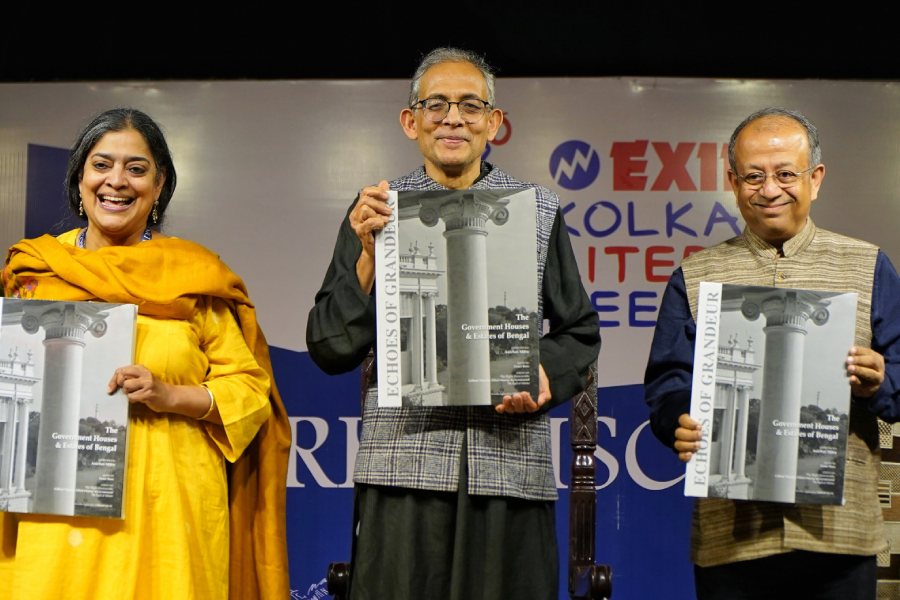
Banerjee, alongside Vikram Scholar Pvt. LTD’s managing director, Gyanesh Chaudhury, Alipore Museum’s director, Jayanta Sengupta and Kolkata Literary Meet director, Malavika Banerjee, launched the book Echoes of Grandeur.
Documented by Anirban Mitra, the book explores the architectural heritage of Bengal's colonial-era buildings.