On a winter morning at the end of December 2025, my phone rang with a call I did not expect.
The booth-level officer (BLO) assigned to my area told me a hearing letter had been issued in my name for the special intensive revision (SIR) of electoral rolls, and that I would have to collect it from my polling booth within two days.
The call was brief, procedural, unsettling.
I no longer live in the area where I am registered as a voter. I live in south Kolkata since 2022, while my polling booth remains in north Kolkata.
Until now, voting had always felt like a right I simply exercised. Suddenly, it felt like a right I had to account for.
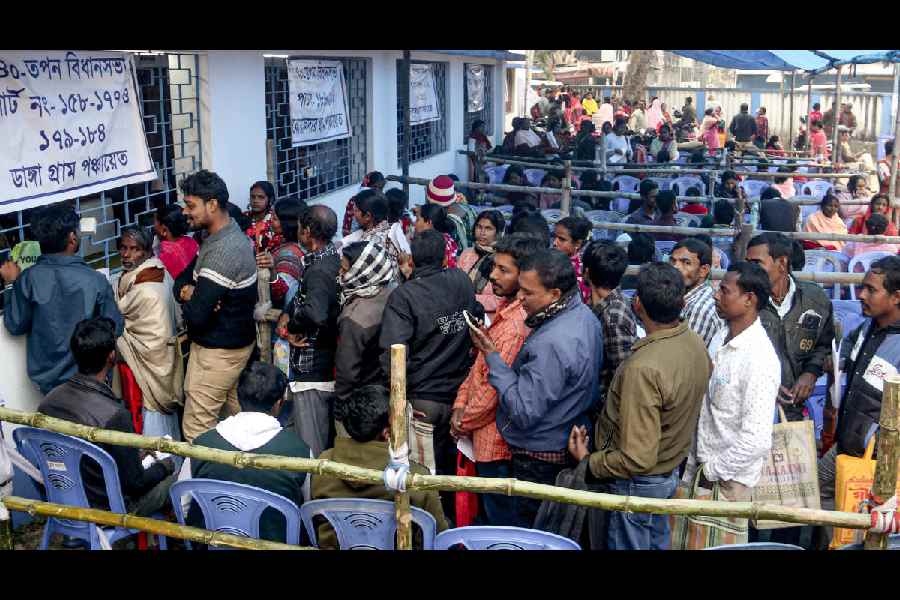
I went to collect the letter the next day. The polling booth, in north Kolkata, was already busy. Local political presence was impossible to miss. The Trinamool councillor of the ward and several party workers stood outside, offering to “assist” voters who had been summoned.
They noted down names and part numbers of those arriving to collect hearing letters. Inside, the process moved fast. I was handed a letter and was asked to reappear on 2 January, 2026, after 11am.
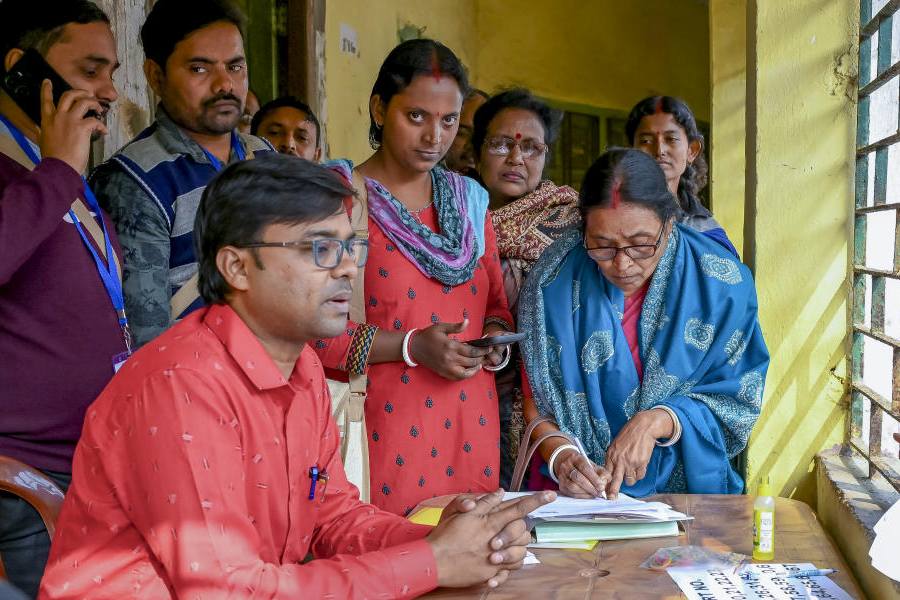
On the day of the hearing, the community hall designated as the centre was already filling up fast when I arrived. Four long tables were arranged along one side of the room.
BLOs and Election Commission officials sat behind them, stacks of files and forms spread out, while plastic chairs faced them for voters.
A volunteer handed me a token. Number 7. I sat down and waited, watching the room steadily fill with people clutching folders, envelopes and plastic bags stuffed with documents.
The woman who sat beside me looked to be in her late 60s. She held a worn plastic carry bag filled with papers and photocopies. She told the man next to her that she had been called for a ‘mapping’ issue.
Her name did not figure in the 2002 rolls, and she had not been able to adequately link herself to her parents through documents.
Her family, she said, had once lived in Kolkata, but moved to Surat in the 1990s. She stayed back with her husband. Her brother had died. Her nephews lived in Surat. The BLO had asked her to find out whether they had completed the SIR process.
“I am not in touch with them,” she said softly. “But I am trying.”
Another woman, younger and visibly anxious, joined the conversation with a laugh. She said she had eloped years ago and settled in Kolkata. She had a marriage certificate, a newly issued voter ID and Aadhaar. Nothing that linked her to her parents.
“I don’t know what I’ll do if they ask for parental documents,” she said.
Mapping issues, it became clear, were at the heart of many hearings that day. My own case was different, but similar too. The absence of paperwork from the past.
My father left Ranchi, then in Bihar, in 1994. Voter cards were introduced around that time. Life intervened. Marriage, work, children. He finally got his voter card made in 2018. My mother never got one and passed away in 2016 without ever voting. Their neglect had landed me here.
The hearing letter had listed 11 indicative documents, any three of which could be submitted. I carried my Kolkata Municipal Corporation (KMC) birth certificate, my Class X admit card and my passport. Many others in the room were not as prepared.
One woman stood helpless as the BLO read out the list. She had nothing to offer.
The hearing letter listed an indicative, though not exhaustive, set of 11 documents that could be submitted for self, father or mother. These included identity cards or pension orders issued to government employees or pensioners, identity cards or certificates issued by government or local authorities, banks, post offices, LIC or PSUs prior to 1 July, 1987, birth certificates, passports, matriculation or educational certificates from recognised boards or universities, permanent residence certificates issued by state authorities, forest rights certificates, OBC, SC or ST caste certificates, the National Register of Citizens (NRC) where applicable, family registers prepared by state or local authorities, and land or house allotment certificates issued by the government.
Aadhaar could be considered subject to Election Commission directions, along with extracts from the Bihar SIR electoral roll with reference to 1 July, 2025.
When the young woman’s turn came, the BLO asked if she had any school certificate. She hesitated, then asked if a certificate from a tailoring school would count. The BLO consulted a senior officer.
They discussed her case seriously, without dismissal, trying to find a way forward.
My token number was called soon after. I signed the attendance register. The officer checked my documents and forms. There was a pause when my father’s details came up. “Was there a problem linking his documents,” she asked. I nodded.
A senior officer leaned in and asked if my father had a passport or Aadhaar card. He did. I was told to get printouts, as I only had digital copies.
I stepped out, found a nearby photocopy shop, and returned within half an hour. The documents were accepted. A photograph was taken of me standing beside the officers. When I asked why, the BLO explained it was proof that I had appeared physically for verification.
The process, from start to finish, took about an hour and a half.
As I packed my papers, one of the officers stood up, excusing herself for a quick break. “I have come straight from the school, and had not eaten since morning,” she said. It was already past 1pm.
The comment stayed with me. Amid the anxiety and uncertainty inside that hall, there was also relentless work being done by officials navigating an overwhelming process.