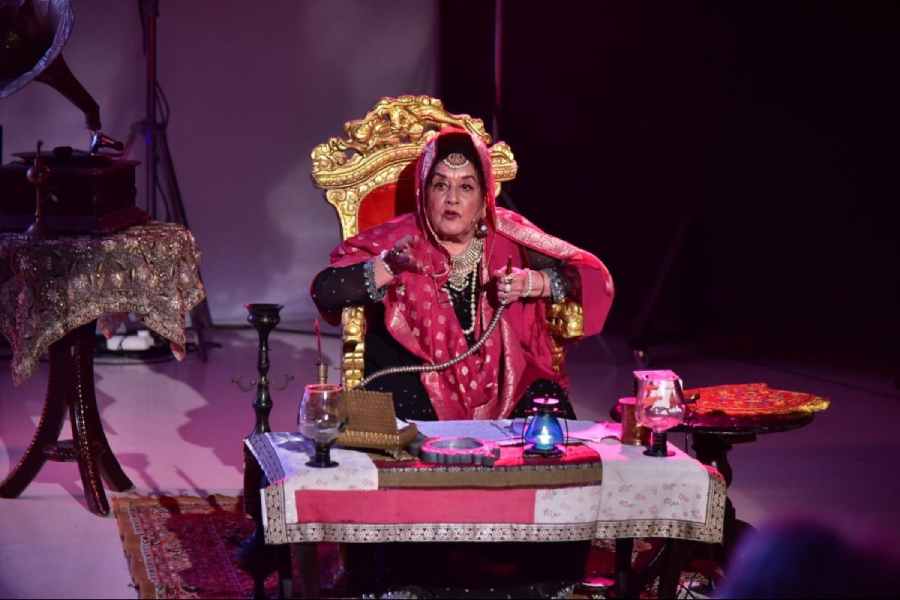
A courtesan from Calcutta’s Chitpore district in 1881 was in the foreground of the play, Gulabijaan, staged at the Kolkata Centre for Creativity recently. The work addressed the erasure of the tawaif as a fallen woman and attempted to reclaim her status as an artiste-practitioner of Kathak, thumri and ghazal, all forms that have survived through them. It also attempted to interrogate the dominant historiographies that
sanitised the art forms by invisibilising the carriers of these arts.
Using the device of the memoir, the play engaged itself with how colonialism and, later, nationalist bourgeois politics drove away the arts from the individuals who sustained them. From a woman of agency who had control over her destiny and the right to write her own narrative, she was summarily stripped of her social context. The piece intended to return her arts to her, while acknowledging her resilience, dignity, talent and accomplishment. However, in its commitment to restore cultural legacy as lived reality, there was an attempt, as is often the case, of ideological overcorrection. In the throes of ardent reformist anxiety, the playwright positioned the tawaif as a tragic figure whose love is forever unrequited and whose role must be redeemed by her participation in the nationalist struggle. In all of this, her value as an artiste is reduced manifold.
Gulabijaan sets out to integrate dance, music and theatre, but the synthesis remains uneven. Signs of inadequate rehearsal undermine the production, which manages to stay afloat on the strength of a few robust performances. Shukla Banerjee’s script
is choppy, although it is rescued, intermittently, by Pamela Singh’s powerful singing and energetic stage presence. Ramandeep Kaur’s dancing brings joy, while Moumita
Mitra stands out as a dependable singer-actor in an otherwise inconsistent ensemble.
An electronic tanpura, a spiral-bound exercise book used for Gulabijaan’s memoirs, and the inclusion of Faiz Ahmad Faiz’s nazm, “Hum dekhenge”, which would be written in 1979 by a poet who would be born in 1911, were among some of the production’s indefensible anachronisms.