The test of art is infection, Leo Tolstoy had argued in his book, What is Art? That is a test that all the participants of Outsider Art (on view at CIMA Gallery till May 2) passed with flying colours. Tolstoy held that art is the transmission of feeling from one person to another and an artist, therefore, is someone who successfully communicates a genuine feeling. CIMA’s exhibition brings together a group of individuals whose creative instincts exist outside the chains of formal training but who deftly communicate a moment of lived experience.
Take, for instance, the digital paintings by the entrepreneur and art connoisseur, Dilip De. Bold, solid swathes of colours come together in the stunning way in which clashing shades co-exist in nature. Amartya Mukherjee, a chartered accountant, on the other hand, lets nature do the talking by using his lens to capture majestic landscapes and beasts and birds in their elements. Kanak Sharma’s watercolours are simple and neat as postcards that convey the traveller’s wonder at not just natural beauty but also architectural marvels. The graphic designer, Anjana Dutt, shows equal skill with colour pencils as she does with a mouse when it comes to drawing creatures big and small. Her use of black negative space as a background for her natural settings makes the colours pop.
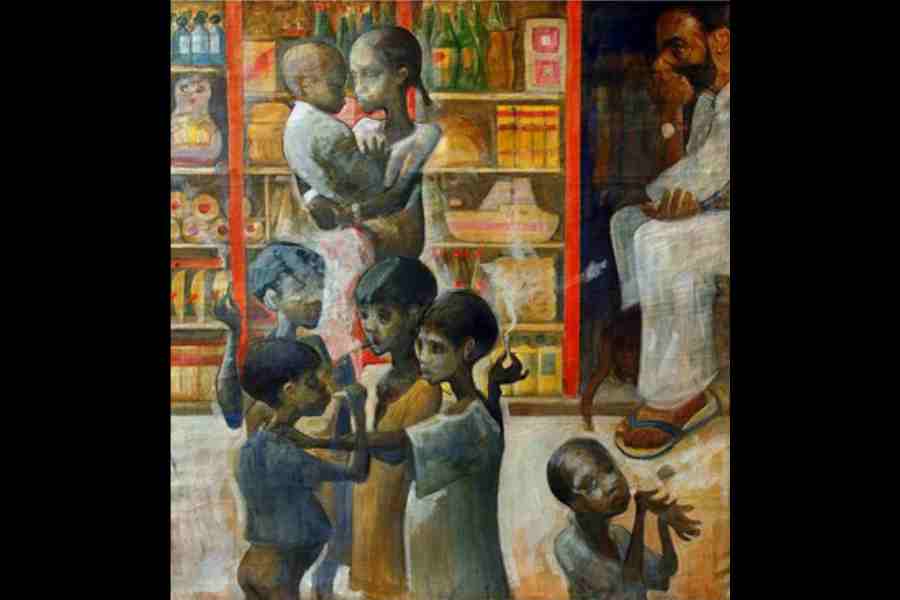
The two watercolour pieces by the danseuse, Amala Shankar, might not have been large in size but the drama that they reproduced was larger than life, evoking the lavish sets and the lights of Uday Shankar’s style of dance theatre. Her unique approach of using her fingernails to etch lines with watercolours created scenes that seem to be flooded with divine light. Upendrakishore Raychaudhuri’s monochrome illustrations from the Hindusthani Upakatha series were as charming as they were detailed in their characterisation. Ranjitsinh Gaekwad’s Street Urchins, where a man in a shop full of novelties watches impoverished kids on the street smoke and play, the allures of his shop beyond their reach, was not just technically remarkable but was also incisive, self-deprecatory social commentary (picture, left). The geometric approach of the musician, Ayaan Ali Bangash, to Ganesha playing the sarod used colour blocking to striking effect, evoking a sense of energy reverberating around the deity.
The businessman and art collector, Pradip Bothra, used palette knives to create textured oil paintings that question whether painting can ever truly reflect reality. Lalit Mohan’s paintings hover somewhere between realism and abstraction, breathing vivid life into the mechanical. The activist, Ruchira Gupta, brings a child-like wonder and enjoyment to the pursuit of art in the paintings of her garden, whereas the chief minister of West Bengal, Mamata Banerjee, expresses a simple yet animistic spirit where her subject appears alive and charged with presence. A similar vitality animates the stoneware by the film-maker, Ranajit Ray. The actress, Moon Moon Sen, is an astute
observer of the female form, while her daughter and actress, Riya Sen, can look beyond external form at the internal whimsy of human beings. Whimsical is also the perfect epithet for the intricate, vivid and bold portraits by the fashion designer, Bobo. The jewellery designer, Saba Ali Khan, brings the same eye for detail to her floral sketches as she does to her jewellery whereas Sanjay Ghosh’s digital graphics border on the surreal.
Aparna Sen’s black and white photographs are a testament to her eye for the interplay of light and shade, while Soumitra Chatterjee’s dense cross-hatchings — reminiscent of Tagore’s style — establish the late actor as an astute observer of human idiosyncrasies. But it is the landscapes (picture, right) by Sankarshan Thakur, the former editor of this paper, that left the deepest mark on this reviewer, not just because of their technical acuity or their ability to convey the artist’s sense of wonder but because they were a reminder of why art can continue to carry the soul of the artist long after the latter is gone.