Through most of the year, it is an unremarkable lane off Calcutta’s Central Avenue. One of many narrow arteries running at right angles to the main road, easy to miss if one is not looking for it. But twice a year — in December and again in the run-up to Poila Baisakh — Calendarpara stirs awake.
With the Bengali New Year only days away, the lane just north of the Mahatma Gandhi Road crossing near Mechhua Bazar hums with orders for the year 1433. Inside a shop, a veteran salesman leans over a counter to help a younger assistant struggling with an order.
“Add seven to the last two digits of the English year and you get the Bengali one. Twenty-six plus seven, see?” he says softly, as if passing on one more rule of a trade built on repetition and memory.
Yet for all the seasonal bustle, business is no longer what it used to be.
“A few decades ago, at this time of the year I would not have been able to stop and speak to you,” says Sheo Kumar Chandak, who entered the trade as a college student 35 years ago and today runs his own outlet near the mouth of the alley.
“We lived on cha and biscuit through the day because there was no time to stop. Customers from the districts would begin arriving from late March. There were only seven shops then. Now there are 70.”
The number may be an exaggeration, but not by much. Shops have indeed multiplied, often started by former workers. “Even those who did mounting earlier have their own businesses now,” Chandak says without complaint, but with an air of resignation. Mounting refers to the physical finishing and assembly processes a calendar has to go through before it can be displayed, be it on a wall or a desk.
The business pie itself has shrunk even as more hands reach for it.
Once, sourcing a wall calendar or two on Poila Baisakh from the jeweller or sari shop was part of the season’s small triumphs for a household. Not any more. Calendars hung in kitchens, above telephones, beside almirahs — that habit has faded.
“People now live in smaller flats, with less wall space. And many avoid hanging calendars because the metal strip leaves marks on the wall,” says Somnath Chatterjee, joint partner at Ad Wings. He describes his business as “the lane’s only Bengali-owned outlet”. Like many others here, he too began as an employee before branching out after 18 years.
Printing costs too have risen sharply. “At one time, in peak season, business could touch ₹3-4 lakh in one day. Today, costs have tripled,” says Chandak, lifting a glossy plastic sheet from a stack. “This crystal variety costs ₹43 per sheet. Printing is done in Delhi, and the material comes from Gujarat.”
At Oswal Imprint, among the largest and oldest retailers in the lane, the costliest variety — called “mirror” — is priced at ₹45 for a 20x30-inch sheet. Its glazed finish lends the glitter effect to the ornaments on images of deities.
“It sells for close to ₹60 after mounting,” says Nathmal Agarwal, who has worked here for 53 years. The next grade is chamki, then comes the plainest of sheets that costs even less. But the cheapest wall calendar with a picture cannot be sold for less than ₹18 or ₹19.
Such prices have altered buying habits. “For the English New Year, corporate orders still support the costlier varieties. For Bengali New Year, most orders come from shopkeepers who want the cheaper ones,” he says.
To adapt, the market has split in two directions.
One is the panji calendar — stripped of decorative imagery, carrying only dates in bold, along with basic almanac references such as purnima, amavasya, ekadashi and ritual markings. Even here, customers now negotiate size before design.
“Do you have one in a smaller size?” two young men ask Chandak. Without missing a beat, he produces a catalogue of 26 varieties. “We make calendars from 11x18-inch to 4.75x7.25-inch,” he says, as the visitors — from a club in Nadia — settle on 100 of the smallest size.
“Just 100?” Chandak mutters, his face falling briefly before he notes down the club name to be printed on top. “Such orders are hardly worth taking. But if we don’t, someone else will.”
The second direction is newer, desk calendars. “Earlier, these were only for the English New Year. For the last 10-15 years, Bengali desk calendars too have become popular,” says Chatterjee.
Among the “dependable” customers are sweet shops, sari stores, jewellers, fish traders, paan wholesalers, furniture dealers and paddy merchants, many of whom gift calendars at harvest time.
Subodh Saha, who works with Chatterjee, remembers a time when calendars began not on computer screens but on drawing boards.
“Artists would paint samples and bring them to us. Once chosen, the image went to a cameraman. Their negative film became a positive for offset printing,” he says. “Now artists who made calendar art are gone. It is all computers and plates. Machines today can print seven to eight colours.”
The shop has even experimented with artificial intelligence (AI) this year, producing a desk calendar featuring Radha-Krishna generated with AI-assisted imagery. “If this sells well, we may commission more AI illustrations,” Chatterjee says.
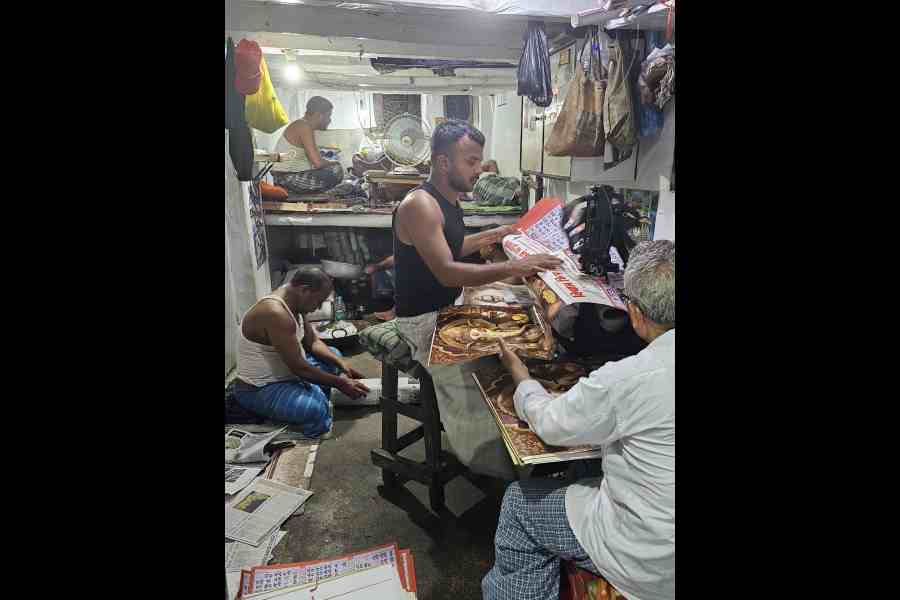
Yet one part of the process has refused to modernise. Across the lane, in a single-room workshop, Mohammed Irrafir mounts calendars. A thread is positioned at the centre, beneath the printed sheet, then a lever is pulled to clamp a strip of tin around it. The sheet moves to another table where the pages with dates on them are pasted, and then placed under a manually operated stapling machine.
“The sheets come from offset presses in Sealdah through the retailers, along with bundles of date pages. We charge one or two rupees for mounting,” he says, chopping vegetables for the evening meal beside the machine, while finishing a Ram-Sita calendar order for a fishery in Chakdaha.
When asked which images are most in demand, he says without looking up, “We work with all the gods.”