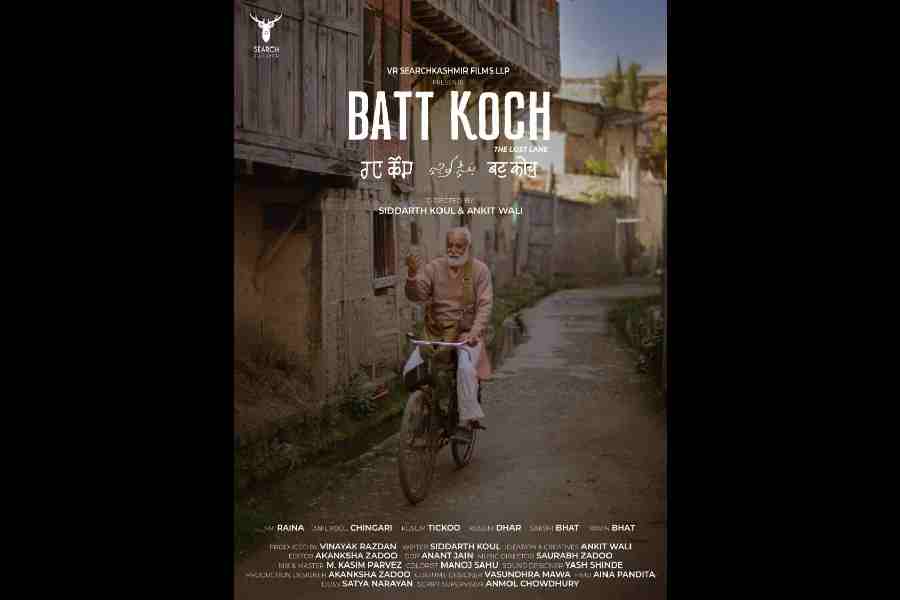
For Siddarth Koul and Ankit Wali, the only way to a home they had never known outside of community nostalgia was through a film. So they made one. And that’s what Batt Koch, a Kashmiri language film, is to many among its cast and crew, a journey homeward.
Batt Koch premiered in 2025 and is currently making the rounds of film festivals across the world.
The film itself is about the Kouls, a Kashmiri Pandit family living in Jammu. The Kouls have been trying to visit their ancestral home in Kashmir for the past 35 years but something always gets in the way. And then one day, a plan finally comes together and the journey begins.
Batt koch means the gully of the Kashmiri Pandits. The journey to Kashmir, even if it was just for the shooting, was memorable for the team of 40 Kashmiri Pandits. Most of them belong to a generation that has never lived in Kashmir, and only visited, if at all, fleetingly.
The 77-year-old theatre actor and director M.K. Raina, who plays the patriarch Poshkar Nath Koul, tells The Telegraph, “I never realised that some of these young people — the boys who made the film — had never been to Kashmir.” He continues, “As we were driving up from Jammu, the mountains started looming into view and they seemed to be in such awe.”
Almost half the film was shot in Jammu and the other half in Kashmir. Some of it in Pahalgam and the rest in the Khar Mohalla of Anantnag district. In between shoots, locals would approach the cast and crew and chat, they would ask them about their Kashmir connection, where from, which kadal, which lane, which neighbourhood…
Not too far from where they shot in Anantnag is the Mattan Temple, which Siddarth’s grandmother would often visit when they lived there. The temple features in the film as well, if only in anecdotes.
As shown in the film, a piece of the lost homeland always lingers in the Koul household. In their radish chutney served with dinner, in the songs the women hum while watering plants and making rotis, and in the soft tunes that drift from grandfather Poshkar Nath’s radio.
Sakshi Bhat, who plays Poshkar Nath’s granddaughter, says, “My family lived in Kulgam district and we were one of the last ones to leave in 2000. I was in school and I still have a vivid memory of our village. It would have been only one or two hours away from where we were shooting.”
Ankit speaks of a Vikas bhaiyya, his distant relation and one of the few Kashmiri Pandits still living there. “We shot the final scene in Vikas bhaiyya’s house,” says Ankit. “His house too is in shambles. He lives in one room and only one window frame is painted,” he adds.
None of the younger lot went looking for the home that lives on in their parents’ and grandparents’ anecdotes; there was a deadline to meet after all. But more than one person told The Telegraph that the knowledge that home was somewhere nearby felt just about enough.
Raina does not have a home in Kashmir but he never left the place either. “I kept going back to Kashmir since 2000. The violence had wiped out all forms of culture in the Valley. There was no cinema, the theatres were burnt down. I kept working with Kashmiri youth in remote villages and small towns, in the hope of reclaiming our culture.”
Ankit never could manage to visit Kashmir while growing up. He says, “It got to a point where I resolved that if I ever visit Kashmir, it will be to shoot a film.” Siddarth adds, “When we were growing up, it was always a struggle to visit Kashmir. We would try to visit every two years, but often we had to cancel because of disturbances in the region.”
Raina says, “In the film, you won’t see the Kashmir that tourists visit. You will see neighbourhoods of Kashmiri Pandits. You will see broken and abandoned houses. And you will see people living their lives the way they do in any other part of India.” The film ends with Poshkar Nath finally finding his way back to his old house.
The goal was to create something that contributes to the Kashmiri-language film industry,” says Siddarth. “We have many talented artistes, yet nothing new is ever created.”
The characters in Batt Koch too hold on to the old; they play Kashmiri folk songs again and again and again.
The film has two original songs. One is called Woth Batni, which means wake up. Batni is the word for Kashmiri Pandit women. The other song is Katye Tshandakh, which speaks of the search. The lyrics haunt — “Where will they find the shade of chinar trees?”
Batt Koch premiered at the International Film Festival of Srinagar. It was screened at the city’s Tagore Hall. Siddarth says, “The audience was mainly Kashmiri Muslim students. And they were in tears.”
Raina points out that Batt Koch is one of the few films in recent years in which Kashmiris are telling their own story. “So much of Kashmir has been exploited. Whether it’s the filmmakers of Bollywood with high budgets or the journalists, they always come with their own narratives and leave the real Kashmir behind,” says Raina. “Our film does not point an accusing finger at anyone.”
Batt Koch makes no grand political statement. It talks about raliv, galiv and tchaliv, meaning merge with them, leave the Valley or die — the three options Kashmiri Pandits were faced with. But it is also careful to establish that only “intentions can be wrong, not someone’s religion”.
The film has been screened at over 10 locations in India. It has also travelled to the US, where the audience comprised mostly Kashmiri Pandits. Ankit jokes, “You can find Kashmiri Pandits anywhere. You can find them even where there are no humans. We are omnipresent.”