 |
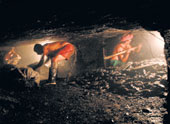
| BELLY OF THE BEAST: Safety norms are rarely adhered to in mines and quarries |
Lal Kuan, or the red well, is where they live. And the place could well be a metaphor for their lives. For the abyss into which the workers have sunk is coloured by their blood. The stone crushing industry in the rocky area, a little distance from the Qutub Minar in south Delhi, has been a source of their livelihood and the cause of their deaths.
“The entire area was covered with stone dust when the quarries were operational. An outsider would have found it difficult to stand here for five minutes. Yet we lived and worked here,” says Devender, who started going to the stone quarries with his parents as a child. The effects were evident much later. People developed silicosis. But it was diagnosed as tuberculosis at that time.
Devender’s woes are now in court. A writ petition has been filed by the New Delhi-based People’s Rights and Social Research Centre (Prasar) in the Supreme Court. And a hearing is scheduled for July.
Prasar president S.A. Azad smelt trouble when he saw the high rates of mortality among the workers, and the fact that those supposedly suffering from TB seldom recovered from it. But by the time the first diagnosis for silicosis from the area came through in 2002, many had already perished. As of now, there are 17 confirmed cases of silicosis ? 16 of whom worked in the stone quarries.
Panni Ram, for instance, was repeatedly diagnosed with TB for the last 30 years. Recent tests confirmed that he suffers from silicosis. Those with silicosis complain of shortness of breath, cough, fatigue, loss of appetite, chest pain and fever. Workers exposed to dusty environments develop cold, cough and sneezing within five to six months of joining work. The disease is preventable if the exposure is reduced.
The problem partially springs from the fact that neither the Factories Act nor the Mines Act covers the contract workers in the quarries. “Since the workers employed in the mines are essentially employed by contractors, employment-related diseases can easily be shrugged off by both the employer and the contractor. The former can plead that he was not responsible as the work had been given out on contract. The contractor too says that as these were contract workers he was not responsible for them. So the safety norms are not adhered to,” says Bipin Mathew Benjamin, a lawyer at the New Delhi-based Human Rights Law Network.
Realising the lacunae, Azad, who went to Lal Kuan in 1999 as part of a programme to educate local children, approached the National Human Rights Commission in June 2003, highlighting occupational hazards among workers employed in stone quarries, mines, and other construction activities at Lal Kuan. He referred to the high prevalence of silicosis and asked for directions for investigation into the problem, its prevention, treatment, compensation and alternate employment.
It is a progressive disease and has no cure,” says Bedoshruti Sadhukhan, an environmentalist at Human Rights Law Network. Moreover, silicosis is not confined to Lal Kuan but is a widespread problem. The Jodhpur-based Gramin Vikas Vigyan Samiti examined 288 workers in the sandstone mines in Jodhpur in 1996 and found that 42 per cent suffered from silicosis. According to one estimate, up to 800,000 workers might be affected in Rajasthan alone.
Rajeev Gupta, owner of one of the stone crushing units in Pali, stresses that the industry is doing what it can. “We have put water sprinklers and given face masks to the workers for protection,” he says.
However, activists say that by and large, the safeguards are ignored. This despite the fact that in the Bandhua Mukti Morcha vs Union of India (1984) case, the court had ordered the central government and the government of Haryana to take steps to ensure that quarry owners adopt safety devices such as keeping a drum of water above the stone crushing machine with arrangements for continuous spraying of water upon it or installation of dust sucking machines. The directions of the court on medical treatment and compensation from authorities have not been implemented either.
This is also not the first time that activists have gone to court with regard to the Lal Kuan problem. In 1985, a writ petition was filed with the Supreme Court to stop the pollution of air in Delhi caused by the stone crushers operating in Lal Kuan and nearby areas. Subsequently, the apex court ordered the closure and the shifting of the stone crushers from Lal Kuan to a new “crushing zone” at village Pali in Haryana.
The present writ filed by Prasar “wants the government to form a high-level committee to investigate the incidence of occupational disease among residents of Lal Kuan,” says Benjamin. “The committee should comprise the secretaries of health and labour, the director of the Central Pollution Control Board, an expert working on the field of occupational disease, and an expert from an NGO,” he adds.
The writ also wants proper and mandatory guidelines for the operation of crushers, quarries, etc, and for the prevention of silicosis. Moreover, state governments should be directed to formulate stringent occupational exposure limits and technical standards for silica under Section 41-F of the Factories Act, and take steps to compensate and rehabilitate victims and their families adequately.
It now remains to be seen how the apex court responds to this human tragedy being played out in the quarries around Lal Kuan.