 |
 |
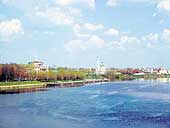
| Reliving the past: Tver in Russia, and (below) the route Nikitin followed to reach India |
Phalguni Matilal admits he had never heard of Afanasy Nikitin — despite being a student of history — until Hari Vasudevan, professor of history at Calcutta University and a friend, brought up his name during a conversation aboard the Delhi-Calcutta Rajdhani Express about a year ago. Last Tuesday, the two, accompanied by a team of 12 other people from varied walks of life, took a flight out to Moscow to try and retrace the path taken by the solitary traveller more than 500 years into the past. And one of the greatest journeys ever made during the medieval ages is about to be done twice over.
It’s a long sojourn, through a host of countries across a rarely-explored stretch of Central Asia, fraught with political tension, inhospitable terrain and stringent thoroughfare rules. Nonetheless, the party is giving it a go with untold zest — it returns to India 35 days later, only to reassemble in the space of a month to embark on a second trip within the country, and round off a trip its members feel will throw up several interesting facts that have been never been unearthed.
Nikitin, for starters, was a Russian businessman and traveller of the 15th century who, for reasons not quite clear to scholars today, set out from his native town of Tver in Russia to travel — aboard ships, on horseback and sometimes even on foot — to reach India in 1471. He lived in India for three years, dividing his time between the Vijayanagar and Bahamani kingdoms of south India and planned to return to his homeland in 1474.
Eventually, he couldn’t make it back to Tver and died in the town of Smolensk, a few hundred kilometres away, in 1475. However, Nikitin wrote — during his odyssey — an account of the trip called ‘Voyage over the Three Seas’, which disappeared with his demise, only to resurface, in fractions, in the early 20th century. It was only then that a treasure trove of information on medieval Indo-Russian links and the Central Asian terrain became accessible to academics, providing them with fodder for several kinds of research that continue to date.
It was essentially historical curiosity that prompted the Indian party to follow in Nikitin’s footsteps, says Vasudevan, the brain behind the mission. “There are several unanswered questions about the trip,” he points out. “What exactly did a Russian see in India that he made such a long journey to this country? If business was a motive, why would Russians want to invest here? Our journey could help us find answers to these questions, and thus give Indo-Russian relations newer dimensions beyond our Communist legacy and anti-imperial outlook.”
The party includes experts who would be able to glean information in the course of the tour and throw more light on bilateral issues in their respective domains. Oil expert Sudha Mahalingam, political analyst Ramakant Dwivedi and Kathak dancer Sharmishtha Mukherjee thus came on board, as did journalist Sunrita Sen and photographer Ashok Dilwali for documenting the journey down to the last detail. Besides, the party also went on to include auto experts, doctors and a team of filmmakers to produce a televised feature of the expedition for airing on television.
Organising such a mammoth journey, however, had its nuances. Arranging for permits to travel through six countries across the Caspian, Black and Arabian Sea; raising funds; planning out the logistics — these were crucial aspects that needed to be worked out before the party could even think of setting out. That’s where Matilal came into the picture. A former bureaucrat, the 67-year-old traveller — who did a similar trip while exploring the silk route from Tashkent to Delhi in 1996 — says it took nearly a year for the expedition to be arranged. “To interpret the ancient journey in a modern context is a difficult task, especially when things have changed so drastically over almost five centuries,” he says. “In fact, there were a few hurdles we eventually couldn’t overcome like obtaining a few cross-border permits, and had to alter the course of our journey slightly to bypass them.”
Nevertheless, the eclectic group finally had its way. Apart from several business houses that came to their aid by providing funds, auto giants Mahindra & Mahindra provided them with four SUV vehicles which were shipped to Russia in advance for the explorers to use on their terrestrial journey through Central Asia. “Nikitin didn’t travel by SUVs,” laughs Matilal. “But that’s probably the closest we can get to his experience today.”
Another key area of interest for the party happens to be the presence of a strong Indian community in Russia, which left to seek greener pastures and settled there. “We will look into how the diaspora goes about life there while being estranged from India, and how much of people-to-people contact still remains across so many thousand kilometres,” says Dwivedi. “We will also study their culture, their business ventures and why they were committed to living in Russia and developing a stake in affairs there,” adds Vasudevan.
A couple of months down the line, the team will have taken stock. And Nikitin’s legacy will come alive once again.