 |
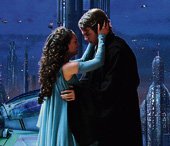
| Natalie Portman as Padm? Amidala and Hayden Christensen as Anakin Skywalker in Star Wars Episode III: Revenge of the Sith |
Cannes, May 12 (Reuters): Like it or not, modern cinema can be divided into pre-Star Wars and post-Star Wars, so pivotal is the space epic that enters its final orbit on Sunday.
As the curtain falls on possibly the most successful film series ever, the industry is divided over whether George Lucas’s galactic clash between good and evil was the film industry’s champion or its nemesis.
Some argue it turned Hollywood into a commercial beast with no regard for artistic merit. Star Wars, it is said, used technology that undermined fundamental principles of acting.
Others contest that the six-part movie marathon brought millions of new viewers to theatres the world over, recognised the power of a film’s score and wowed audiences in a fresh way.
“Star Wars returned the idea of awe to the cinema,” said film critic and author Mark Cousins. “Moviegoers are human beings and they should want to be thrilled,” he said in Cannes.
Star Wars: Episode III ? Revenge of the Sith is the final chapter and brings viewers full circle, back to the first Star Wars film of 1977. It will be shown in 10 US cinemas today to raise money for charity and gets a world premiere in Cannes on Sunday.
Already people are talking of box office records for the finale of a franchise that has already amassed well over $3.5 billion at the box office and $9 billion in merchandise sales.
A casual surf of the Internet shows how many moviegoers speak of Star Wars not as a film, but a religion. There are the “fanatics”, the “agnostics”, and, don’t mention it in Cannes, even the “heretics”.
Clearly this is no ordinary cinema experience.
People tend to remember where they saw the first Star Wars film, so revolutionary were the special effects it produced. “To a very real degree, he (Lucas) invented the special effects film,” said Leonard Maltin, US-based film critic for Entertainment Tonight.
“That is a generalisation, as there have been effects since the silents in 1900. But there was no special effects industry and effects-driven movies were rare.”
The storyline is often complicated, come say too complex, but it boils down to the forces of good against evil, Luke Skywalker against Darth Vader, a concept audiences seem to like.
But for film historian Peter Biskind, that may not be such a good thing. In a recent interview with France’s Le Monde newspaper, he said Star Wars and its good-against-evil storyline has become a simplistic prototype for today’s blockbuster. “Unfortunately, we will be living in the shadow of Star Wars for a long time.”
Director Paul Schrader said the series “ate the heart and soul of Hollywood”.
Now directors have to think more about appealing to “the pulse of suburban teenagers”, as Cousins put it, than creating their personal vision, a change not universally welcomed.
Lucas’s reliance on special effects annoys some moviegoers, especially in the second trilogy where computer-generated images were used so extensively that the cast was often working against blank-coloured screens, with the background added later.
British actor Ewan McGregor, who plays Obi-Wan Kenobi in the second trilogy, has been less than flattering about the acting experience, saying he was playing to the “wide blue yonder” in a process that could be “tortuous”. Perhaps the harshest words have been reserved for Lucas’s decision not to end Star Wars with Return of the Jedi in 1983.
To return to the religious terminology, Lucas is seeking redemption with Sith.