 |
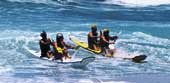
| When the going gets rough : Sea kayakers brave the waves |
We?re cruising now, paddling on a hypnotically blue sea under crisp blue skies. My kayak bobs as it cuts through waves a few inches high. Gentle splashes make a soothing soundtrack.
Muscles are working steadily, the effort ? and the speed of our progress ? much the same as a good strong walking pace. Under the bright sun, the boats and their colourfully clad occupants make a striking picture against the craggy coast, with a Gothically pointy mountain, Ben Stack, rising beyond.
It?s idyllic. But it?s not always like this. Yesterday, in roughly the same spot, we fought against a fierce wind, waves a couple of feet high, a heaving grey sea. Each stroke in these circumstances is a challenge: plant the paddle between the waves and haul the boat over them, pushing with your feet as you pull with your arms and twist your body to force the boat onwards. Wild, but thrilling.
What you don?t want to do in these conditions is let your kayak get side-on to the waves, because that?s when you?ll capsize. Distant shouts make us aware that this has happened to not one, but two of our party. Fortunately, we?ve had lots of practice at falling in.
In fact, it?s difficult to do yourself harm while kayaking unless you?re too close to waves crashing on rocks. Which we steer clear of.
It takes only half an hour to learn the basic strokes: stronger forward paddling, pushing with the left foot while pulling with the right hand, and trying to get the stomach muscles, not the arms or shoulders, to do the work; a wide, sweeping stroke to turn the kayak; using the blade of the paddle like a rudder at the stern to steer.
Then it?s time to get wet and have fun ? after all, one of the joys of watersports is splashing about in the water ? while practising capsizes and rescues. It?s these simple safety techniques that, when the going gets rough, ensure that our two companions are hauled from the water and returned safely to their boats, damp, but smiling.
Our basic training on that first morning takes place at the sheltered end of a smaller sea loch that runs into Loch Laxford, right in front of the outdoor centre where hot showers, cups of tea, satisfyingly filling sandwiches and cakes await ? and nothing has ever felt or tasted better.
Sea kayaks are long and elegant ? longer means faster ? with an upturned prow to cut through waves. They are designed for touring, with storage compartments in which to pack food, clothes and camping gear. Which we do on our second morning, setting off on a two-day expedition that involves breathtaking scenery, glimpses of seals and seabirds, pleasing stops on rocky beaches for coffee and snacks, a blazing campfire, malt whisky and a great deal of hilarity.
At the end of a week that includes a day off at the beach, there are almost too many great memories to make sense of ? from playing in a tide race, the sea-kayaking equivalent of white-water rafting, and riding a swell several feet high through a narrow gorge to the mouth of the loch, within yards of the crashing waves of the open sea. I?m feeling toned, fit and gratifyingly outdoorsy.
There could be no better place to learn kayaking than Cape Adventure, a family-friendly, far from intimidating outdoor centre south of Cape Wrath, the top left-hand corner of Scotland. It?s a two-hour drive north from Inverness.
We?re greeted with the warmest of welcomes by Will and Rebecca, who run the place; our enthusiastic instructors are more like friends than teachers; and the company of the like-minded individuals in our group, of all ages and levels of fitness, is congenial.
If, like me, you want to do more, a good plastic sea kayak costs about ?600, with a more professional fibreglass model about twice that.