 |
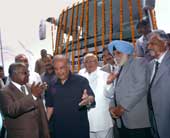
| First day, first show: Chief Justice of India K.G. Balakrishnan (extreme left) declares the mobile court open |
Each time a hearing of his case was scheduled, Khurshid, a resident of Donal village in Haryana, would have to take the day off to make the three-hour journey to Firozepur Jhirka to appear before a sub-divisional court. But on August 24, 2007, when a hearing was due, he hopped on to his cycle and quickly covered the eight km to Lohinga in less than an hour. That was where the state’s new mobile court was parked.
For villagers, India’s first ever full-fledged court on wheels is a blessing. The court — inaugurated in the Punhana town of Mewat district on August 4 by the Chief Justice of the Supreme Court of India, K.G. Balakrishnan — handles civil and criminal cases like a regular court.
An initiative of the Punjab and Haryana High Court, it is essentially a fully equipped air-conditioned bus that travels to four different centres in Mewat district — Punhana, Shikrawa, Indana and Lohinga Kalan — for one week each month. Every Wednesday and Saturday, it is to be found at the Firozepur Jhirka court premises. It functions as a sub-divisional court and is presided over by an officer of the level of an additional civil judge (senior division)-cum-sub divisional judicial magistrate.
“Earlier, it would cost me close to Rs 100 to travel to Firozepur Jhirka for each hearing but now I save both money and time,” says a gratified Khurshid.
On an average, some 50 cases are heard in the mobile court every day. Sandip Singh, the presiding judge, explains that the initiative is aimed at providing cheap and speedy justice to people living in remote areas. “Previously, cases would often get adjourned because of the absence of a witness or the defendant at the hearing. Since the court is now closer to the villages, it is easier for the people to present themselves and, as a result, the number of hearings required for a case has fallen considerably.”
Being a local court has other benefits too. For instance, when Singh finds that a witness has not reported for a hearing, he sends for the witness instead of adjourning the session. Singh has disposed of more than 30 cases in the last three weeks, a task that would have seemed improbable even a month ago.
A permanent staff of 16 people (including the judge) has been delegated to the mobile court. It travels with a convoy of two cars, one each to transport the judge and the staff. The air-conditioned bus has been modified to carve out the court chambers and a small office space with computers and filing cabinets for the administrative staff. It is equipped to handle all legal processes as a sub-divisional court, including receiving plaints, civil and criminal applications, granting bail, issuing summons, receiving police reports, passing sentences and committing convicts to prison.
Initially, people were intrigued by the metamorphosis of a humble bus from a form of transport to a means of delivering justice at their doorstep.
At Lohinga, where the court session was held from August 20 to 24, a huge crowd of curious villagers gathered as soon as the bus reached its designated spot and despite repeated efforts by the staff to disperse it, insisted on staying till evening when the court was adjourned for the day.
“During the first few days, the villagers felt uncomfortable, even nauseous, in the cramped quarters of a bus. Not being used to it, many felt very cold in the air-conditioned interiors. So to put them at ease, I got off the bus and proceeded with the hearing under a tree,” recounts an amused Singh. At each of the four centres, the court has access to a few rooms of the neighbouring schools or police station. Singh explains, “The main motive of the mobile court is not to sit inside a bus and hold trials but to dispense justice to as many, and as expeditiously, as possible.”
The lawyers who used to practise at the Firozepur Jhirka court have had to adapt their style of working to suit the mobile court. Local advocate Aziz Akhtar says that while the initiative has greatly benefited the people, it is the lawyers who are finding it difficult to rework their schedule as per the “itinerary” of the court. “We now have to appear wherever the court is being held.” While most lawyers travel from Firozepur Jhirka, a few local lawyers set up temporary booths outside the mobile court in an effort to secure clientele.
Singh confesses to an initial apprehension with regard to the mobile court — that the proximity of the court may lead to people filing frivolous cases and unnecessarily burdening the system. “My concern was that people would now file cases over petty issues such as missing livestock and family tiffs. But surprisingly, the number of cases filed per week has actually gone down.”
One of the first beneficiaries of this initiative, Nazir Ahmad, a resident of Singar village, feels that the mobile court system should be quickly replicated to ensure cheap and speedy justice for people living in far-flung areas. Ahmad’s case, over disputed land, had been pending in the local court for over three years. “It used to cost a lot of money to travel all the way to the Firozepur court, just to be told that the hearing had been adjourned owing to the absence of witnesses or the defendant.”
Once his case was transferred to the mobile court, it was decided upon within a few hearings. A visibly jubilant Ahmad has since taken to visiting the court to retell his tale of good fortune and sing praises of the mobile court system to anyone willing to listen.
While it is too early to comment on the efficacy of the mobile court and its potential to be replicated elsewhere, it is definitely a scheme that has made the otherwise daunting legal machinery more accessible to the people of Mewat. Today it’s Mewat, tomorrow it could be another part of the country.